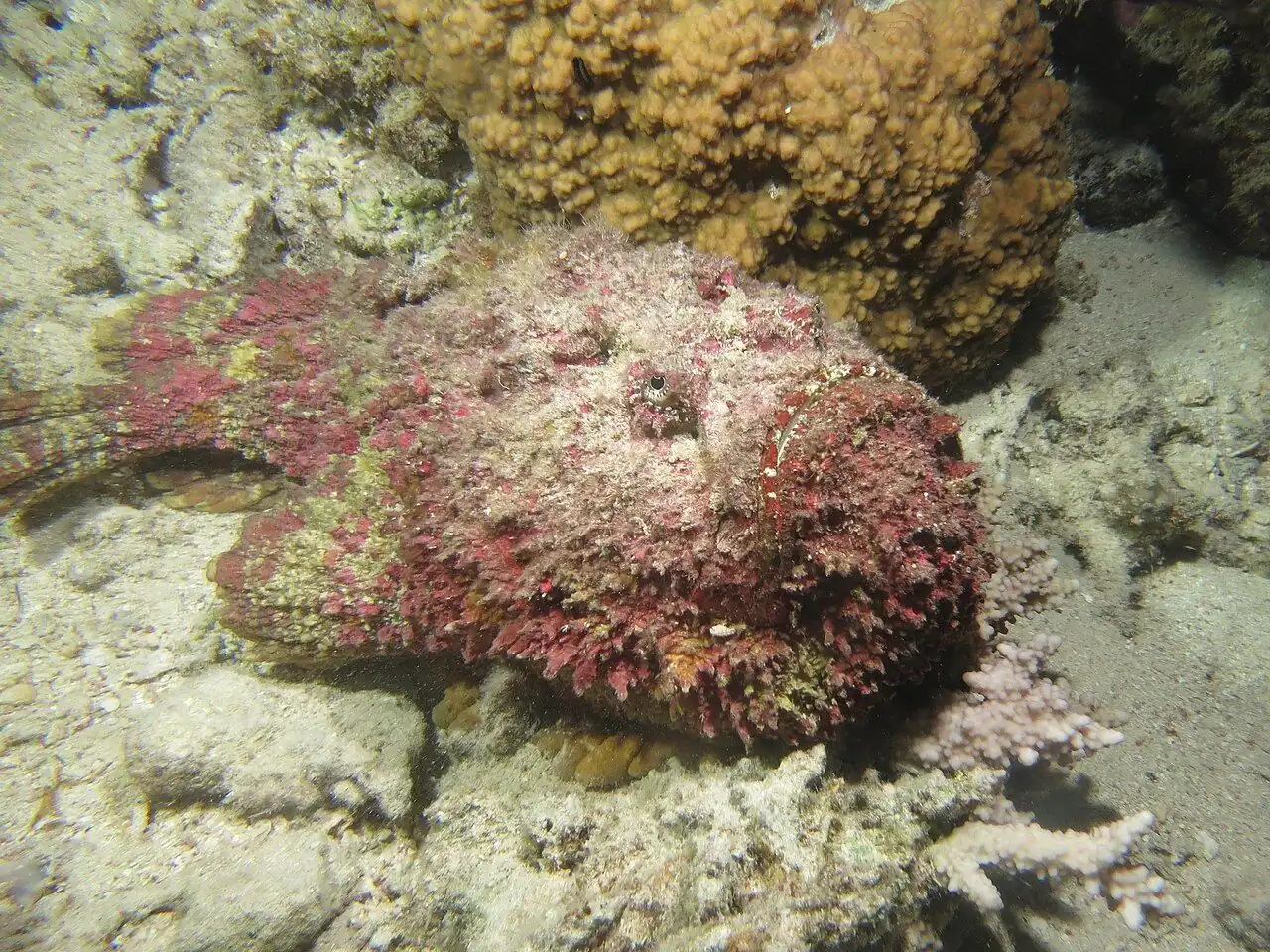
Reef Stonefish
Synanceia verrucosa
A warty ambush predator that passes for a rock on shallow reef flats and carries venom in its back spines strong enough to kill a person.
Photo: Jerome Paillet / IFREMER / CC BY 4.0
3 things to know
- Each of its 12 to 14 stout back spines has a venom gland at its base.
- It can partly bury itself in sand or rubble using its big pectoral fins.
- Stonefishes can lock out a hidden spine on each cheek, described by scientists in 2018.
- Scientific name
- Synanceia verrucosa
- Depth
- 0 m – 30 m
0 – 98 ft - Size
- Up to about 40 cm (16 in) long; commonly around 27 cm (11 in)
- Weight
- Up to about 2.4 kg (5.3 lb)
- Lifespan
- Unknown
- Diet
- Fishes, crustaceans and cephalopods, caught by ambush
- Where
- Indo-Pacific from the Red Sea and East Africa to French Polynesia, north to southern Japan and south to Queensland and New Caledonia; recently recorded in the Mediterranean Sea
- IUCN status
- Least Concern
- Depth zones
- Sunlight
On a shallow reef flat, a reef stonefish can be extremely hard to tell from the rubble around it. Its skin is scaleless and covered in warts, its colors run from pale to dark brown, orange or pink to match its surroundings, and some are even overgrown with algae. Its small eyes sit on top of a broad, flat head, above a big mouth that opens upward. Adults commonly reach about 27 centimeters (11 inches) and can grow to about 40 centimeters (16 inches) and 2.4 kilograms (5.3 pounds).
It is the most widespread stonefish, found from the Red Sea and East Africa to French Polynesia and recently recorded in the Mediterranean. It lives on coral and rocky reefs, under ledges and in caves, and on sandy or rubbly reef flats and shallow lagoons, from the waterline to about 30 meters (98 feet). During the day it may use its large, fleshy pectoral fins to partly bury itself, and at low tide it may shelter in tide pools. At night it ambushes fishes, crustaceans and cephalopods that come close.
Along its back are 12 to 14 stout spines, each grooved and backed by venom glands. Rather than flee, a stonefish usually stays still, and when someone steps on it the spines work like hypodermic needles, pushing venom into the wounds. The venom affects the heart, nerves and muscles. Fishes of Australia, which calls it and the estuarine stonefish the most venomous of fishes, describes the pain as excruciating and says a sting can be fatal without antivenom. No stonefish deaths have been recorded in Australia since European arrival, but deaths have been reported elsewhere in the Indo-Pacific.
In 2018 William Leo Smith of the University of Kansas and colleagues reported a second weapon, the "lachrymal saber," a spine on the bone below each eye that stonefishes can swing out and lock in place, with an unusually large number of muscles and ligaments to work it. The project began when Smith dissected a stonefish he had kept as a pet. He noted that in photos of stonefishes in the mouths of predators, the sabers are always locked out.
The IUCN lists the reef stonefish as Least Concern, from a 2017 assessment. It is occasionally sold in live fish markets, including in Hong Kong, and collected for aquariums.
Sources
- fishbase.se/summary/Synanceia-verrucosa.html
- fishesofaustralia.net.au/home/species/3341
- Study: doi:10.2305/IUCN.UK.2018-2.RLTS.T114180058A116389039.en
- Study: doi:10.1643/CG-17-669
- news.ku.edu/2018/04/09/discovery-switchblade-defensive-system-redraws-family-tree-stone…
- commons.wikimedia.org/wiki/File:Poisson-pierre_(Synanceia_verrucosa)_photographi%C3%A9_…



