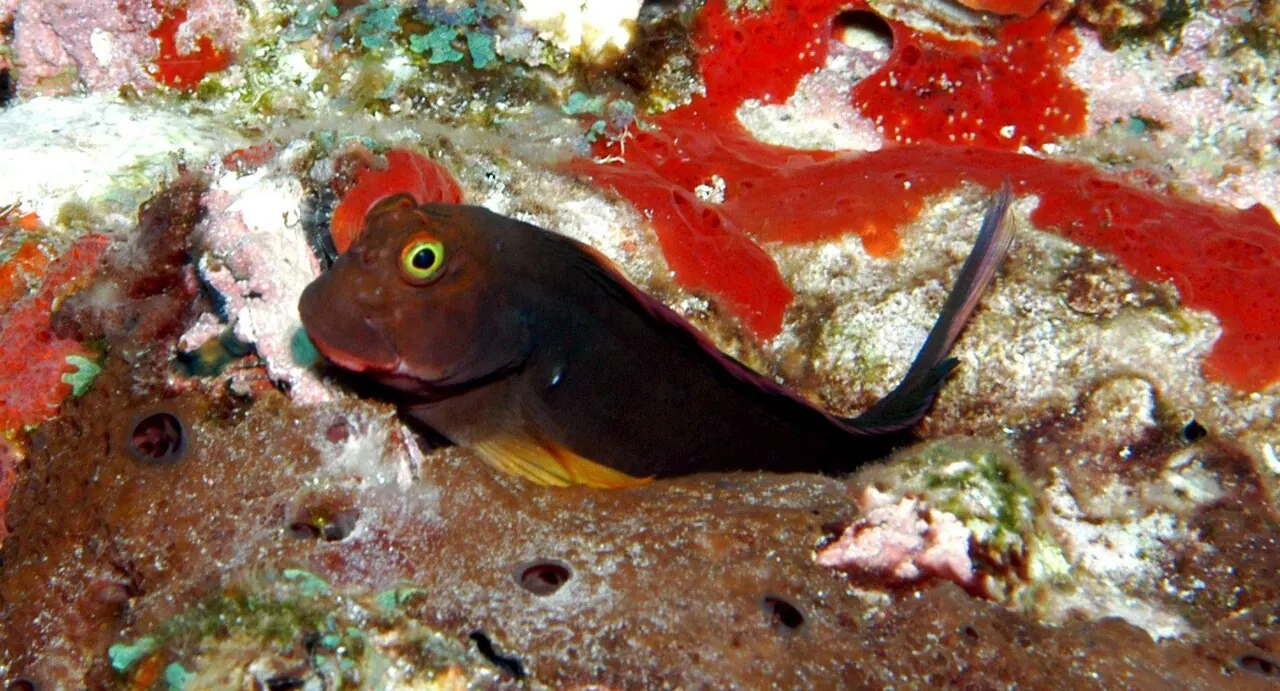
Redlip Blenny
Ophioblennius macclurei
A blunt-faced, red-lipped Caribbean blenny that defends a patch of shallow, wave-washed reef and bites with two long fangs.
Photo: G. P. Schmahl/NOAA (Flower Garden Banks National Marine Sanctuary) / CC BY 2.0
3 things to know
- It carries two long, sharp canine teeth and can bite hard.
- In Barbados, fewer than one in ten lived past their third year.
- Its larvae drift for an estimated six to eight weeks before settling at night.
- Scientific name
- Ophioblennius macclurei
- Depth
- 0 m – 12 m
0 – 39 ft - Size
- Up to about 12 cm (4.8 in) long
- Weight
- Not well known
- Lifespan
- Few live past their third year (Barbados study)
- Diet
- Mostly filamentous algae
- Where
- Western Atlantic from North Carolina and Florida through the Caribbean; the Bermuda population may be a separate species
- IUCN status
- Least Concern
- Depth zones
- Sunlight
A blunt face and big reddish lips make the redlip blenny easy to pick out on a shallow Caribbean reef. The front of the head rises almost straight up, and the forehead juts out over the snout. Typically the head, body and anal fin are dark reddish brown, with red on parts of the pectoral and tail fins. It grows to about 12 centimeters (4.8 inches). Many dive guides still call it Ophioblennius atlanticus, a name FishBase now gives to the eastern Atlantic species; the western Atlantic fish is O. macclurei.
It lives from North Carolina and Florida through the Caribbean, and FishBase notes that the Bermuda population may be a separate species. Adults stay in clear, shallow water over rock and coral, often where there is strong wave action, and guides give depths from the surface to about 8 to 12 meters (26 to 40 feet). Each one perches on its long, thin pelvic fins and defends a patch of reef, chasing intruders away. It grazes on filamentous algae, and it carries two long, sharp canine teeth that the Naturalis Caribbean dive guide warns can deliver a severe bite.
Most of what is known about its life comes from Barbados. Labelle and Nursall collected adults there from 1978 to 1986 and published the results in 1992, under the older name. Adults measured 56 to 126 millimeters, and fewer than 10 percent of the population lived beyond the third year. Males spawn with females one after another, and their nests held between 1,638 and 11,490 eggs, laid in up to four batches. Mates tended to be the same size. The larvae spend an estimated six to eight weeks drifting, mostly over deep reefs near shore, and settle onto the reef at night, around the new moon. Numbers swung widely from year to year, and the authors suggested local water conditions affect how many young arrive.
A small, territorial fish in the open is a target. The Florida Museum lists the redlip blenny among the documented prey of the trumpetfish. The blenny also turns up in the aquarium trade. The IUCN lists it as Least Concern, from an assessment made in December 2024.
Sources
- fishbase.se/summary/Ophioblennius-macclurei.html
- fishbase.se/summary/Ophioblennius-atlanticus.html
- caribbean-diving.linnaeus.naturalis.nl/linnaeus_ng/app/views/species/taxon.php
- reefguide.org/keys/pixhtml/redlipblenny5.html
- ingentaconnect.com/contentone/umrsmas/bullmar/1992/00000050/00000001/art00015
- floridamuseum.ufl.edu/discover-fish/species-profiles/aulostomus-maculatus
- iucnredlist.org/species/46104090/67940477



