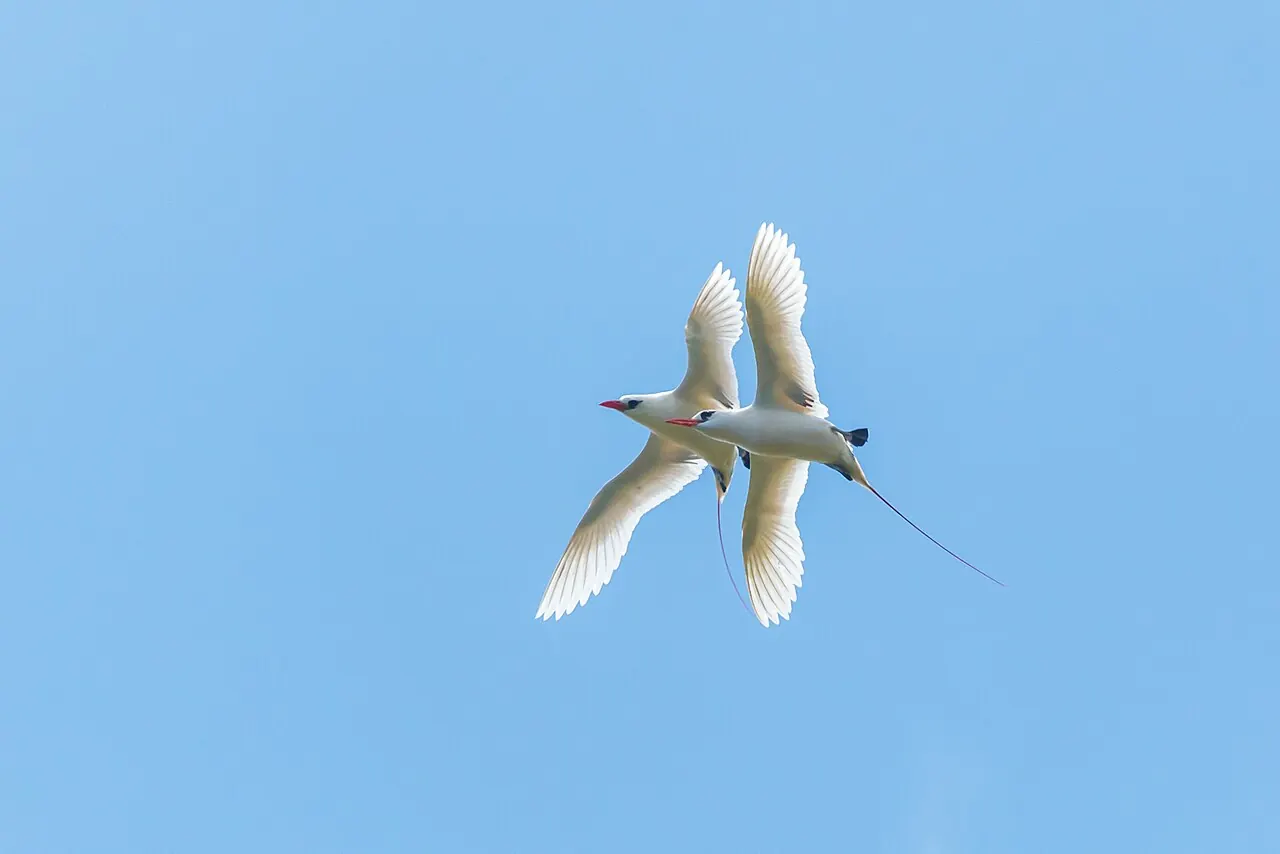
Red-tailed Tropicbird
Phaethon rubricauda
A white tropical seabird with two long red tail streamers that plunge-dives for flying fish and nests on the ground on remote islands.
Photo: Meghan Cassidy / CC BY-SA 4.0
3 things to know
- It hovers up to 50 m (164 ft) above the sea before plunging as deep as 8 m (26 ft).
- Courting birds fly upward and backward in vertical circles above the colony.
- Johnston Atoll holds the world's largest colony, with nearly 13,000 nesting pairs counted in 2021.
- Scientific name
- Phaethon rubricauda
- Depth
- 0 m – 8 m
0 – 26 ft - Size
- About 46 cm (18 in) long plus tail streamers of about 40 cm (16 in); wingspan about 104 cm (41 in)
- Weight
- About 800 g (1.8 lb)
- Lifespan
- Oldest known bird 23 years
- Diet
- Mainly flying fish and squid
- Where
- Tropical and subtropical Pacific and Indian oceans; in US waters it nests in Hawaii and on Johnston Atoll
- IUCN status
- Least Concern
- Depth zones
- Sunlight
Snow white with a coral-red bill and a touch of black around the eye, the red-tailed tropicbird trails two thin red tail streamers almost as long as its body. It measures about 46 centimeters (18 inches) plus those streamers, has wings about 1 meter (41 inches) across and weighs around 800 grams (1.8 pounds). It looks a little like a tern but is not closely related; Cornell's All About Birds notes that genetic studies put tropicbirds in an order of their own, with their closest relatives two unusual landbirds, the sunbittern of Central and South America and the kagu of New Caledonia.
It roams the tropical and subtropical Pacific and Indian oceans, usually alone and far from land. To feed, it hovers 6 to 50 meters (20 to 164 feet) above the water with its bill pointed down, then drops in a steep plunge that can carry it 8 meters (26 feet) under. Flying fish are the main catch, along with squid.
Tropicbirds come ashore only to breed. Groups of 2 to 15 adults court in wide circles above the colony, some flying upward and backward in a vertical loop with their streamers swinging. Pairs stay together for years and nest on the ground, often in the shade of a bush. Both parents tend a single egg, and the chick stays in the nest for 10 to 18 weeks, at one stage outweighing its parents, before it heads out to sea alone. In Hawaii the bird is the koaʻe ʻula, and its tail feathers were prized for kahili, the feather standards carried for royalty. The oldest known bird was 23.
Nesting on the ground has a cost. On Johnston Atoll National Wildlife Refuge, yellow crazy ants that arrived before 2010 spread across 70 acres, where tropicbirds stopped nesting. The ants swarmed nests and sprayed formic acid into the birds' eyes and beaks. Kate Toniolo, superintendent of the Pacific Remote Islands Marine National Monument, told NPR the acid blinded birds and deformed chicks' beaks so they starved. Nearly 100 staff and volunteers spent 10 years and more than 130,000 field hours wiping out the ants, and the US Fish and Wildlife Service announced success in June 2021. The refuge holds the world's largest red-tailed tropicbird colony, with nearly 13,000 nesting pairs counted that year. The IUCN lists the species as Least Concern, with a decreasing trend.
Sources
- allaboutbirds.org/guide/Red-tailed_Tropicbird/overview
- allaboutbirds.org/guide/Red-tailed_Tropicbird/lifehistory
- audubon.org/field-guide/bird/red-tailed-tropicbird
- nzbirdsonline.org.nz/species/red-tailed-tropicbird
- dlnr.hawaii.gov/wildlife/birds/koaeula
- hawaiibirdingtrails.hawaii.gov/bird/red-tailed-tropicbird
- fws.gov/story/2021-06/saving-seabird-paradise-invasive-yellow-crazy-ants
- npr.org/2021/06/25/1010006249/yellow-crazy-ants-exterminated-johnston-atoll-seabirds
- iucnredlist.org/species/22696641/163889221



