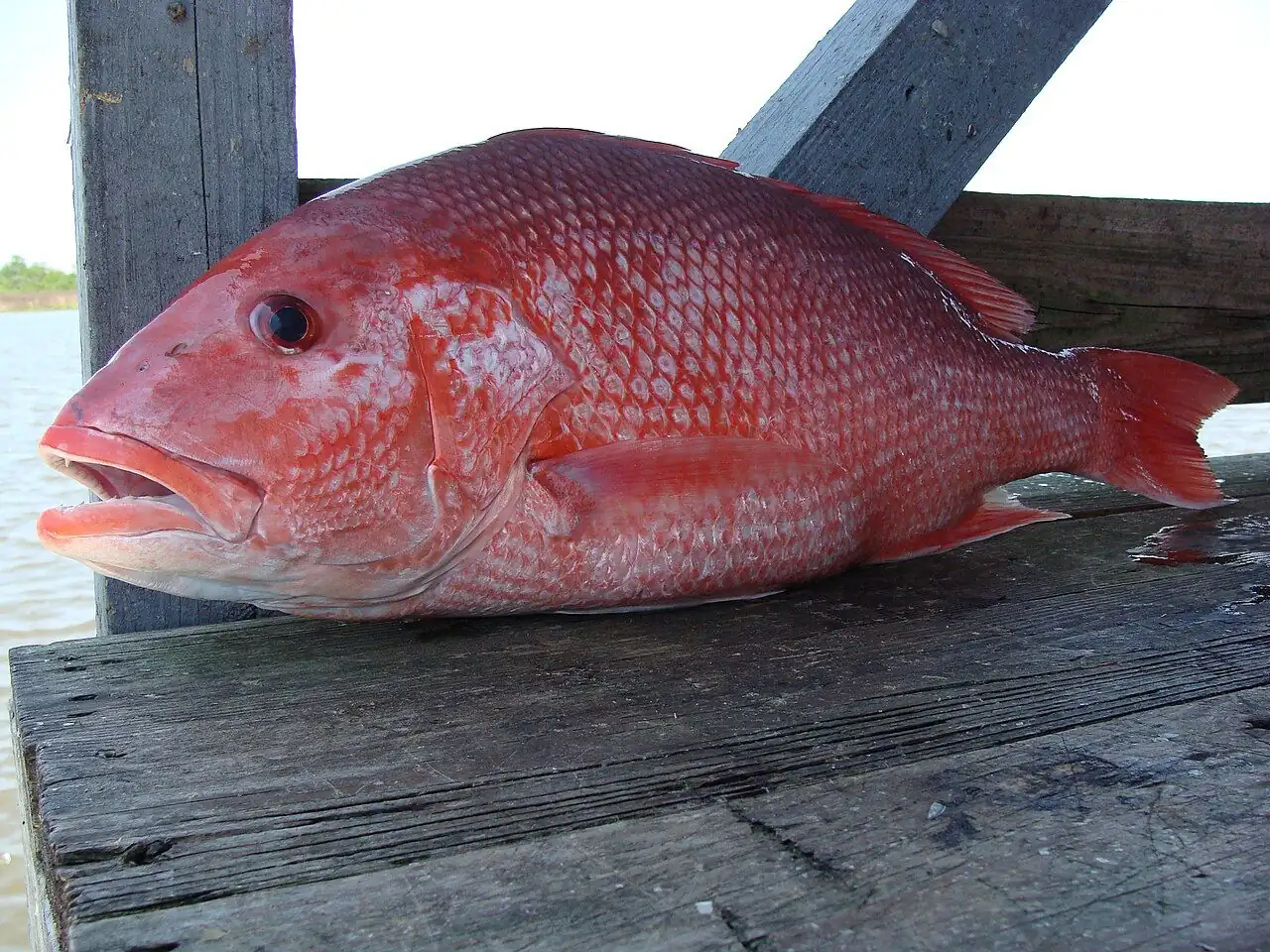
Red Snapper
Lutjanus campechanus
A long-lived Gulf of Mexico reef fish that can pass 50 years of age, and the subject of a $12 million count across the northern Gulf.
Photo: Geeklikepi / CC BY-SA 3.0
3 things to know
- Red snapper as old as 57 years have been reported in the Gulf of Mexico.
- Fish from deeper water tend to be redder than those from shallow water.
- Young fish under about 30 to 35 cm (12 to 14 in) have a large dark spot on the upper side.
- Scientific name
- Lutjanus campechanus
- Depth
- 30 m – 130 m
98 – 427 ft - Size
- Up to about 100 cm (40 in); commonly about 60 cm (2 ft)
- Weight
- Up to about 23 kg (50 lb)
- Lifespan
- At least 57 years in the Gulf of Mexico and 51 years in the South Atlantic
- Diet
- Fish, shrimp, crabs, worms, octopus and squid, plus some plankton
- Where
- Gulf of Mexico and the US Atlantic coast north to Massachusetts, rare north of the Carolinas
- IUCN status
- Vulnerable
- Depth zones
- Sunlight
Red snapper have a long, triangular face that slopes more steeply above the mouth than below it, and enlarged canine teeth, which NOAA Fisheries says give snappers their name. Fish from deeper water tend to be redder than those caught in the shallows, and young fish under about 30 to 35 centimeters (12 to 14 inches) carry a large dark spot on the upper side, below the front of the soft dorsal fin. Adults can reach about 100 centimeters (40 inches) and 23 kilograms (50 pounds).
The species lives in the Gulf of Mexico, which NOAA now calls the Gulf of America, and along the US Atlantic coast, becoming rare north of the Carolinas. It is usually found 30 to 130 meters (100 to 425 feet) down, according to FishBase, and NOAA says it is generally found at about 9 to 190 meters (30 to 620 feet). Juveniles live over shallow sand and mud. Adults stay near the bottom close to hard structure, such as natural reefs, ledges, rocky bottoms and artificial reefs. They eat fish, shrimp, crabs, worms, octopus and squid, along with some plankton.
NOAA reports fish as old as 57 years in the Gulf and 51 in the South Atlantic. Females can spawn as early as age 2, and spawning runs from May to October depending on location.
After heavy fishing, rebuilding plans now aim to restore the Gulf stock by 2032 and the South Atlantic stock by 2044. Anglers are urged to use venting or recompression tools on released fish, whose swim bladders can overexpand when reeled up from depth. Today NOAA rates both stocks as not overfished, though the Gulf stock is still rebuilding. The IUCN, in a 2015 assessment, lists the species as Vulnerable.
In 2021 Greg Stunz of the Harte Research Institute and a team of scientists released the final report of the Great Red Snapper Count, a $12 million study. NOAA's Clay Porch said it gave the agency something it had never had in his career, an absolute population estimate for the whole northern Gulf. The study estimated roughly three times as many red snapper in the Gulf as the 2018 stock assessment had, with perhaps two-thirds of them living in the Gulf's vast low-relief areas, which fisheries do not target. On the reefs and other high-relief structures where most fishing happens, its numbers were similar to the 2018 assessment's.



