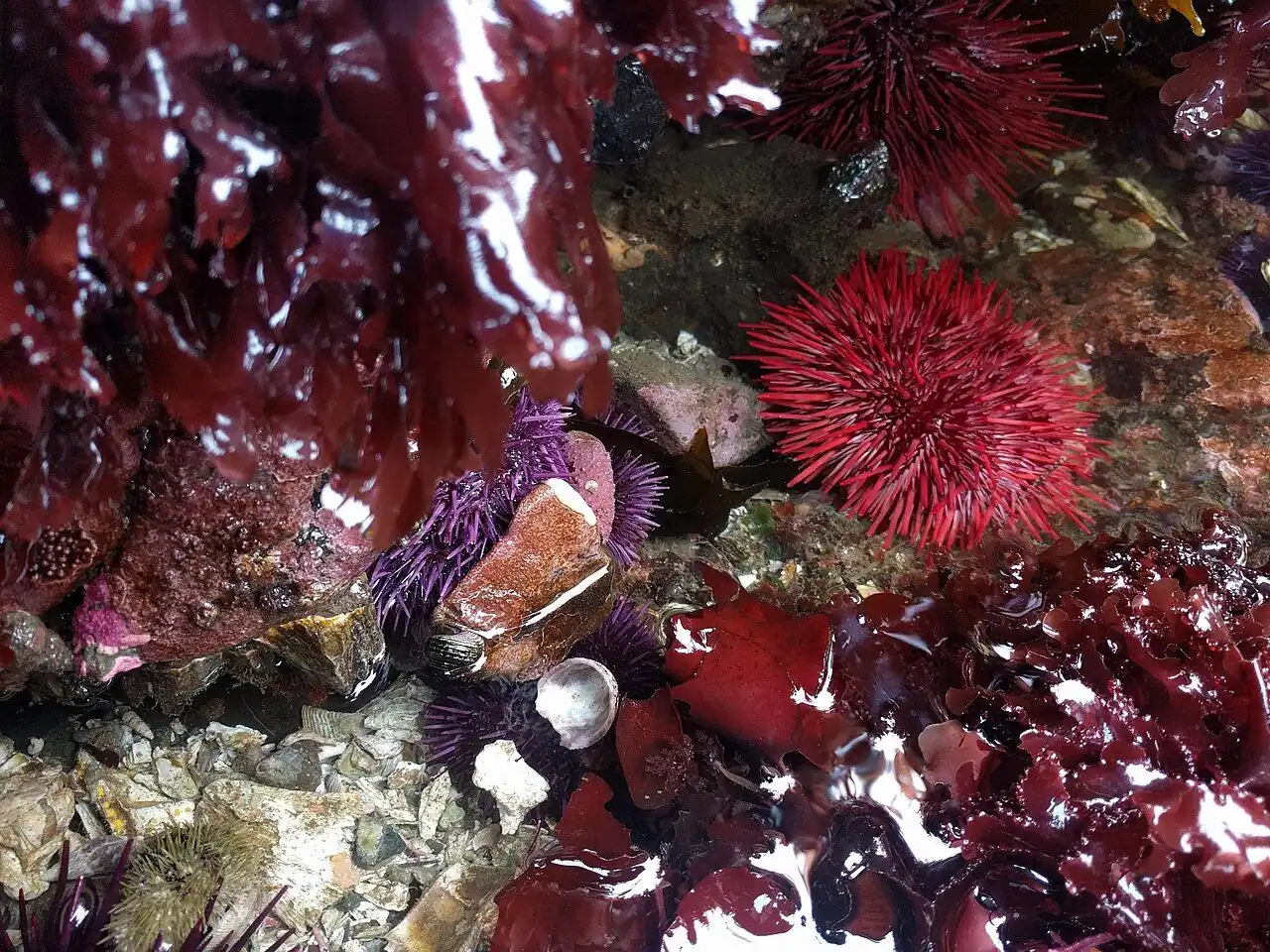
Red Sea Urchin
Mesocentrotus franciscanus
A large Pacific urchin once thought to live about a decade; radiocarbon from bomb tests showed it can pass 100 years.
Photo: brewbooks / CC BY-SA 2.0
3 things to know
- Red sea urchins were once thought to live 7 to 15 years; they can live more than 100.
- Old red urchins show few signs of aging and keep reproducing.
- At one point in the 1990s, sea urchins were among California's most valuable marine resources.
- Scientific name
- Mesocentrotus franciscanus
- Depth
- 0 m – 125 m
0 – 410 ft - Size
- Shell up to about 19 cm (7.5 in) across
- Weight
- Unknown
- Lifespan
- More than 100 years; the largest may be 200 or more
- Diet
- Kelp and other algae
- Where
- North Pacific; along North America from Alaska to Baja California, Mexico
- IUCN status
- Not Evaluated
- Depth zones
- Sunlight
For a long time, red sea urchins were believed to live only 7 to 15 years. In 2003, Thomas Ebert of Oregon State University and John Southon of Lawrence Livermore National Laboratory reported in the US government's Fishery Bulletin that they can live more than 100 years. Two independent methods gave the same answer, one of them based on radiocarbon from atomic bomb tests. Some of the largest red urchins, up to 19 centimeters (7.5 inches) across, have been found off British Columbia, and by the researchers' calculations they are probably 200 years old or more. Old urchins show few signs of aging, and the more mature ones appear to be the most prolific spawners.
Mesocentrotus franciscanus lives in the North Pacific, and along North America it ranges from Alaska to Baja California. SeaLifeBase records it from the shore down to 125 meters (410 feet), on open, wave-exposed rocky shores and in kelp forests, where it often gathers at the base of giant kelp. It grazes kelp and other seaweed.
Growth starts fast and then nearly stops. According to Ebert, a two-year-old can double in a year, from 2 to 4 centimeters (about 0.8 to 1.6 inches), and it takes at least six or seven years to reach harvestable size. At age 22, a red urchin grows only from about 12 to 12.1 centimeters in a year, though it never quite stops. The sexes are separate, eggs are fertilized in open water, and the larvae feed for a month or more before turning into tiny urchins.
People have changed their minds about this animal more than once. In the 1960s, Ebert recalled in Oregon State's 2003 announcement, sea urchins in the US were seen as a menace to kelp forests, and people tried to poison them. A commercial fishery started in the 1970s, selling the roe mostly to Japan, and at one point in the 1990s sea urchins were among California's most valuable marine resources. In northern California, the kelp forest collapse that began in 2014 turned reefs into purple urchin barrens, and the north coast's commercial red urchin fishery, worth about $3 million a year, collapsed from 2015. The IUCN has not evaluated the species.



