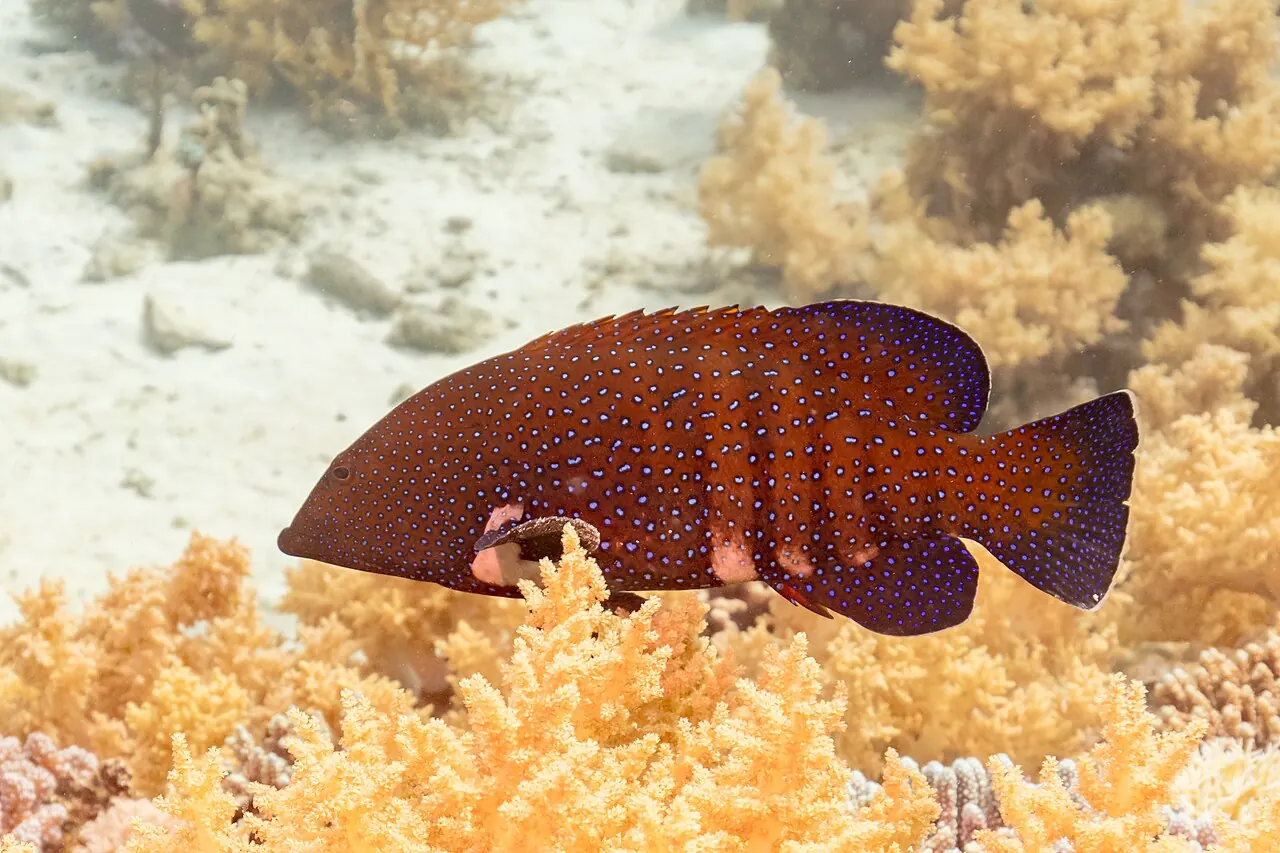
Red Sea Coralgrouper
Plectropomus marisrubri
A blue-spotted Red Sea grouper that recruits giant moray eels as hunting partners with a shake of the head.
Photo: Diego Delso / CC BY-SA 4.0
3 things to know
- It was described as a subspecies of the roving coral grouper in 1986 and is now treated as a species of its own.
- With a giant moray along, groupers in Egypt caught almost five times as much prey per hour.
- Groupers point out prey hiding in a crevice by hanging head-down over the spot.
- Scientific name
- Plectropomus marisrubri
- Depth
- 3 m – 100 m
10 – 328 ft - Size
- Up to about 120 cm (3.9 ft) long
- Weight
- Not well known; fish landed in Saudi Arabia in 2022–2023 weighed up to about 12.4 kg (27 lb)
- Lifespan
- At least 15 years (the oldest fish aged in a 2022–2023 Saudi study)
- Diet
- Fish
- Where
- Red Sea; Eschmeyer's Catalog of Fishes also lists the Gulf of Aden
- IUCN status
- Vulnerable
- Depth zones
- Sunlight
Numerous small blue spots, each with a dark edge, cover the brown to orange-red body of the Red Sea coralgrouper. About 30 to 50 of them crowd each cheek, the eye is narrowly ringed in blue, and most fish carry seven dark bars across the body. FishBase gives a maximum length of 120 centimeters (3.9 feet).
Randall and Hoese described the fish in 1986 as a Red Sea subspecies of the roving coral grouper, Plectropomus pessuliferus. A 2016 molecular family tree of groupers by Ka Yan Ma and colleagues showed that the two are not directly related; the roving coral grouper's closest relative is the coral trout. Eschmeyer's Catalog of Fishes lists authors treating the Red Sea fish as a full species, P. marisrubri, from 2015 on, and the IUCN Red List published separate assessments of the two in 2018.
It is found in the Red Sea, and the Catalog of Fishes adds the Gulf of Aden. It lives on or near coral reefs and outer reef slopes, sometimes in lagoons or over seagrass and sand. The IUCN assessment gives its depth range as 3 to 100 meters (10 to 330 feet). It hunts other fish by day in open water.
It can change sex during its life and gathers in spawning aggregations. Among fish landed in Saudi Arabia in 2022 and 2023, half were mature at about 31 centimeters (12 inches), and the oldest of those aged was 15 years old. It is a popular food fish on the Saudi coast and heavily fished there, and the 2026 study judged that stock overexploited. The IUCN lists it as Vulnerable: its spawning aggregations are heavily fished, and declines have been documented or suspected off Saudi Arabia, Eritrea and Sudan since the mid-1990s.
Its fame was earned under the old name. Between 2002 and 2004, in Egypt's Ras Mohammed National Park, Redouan Bshary and colleagues watched groupers shake their heads at giant morays resting in crevices. In 58 percent of 120 cases the moray left its hole and the two swam off through the reef, and with a moray along the groupers caught almost five times as much prey per hour. In 2013 Alexander Vail, Andrea Manica and Bshary described groupers hanging head-down over a crevice where prey had hidden, a signal that met five criteria for a referential gesture, until then credited only to great apes and ravens.
Sources
- fishbase.se/summary/Plectropomus-marisrubri.html
- marinespecies.org/aphia.php
- researcharchive.calacademy.org/research/ichthyology/catalog/fishcatget.asp
- iucnredlist.org/species/118360372/118360410
- eprints.cmfri.org.in/13303/1/Rekha%20J%20Nair_IUCN_UK_2018-2.RLTS.T118359431A100469254.…
- Study: doi:10.3390/fishes11010029
- Study: doi:10.1371/journal.pbio.0040431
- Study: doi:10.1038/ncomms2781
- commons.wikimedia.org/wiki/File:Mero_%28Plectropomus_pessuliferus%29%2C_parque_nacional…



