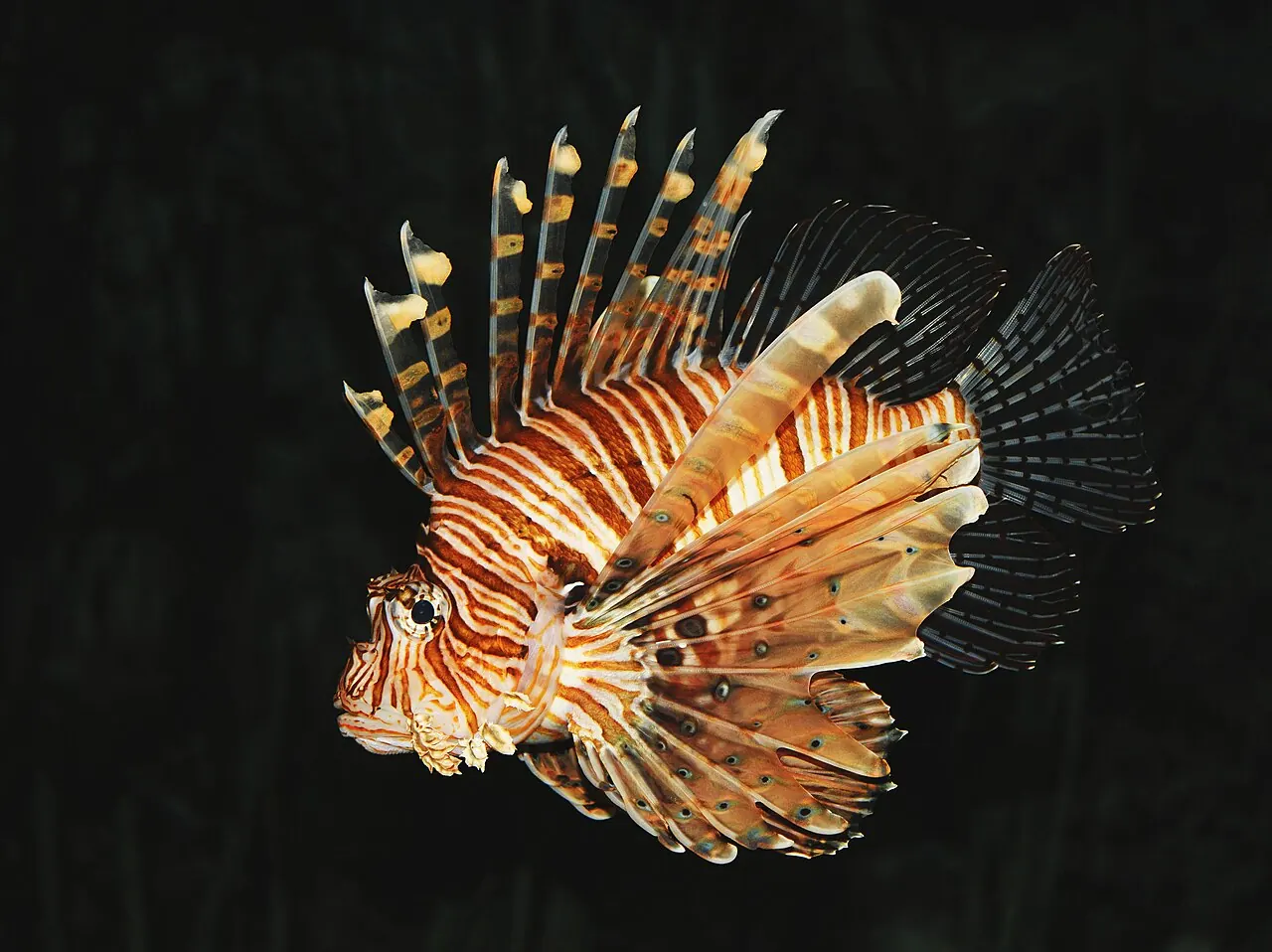
Red Lionfish
Pterois volitans
A striped, venomous Pacific reef fish that got loose in the Atlantic and now eats native reef fish from North Carolina to South America.
Photo: Michael Gäbler / CC BY 3.0
3 things to know
- Venomous spines on its dorsal and anal fins may help explain why it has few natural enemies.
- It hunts at night, using its wide fins to pin prey in a corner.
- On small Bahamas reefs, a single lionfish cut the arrival of young native fish by 79 percent in five weeks.
- Scientific name
- Pterois volitans
- Depth
- 2 m – 55 m
7 – 180 ft - Size
- Up to about 46 cm (18 in) long
- Weight
- Up to about 1.4 kg (3 lb)
- Lifespan
- Up to about 10 years reported
- Diet
- Small fish, shrimps and crabs
- Where
- Native to the eastern Indian Ocean and western and central Pacific; invasive in the western Atlantic, Gulf of Mexico and Caribbean
- IUCN status
- Least Concern
- Depth zones
- Sunlight
Bold red-and-white stripes, feathery fins and a crest of long spines make the red lionfish hard to miss. It grows to about 46 centimeters (18 inches) and 1.4 kilograms (3 pounds). The spines on its dorsal and anal fins carry a venom that can give a painful sting, which may help explain why it has few natural enemies.
At home the red lionfish lives in the Pacific and the eastern Indian Ocean, from Western Australia and the Cocos-Keeling Islands to the Marquesas and Pitcairn islands, north to southern Japan and Korea and south to northern New Zealand. A near-twin, the devil firefish (Pterois miles), takes over from the Red Sea to Sumatra. Red lionfish live in lagoons and on seaward reefs down to about 50 meters (165 feet), hiding by day in crevices, often head down. At night they hunt small fish, shrimps and crabs, spreading their wide pectoral fins to pin prey in a corner before swallowing it in one gulp. FishBase lists a maximum reported age of 10 years.
In the western Atlantic it is an invader. Both lionfish species got there, most likely through the aquarium trade, and in the invaded range only a genetic test can tell them apart. Lionfish are now established along the US coast from the Florida Keys to Cape Hatteras, across the Gulf of Mexico and the Greater Antilles, and along the Caribbean coasts of Central and South America. There they live on reefs, wrecks, bridge pilings and seagrass beds, from a few inches of water to more than 300 meters (about 1,000 feet).
On small patch reefs in the Bahamas, Mark Albins and Mark Hixon found in 2008 that a single lionfish cut the number of young native fish settling onto a reef by 79 percent over five weeks. A 2012 study led by Stephanie Green linked rising lionfish numbers on Bahamas reefs to a 65 percent drop in the combined biomass of 42 prey fish species in two years.
In its native range the IUCN lists the red lionfish as Least Concern, and in parts of the Pacific it is eaten as a food fish.



