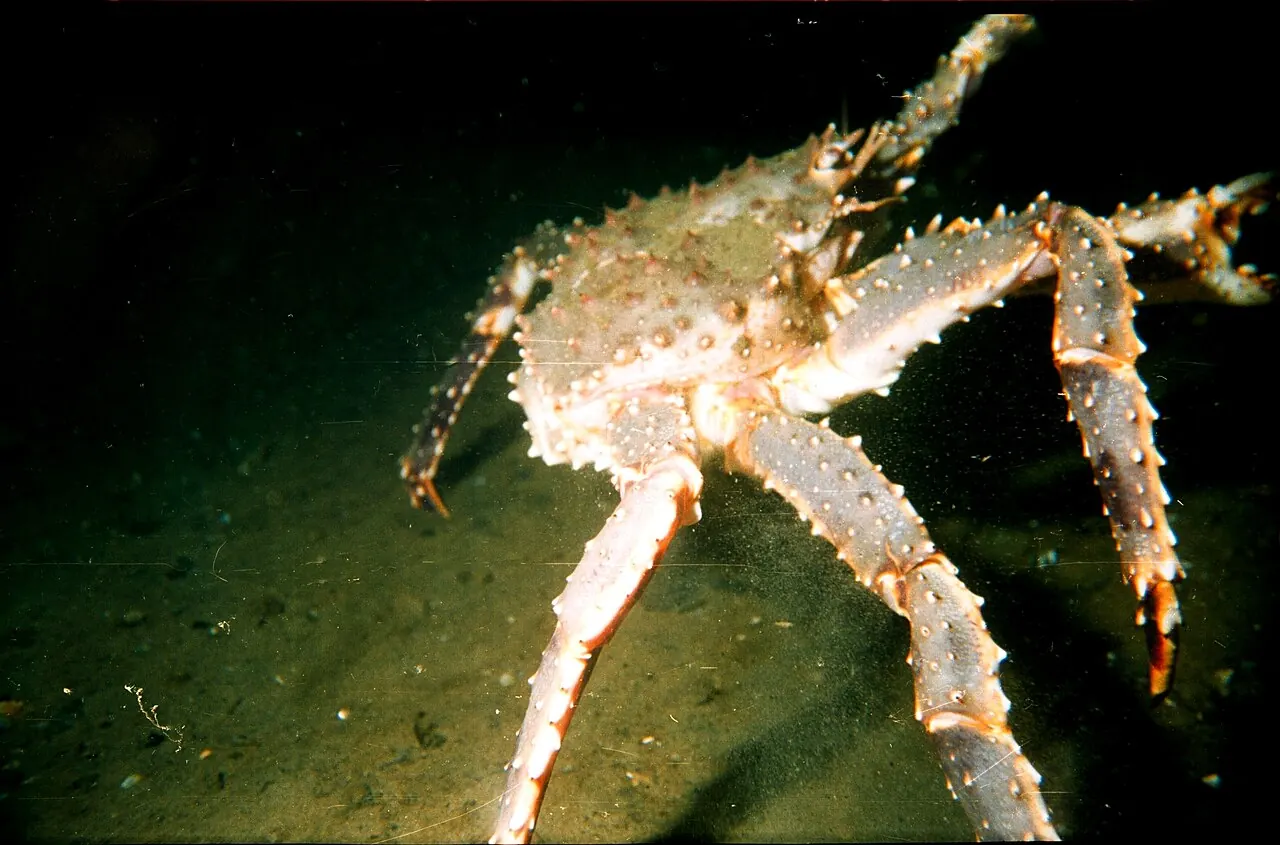
Red King Crab
Paralithodes camtschaticus
The largest crab fished commercially, with legs spanning up to 1.5 meters, and an introduced predator spreading along the Barents Sea coast.
Photo: Dr. Aleksey Zuyev, Murmansk Marine Biological Institute (NOAA Photo Library) / Public domain
3 things to know
- Young red king crabs gather in pods of tens of thousands.
- The Bristol Bay fishery was closed for the 2021/22 and 2022/23 seasons.
- Russian scientists introduced red king crabs to the Barents Sea in the 1960s.
- Scientific name
- Paralithodes camtschaticus
- Depth
- 0 m – 200 m
0 – 656 ft - Size
- Shell up to about 28 cm (11 in) long; leg span up to about 1.5 m (5 ft)
- Weight
- Up to about 11 kg (24 lb)
- Lifespan
- Record-size crabs were estimated at 20–30 years old
- Diet
- Worms, clams, mussels, barnacles, crabs, fish, sea stars, sand dollars and brittle stars
- Where
- North Pacific from Japan to British Columbia and north into the Bering Sea; introduced to the Barents Sea
- IUCN status
- Not Evaluated
- Depth zones
- Sunlight
NOAA Fisheries calls red king crabs the largest of the commercially harvested crabs. According to Alaska's Department of Fish and Game, the record male weighed about 11 kilograms (24 pounds) and had a leg span of nearly 1.5 meters (5 feet), and the record female weighed 4.8 kilograms (10.5 pounds); both were estimated to be 20 to 30 years old. The shell is dark red to burgundy and covered in sharp spines. At a glance a king crab seems to have only three pairs of walking legs and a pair of claws, the right claw usually the bigger one. A fifth pair of small legs stays tucked under the back of the shell, and females use them to clean their eggs.
The species lives in the North Pacific from Japan to British Columbia and north into the Bering Sea, with Bristol Bay and the Kodiak Archipelago as its centers in Alaska. Adults feed in deeper water, typically shallower than about 200 meters (650 feet), and come into the shallows in late winter and spring to hatch eggs, molt and mate. Some Kodiak males travel up to 160 kilometers (100 miles) round trip in a year. Older juveniles gather in pods of tens of thousands that pile up by day and feed at night, likely for protection. Crabs eat almost anything they can crush: worms, clams, mussels, barnacles, other crabs, fish, sea stars, sand dollars and brittle stars.
The Alaska fishery is managed by size, sex and season, and only males above a set size may be kept. Even so, the Bristol Bay fishery was closed for the 2021/22 and 2022/23 seasons because too few mature females were counted, and the Pribilof Islands fishery has been closed since 1999.
On the far side of the Arctic, the crab is an introduced species. Russian scientists released red king crabs into the Barents Sea in the 1960s to create a new fishery, and they have since spread east and west along the coast. Norway's Institute of Marine Research reports that large bivalves, echinoderms and peanut worms disappear where the crabs are abundant. Norway sets quotas east of 26 degrees east and leaves fishing open for crabs of all sizes west of that line to keep the crab from spreading further.
The species has not been assessed for the IUCN Red List.



