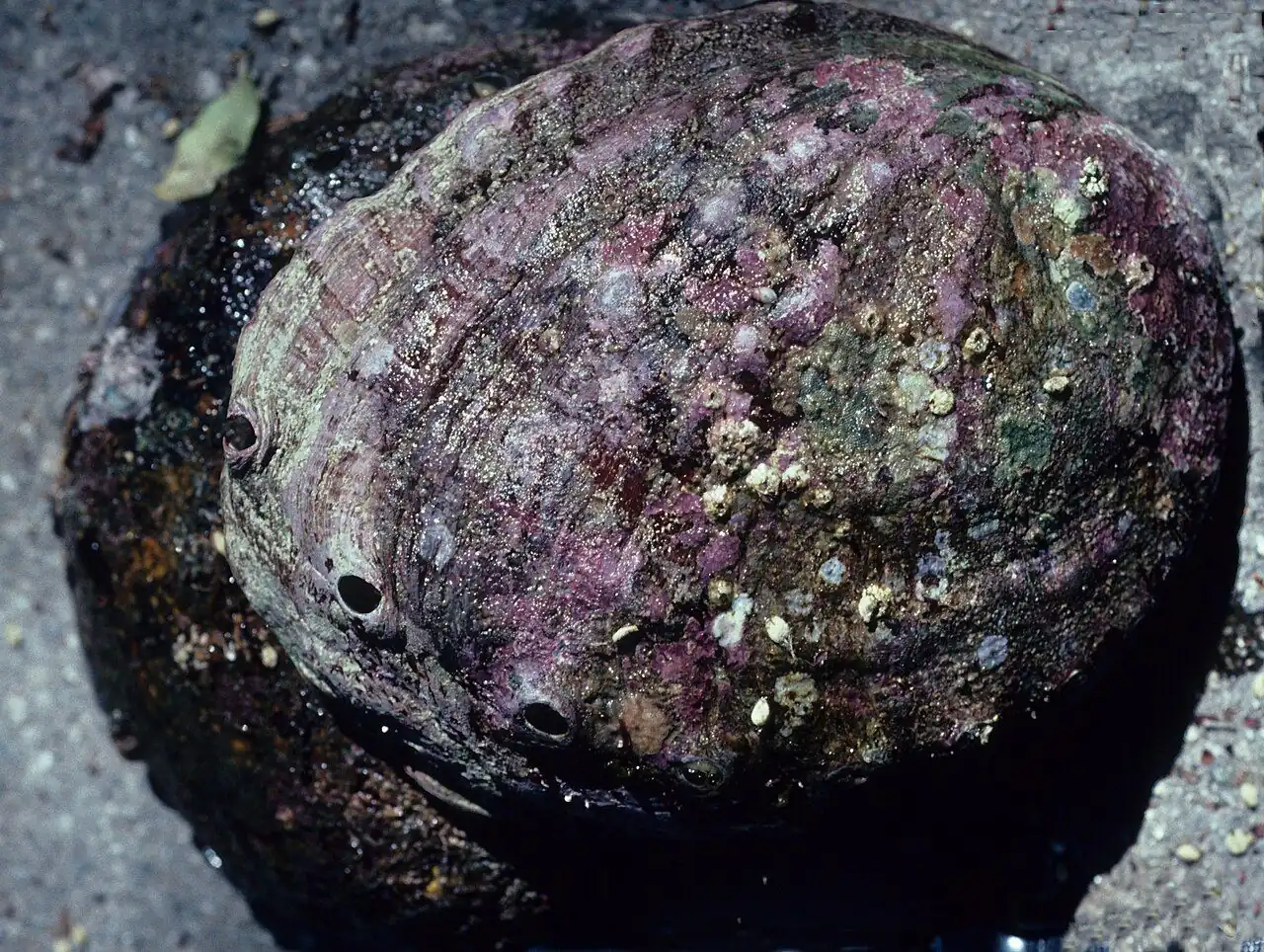
Red Abalone
Haliotis rufescens
The biggest of California's abalones, a kelp-eating sea snail whose north coast numbers crashed when bull kelp forests collapsed.
Photo: Dr. Dwayne Meadows, NOAA/NMFS/OPR / Public domain
3 things to know
- It is the largest of the eight abalone species found in California.
- A large adult can release as many as six million eggs in a spawning.
- California's north coast recreational fishery closed in 2018 and is now set to stay closed until April 1, 2036.
- Scientific name
- Haliotis rufescens
- Depth
- 0 m – 30 m
0 – 98 ft - Size
- Shells today average up to about 20 cm (8 in); reported to 30 cm (12 in)
- Weight
- Not well known
- Lifespan
- About 30 to 35 years
- Diet
- Kelp, much of it drifting pieces: bull kelp in the north, giant and feather boa kelp in the south
- Where
- Oregon to central Baja California, Mexico
- IUCN status
- Critically Endangered
- Depth zones
- Sunlight
Tap a red abalone and it clamps down, pulling in its fringe of tentacles and pressing its shell against the rock with its foot, a broad, flat muscle that fills most of the shell. Once it holds on, it is extremely hard to pry loose. It is the largest and most common of the eight abalone species in California. Shells today average up to about 20 centimeters (8 inches), and animals that escape harvest have been reported at 30 centimeters (12 inches). The shell is usually a dull brick red, often crusted with algae, with three or four open holes along one side through which the animal breathes.
Red abalone live from Oregon to central Baja California, Mexico, from the low intertidal zone to about 30 meters (100 feet), on rocky shores and in kelp forests. In southern California they stay below the tides, in places cooled by upwelling. Once they are about 5 centimeters (2 inches) long they begin feeding on drifting kelp: bull kelp in the north, giant and feather boa kelp in the south.
They breed by releasing eggs and sperm into the water through those holes, and when one starts, others nearby usually follow. A large adult can spawn as many as six million eggs, but fertilization succeeds only when spawners are close together, no more than about 1.5 meters (5 feet) apart, according to the Aquarium of the Pacific. Red abalone usually mature at a shell length of about 13 centimeters (5 inches) and can live 30 to 35 years.
That need for close neighbors makes losses hard to undo. In northern California, sea stars began dying in 2013, the ocean warmed sharply from 2014, and purple sea urchins took over. Laura Rogers-Bennett and Cynthia Catton reported in 2019 that bull kelp canopy shrank by more than 90 percent along more than 350 kilometers (220 miles) of coast. Starving abalone died en masse, about 80 percent in 2017, and in 2018 the state closed its recreational abalone fishery, worth an estimated $44 million.
Commercial abalone fishing is already banned in California. In December 2025 the California Fish and Game Commission extended the recreational closure to April 1, 2036, citing warm water and starvation. The IUCN listed the red abalone as Critically Endangered in 2021, with a falling population. Two other California species, the white and black abalones, are listed as endangered.
Sources
- iucnredlist.org/species/78771583/78772573
- Study: doi:10.2305/IUCN.UK.2021-3.RLTS.T78771583A78772573.en
- aquariumofpacific.org/onlinelearningcenter/species/red_abalone
- sealifebase.se/summary/Haliotis-rufescens.html
- Study: doi:10.1038/s41598-019-51114-y
- ceqanet.lci.ca.gov/2025121100
- files.ceqanet.lci.ca.gov/328045-1/attachment/lwsnDafTGgrF4jNdKQF18f1SA767WRk0vt3Bfqhh68…
- fishbio.com/news/california-extends-recreational-red-abalone-fishing-closure-through-2036



