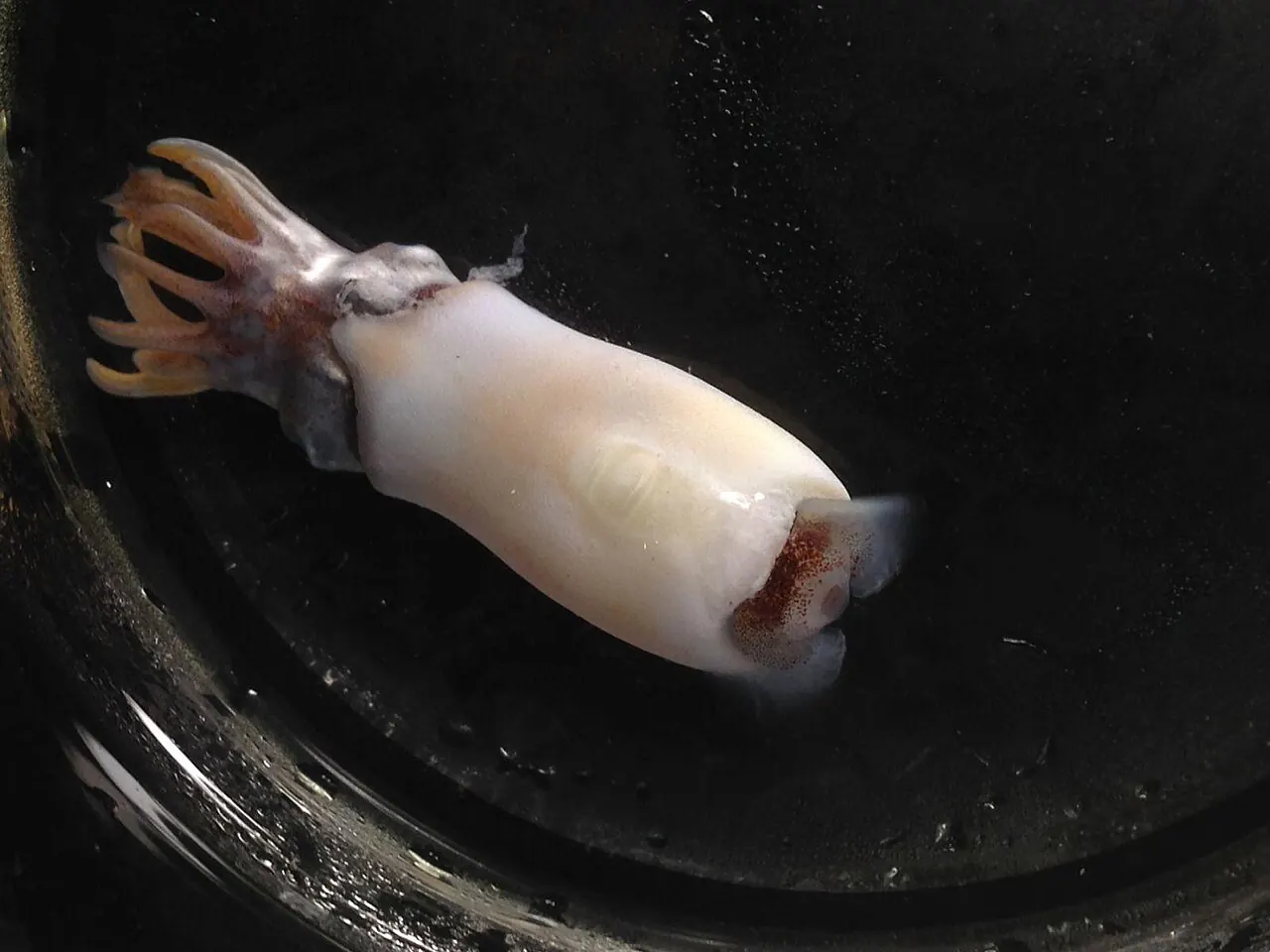
Ram's Horn Squid
Spirula spirula
A tiny deep-water squid with a coiled, chambered shell inside its body. Its empty shells wash up on beaches worldwide.
Photo: Victor Tuset / OIST / CC BY 4.0
3 things to know
- A coiled, gas-filled internal shell helps it control its buoyancy.
- A light organ at its tail end can glow for hours.
- The first video of one alive in its habitat, in 2020, showed it floating head up.
- Scientific name
- Spirula spirula
- Depth
- 100 m – 1,000 m
328 – 3,281 ft - Size
- Mantle rarely more than 4.5 cm (1.8 in) long
- Weight
- Not well known
- Lifespan
- Unknown
- Diet
- Not well known
- Where
- Tropical and subtropical open ocean worldwide
- IUCN status
- Least Concern
- Depth zones
- Sunlight · Twilight
Inside the back end of Spirula spirula sits a coiled shell, curled like a ram's horn without the coils touching and divided into chambers. The shell keeps the chambers and connecting tube of its distant ancestors' shells, and the squid uses it as a buoyancy device. The animal itself is small, with a mantle that rarely tops 4.5 centimeters (1.8 inches). A large light organ at its tail end can glow for hours, and the squid can pull its head and arms completely inside its mantle and close the opening with flaps, according to the Tree of Life Web Project.
The shells are far easier to find than the squid. Empty ones wash up on beaches, often in large numbers, including in Florida. The animal lives in tropical and subtropical open ocean and moves up and down each day: SeaLifeBase puts it at 550 to 1,000 meters (1,800 to 3,300 feet) by day and 100 to 300 meters (330 to 980 feet) at night. Young ones have been caught at 1,000 to 1,750 meters, which suggests females lay their eggs on the bottom of continental slopes.
It is the only living member of its genus, family and order. Because the buoyant shell sits at the tail, the Tree of Life account describes it hanging head down, and captive animals hold that pose in aquariums. Then, in 2020, Schmidt Ocean Institute's remotely operated vehicle SuBastian, working from the research vessel Falkor on Australia's Great Barrier Reef, filmed a ram's horn squid about 7 centimeters (3 inches) long at about 850 to 860 meters (2,800 feet). It was the first footage of a live one in its natural habitat, and it was floating head up. "A lot of people are freaking out because the head is up," Michael Vecchione of the Smithsonian's National Museum of Natural History told ScienceAlert. Vecchione had noted a problem with the head-down picture: hanging that way, the squid would aim its light organ upward, which he called highly unusual for deep-sea animals. Predators in the twilight zone look up for silhouettes, and a light pointing up would do little to hide one.
What it eats and how long it lives are not well known. The IUCN lists it as Least Concern, from a 2009 assessment that includes US waters in its range.
Sources
- tolweb.org/Spirula_spirula
- sealifebase.se/summary/Spirula-spirula.html
- sciencealert.com/first-ever-deep-sea-footage-of-a-ram-s-horn-squid-has-scientists-freak…
- divernet.com/2020/11/01/minion-squid-filmed-for-first-time
- iucnredlist.org/species/162587/922936
- Study: doi:10.2305/IUCN.UK.2012-1.RLTS.T162587A922936.en



