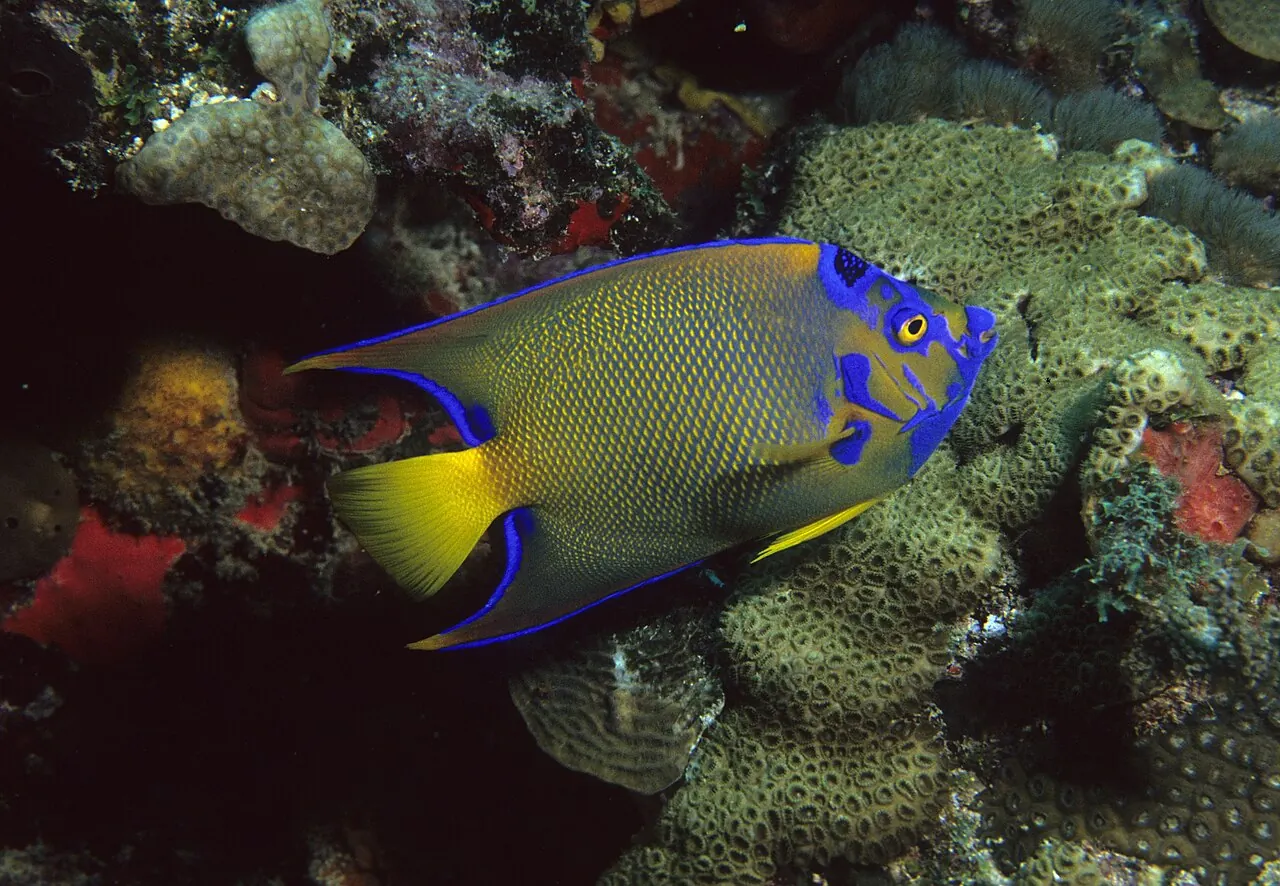
Queen Angelfish
Holacanthus ciliaris
A Caribbean and Florida reef angelfish named for the blue-ringed crown on its forehead, which lives almost entirely on sponges.
Photo: Dr. Dwayne Meadows, NOAA / Public domain
3 things to know
- The dark spot on its forehead, ringed and dotted with blue, looks like a crown.
- Stomach contents show it eats almost nothing but sponges.
- Young queen angelfish clean parasites off larger fish.
- Scientific name
- Holacanthus ciliaris
- Depth
- 1 m – 70 m
3 – 230 ft - Size
- Up to about 45 cm (18 in) long
- Weight
- Up to about 1.6 kg (3.5 lb)
- Lifespan
- Not well known
- Diet
- Mostly sponges, with small amounts of algae, tunicates, hydroids and bryozoans
- Where
- Western Atlantic from Florida and the Gulf of Mexico to Brazil, most abundant in the Caribbean; also St. Paul's Rocks in the central Atlantic
- IUCN status
- Least Concern
- Depth zones
- Sunlight
On the forehead of the queen angelfish sits a dark spot ringed in electric blue and speckled with blue dots, the crown that gives the fish its name. Large adults are purplish blue with yellow-orange rims to the scales, and have an all-yellow tail and yellow pectoral fins with a large blue spot at their base. They reach about 45 centimeters (18 inches) and 1.6 kilograms (3.5 pounds). Juveniles look different, mostly dark blue with a yellow tail and a yellow area around the pectoral fins.
The species lives in the western Atlantic, from Florida and the Gulf of Mexico to Brazil, and is most abundant in the Caribbean. It also lives far out on St. Paul's Rocks, on the Mid-Atlantic Ridge. Queen angelfish are found from 1 to 70 meters (3 to 230 feet) down, alone or in pairs, swimming between sea fans, sea whips and corals.
Adults are sponge specialists. In stomach contents from 26 fish, sponges made up almost the entire diet, with small amounts of algae, tunicates, hydroids and bryozoans. Young queen angelfish run cleaning stations, picking parasites off larger fish.
Adults are found in pairs all year, which the Florida Museum suggests may mean long-term monogamous bonds. A pair rises together and releases clouds of eggs and sperm, and a female can release 25,000 to 75,000 eggs in an evening. The eggs are clear and buoyant and drift in open water.
The queen angelfish occasionally interbreeds with its close relative, the blue angelfish, producing hybrids that show features of both parents. In 2009 M. W. Feeley, O. J. Luiz and N. Zurcher described an unusually colored probable queen angelfish from Dry Tortugas, Florida, a color form previously described only from St. Paul's Rocks. They suggested it might be explained by a recessive gene, while noting that more testing was needed.
The queen angelfish is collected commercially for home aquariums. The IUCN lists it as Least Concern, from a 2009 assessment.



