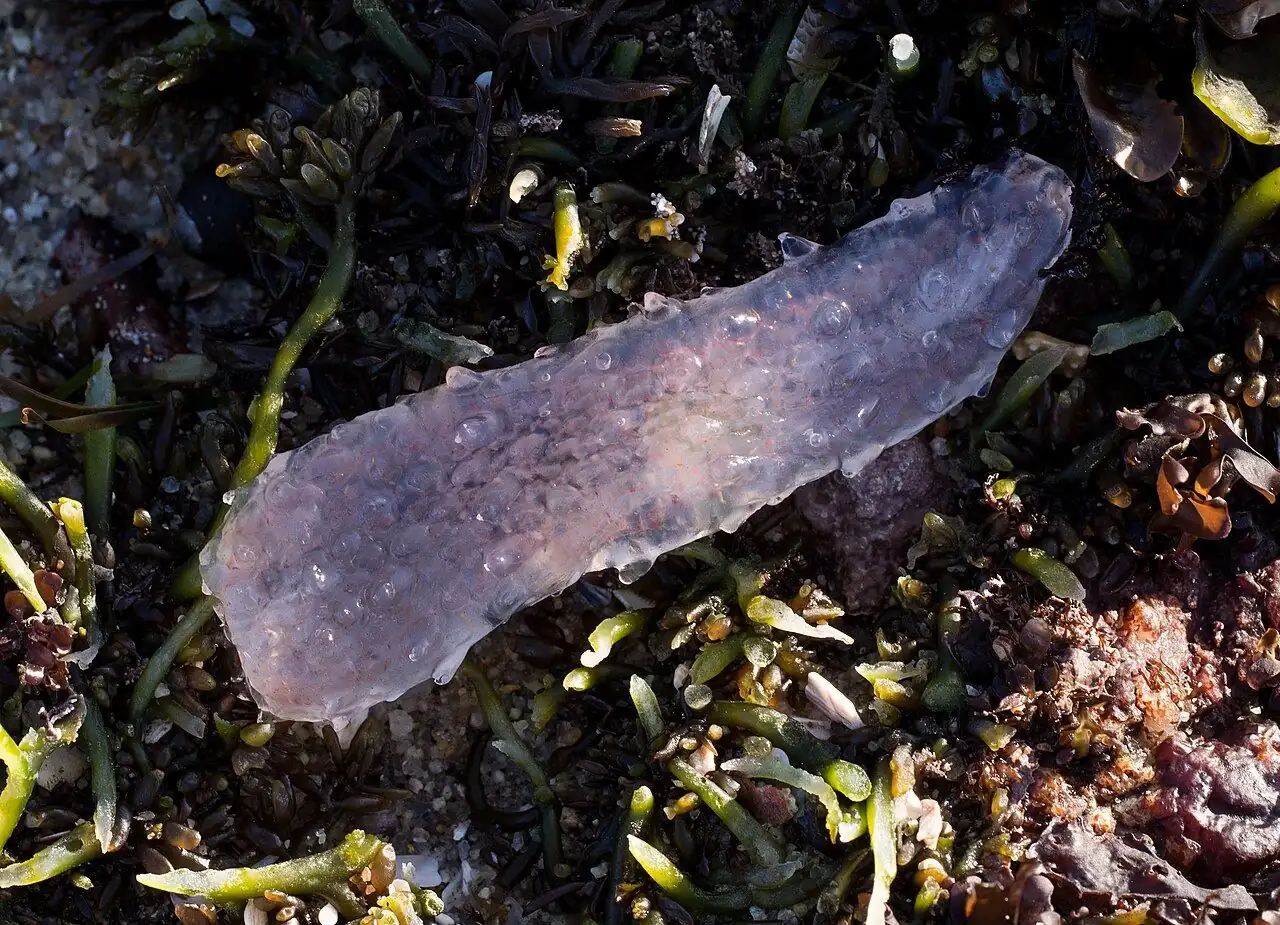
Pyrosome
Pyrosoma atlanticum
A glowing, tube-shaped colony of tiny clones, kin to vertebrates rather than jellyfish, that swarmed the Pacific Northwest coast in 2017.
Photo: Rhododendrites / CC BY-SA 4.0
3 things to know
- A pyrosome is a colony of tunicates, chordates in the group closest to vertebrates.
- Its name means fire body, after its bright bioluminescence.
- In May 2017 one five-minute research tow off the Columbia River caught about 60,000 pyrosomes.
- Scientific name
- Pyrosoma atlanticum
- Depth
- 0 m – 700 m
0 – 2,297 ft - Size
- Colonies a few centimeters to about 60 cm (2 ft) long; up to 78 cm (31 in) measured off Oregon in 2017
- Weight
- Unknown
- Lifespan
- Unknown
- Diet
- Phytoplankton and other small plankton filtered through mucus nets
- Where
- Tropical to temperate waters of the Atlantic, Mediterranean and Indo-Pacific; spread north to Oregon, Washington and Alaska after 2014
- IUCN status
- Not Evaluated
- Depth zones
- Sunlight · Twilight
Pick up a pyrosome and you are holding a colony: a firm, hollow tube closed at one end, its wall packed with tiny individuals called zooids, all joined in a shared tunic. Each zooid draws water through a mucus filter to catch plankton, and the beating of tiny hairs inside the zooids both feeds the colony and slowly moves it along. It looks like a jelly but is a tunicate, and tunicates belong to the chordates, in the subphylum that is the closest relative of the vertebrates.
The name means fire body. Each zooid has light organs, and a touch or a flash of light can set off a glow that spreads across the colony. In 1849, aboard HMS Rattlesnake, the young Thomas Henry Huxley described them in his diary as "shining like white-hot cylinders in the water." Biologists had proposed that bacteria made the light. In 2020, Michael Tessler, Jean Gaffney and colleagues found a light-making enzyme, which they named PyroLuc, in the animal's own genetic material; it glowed when mixed with a chemical called coelenterazine. Their results point to the animal making its own light, though the team wrote that bacteria could not yet be ruled out.
Pyrosoma atlanticum lives in tropical to temperate seas, historically between about 50° north and 50° south, and off California mostly south of Point Conception. It is most often seen in the upper sunlit layer, makes daily vertical migrations reported to reach depths of 700 meters (2,300 feet), and has been recorded to 1,000 meters.
Then it moved north. Pyrosomes began appearing off southern Oregon in 2014, and by 2017 they seemed to be everywhere off the Oregon coast. NOAA Fisheries reported that a five-minute midwater tow off the Columbia River in late May 2017 brought up about 60,000 of them, and that Ric Brodeur of the Northwest Fisheries Science Center, who had worked off Oregon since the 1980s, had never seen one before 2014. Colonies in a NOAA survey reached 78 centimeters (31 inches), pyrosomes clogged fishing gear by the thousands, and by summer the swarm reached the western Gulf of Alaska. Off Oregon in the spring of 2018, Jessica O'Loughlin and colleagues estimated the colonies were grazing up to 22% of the available phytoplankton.
The species has not been assessed for the IUCN Red List.
Sources
- fisheries.noaa.gov/feature-story/researchers-probe-explosion-pyrosomes-northwest-coast
- Study: doi:10.1002/ecy.2429
- par.nsf.gov/servlets/purl/10074440
- Study: doi:10.1038/s41598-020-73446-w
- nature.com/articles/s41598-020-73446-w
- Study: doi:10.1016/j.pocean.2020.102424
- Study: doi:10.1093/plankt/fbac006
- sealifebase.se/summary/Pyrosoma-atlanticum.html
- api.gbif.org/v1/species/5232532/iucnRedListCategory



