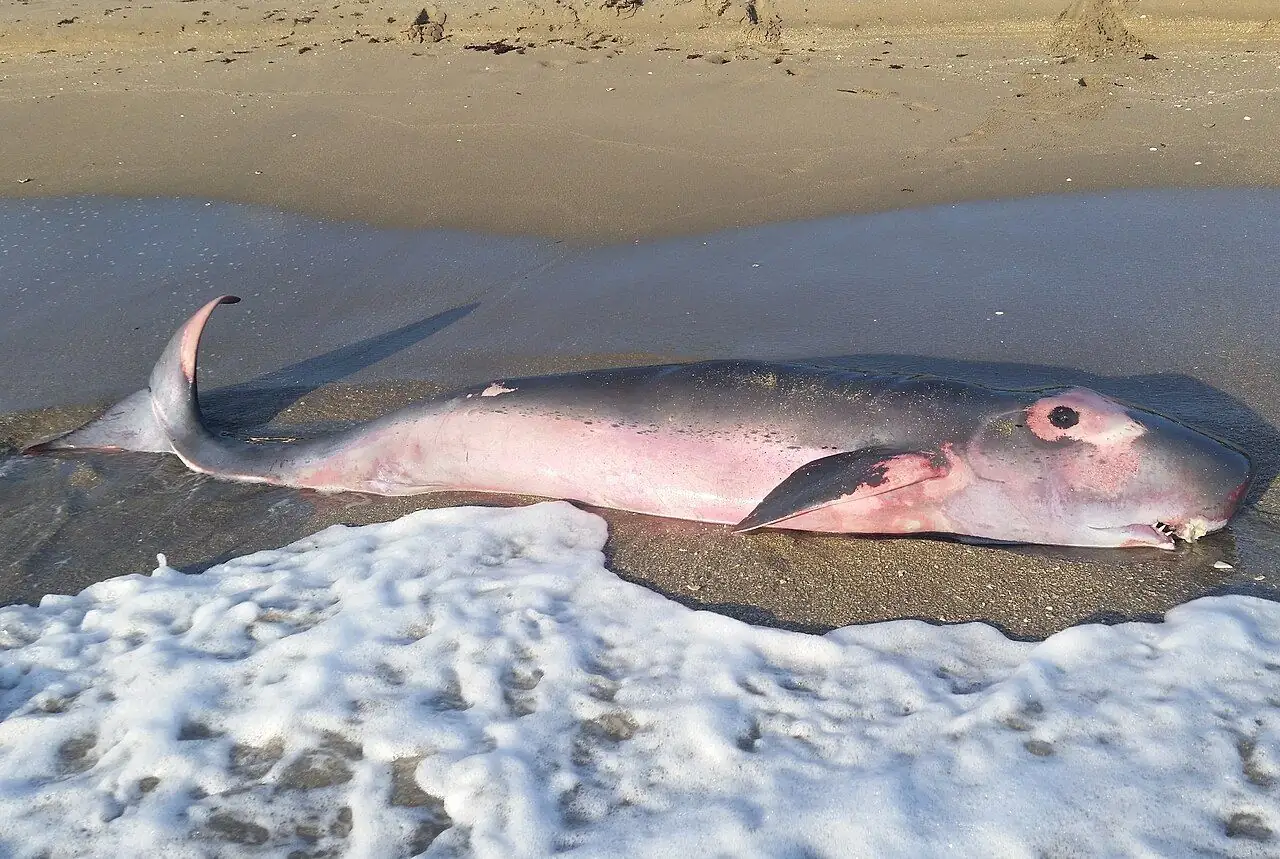
Pygmy Sperm Whale
Kogia breviceps
A small, shy cousin of the sperm whale that can squirt a cloud of reddish-brown ink to escape predators, and often strands in the US Southeast.
Photo: Inwater Research Group / CC BY-SA 4.0
3 things to know
- It can release more than 11 liters (3 gallons) of reddish-brown ink from a special sac.
- Pygmy and dwarf sperm whales were not recognized as separate species until 1966.
- From 1978 to 1997, 446 pygmy sperm whales were reported stranded on the US Atlantic and Gulf coasts.
- Scientific name
- Kogia breviceps
- Depth
- 0 m – 300 m
0 – 984 ft - Size
- Up to about 3.5 m (11.5 ft) long
- Weight
- About 320–450 kg (700–1,000 lb)
- Lifespan
- Up to about 23 years
- Diet
- Squid and octopus, crabs and shrimp, and fish
- Where
- Tropical, subtropical and temperate seas worldwide, often along the edges of continental shelves
- IUCN status
- Least Concern
- Depth zones
- Sunlight · Twilight
Like the much larger sperm whale, this small whale is named after spermaceti, the waxy substance in its head. It has 10 to 16 pairs of teeth in the lower jaw and none in the upper jaw, and a mark behind the eye called a false gill because it looks like a fish's gill slit. Adults reach about 3.5 meters (11.5 feet) and 320 to 450 kilograms (700 to 1,000 pounds). It and the dwarf sperm whale were not recognized as separate species until 1966.
It lives in tropical to temperate seas worldwide, alone or in groups of six or seven, and almost never approaches boats. It eats squid, octopus, crabs, shrimp and fish, and NOAA says it dives at least 300 meters (1,000 feet) for them. When threatened, it can release more than 11 liters (3 gallons) of reddish-brown ink from a special sac, a squid-like escape that only it and the dwarf sperm whale use.
The first information on how it moves and dives at sea came from one young female. Nicknamed Inky, she stranded alive in New Jersey on November 24, 1993, sick because several large pieces of plastic had blocked her stomach. At the National Aquarium in Baltimore the plastic was removed, and on May 31, 1994, she was released into the Gulf Stream off Cape Canaveral, Florida, carrying a radio transmitter and depth recorder, because her dorsal fin was too small for a satellite tag. For four days Michael Scott and colleagues followed her north between the edge of the continental shelf and the eastern edge of the Gulf Stream. She made long dives of more than eight minutes at night and on overcast days, when squid rise toward the surface, and mostly short dives on clear days. The depth recorder was never recovered. Then the signal stopped, and her fate is unknown.
Strandings are common in the US Southeast: Scott's team cites 446 reported on the Atlantic and Gulf coasts from 1978 to 1997. Some stranded whales have had plastic and other trash blocking their stomachs. Entanglement in fishing gear is a main threat, and harpoon hunters in Indonesia, the Lesser Antilles and Japan still take some. Pregnancy lasts 9 to 11 months, and NOAA says the whales live up to 23 years. The IUCN lists the species as Least Concern, and it is protected under the US Marine Mammal Protection Act.



