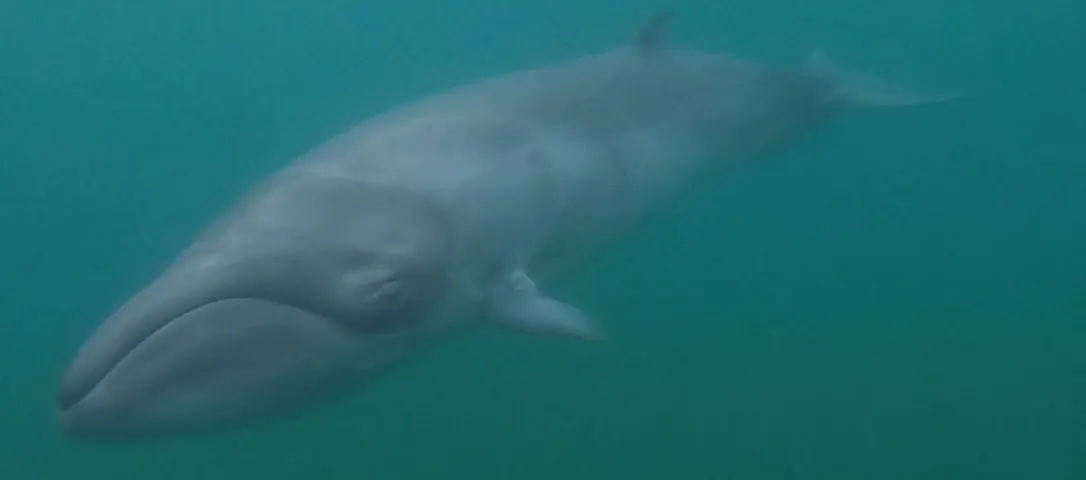
Pygmy Right Whale
Caperea marginata
The smallest and least-known baleen whale, possibly the last survivor of a whale family thought to be extinct.
Photo: Henry Cordell, in Dedden et al. (2023), Frontiers in Marine Science / CC BY 4.0
3 things to know
- It is the smallest living baleen whale, at up to about 6.5 m (21 ft) long.
- Its small size spared it from commercial whaling.
- A 2013 study argued it is the last living cetothere, a family otherwise known only from fossils.
- Scientific name
- Caperea marginata
- Depth
- 0 m – 200 m
0 – 656 ft - Size
- Up to about 6.5 m (21 ft) long
- Weight
- About 2.9–3.9 metric tons (6,300–8,500 lb) in the few adults weighed
- Lifespan
- Unknown
- Diet
- Copepods and small krill
- Where
- Southern Hemisphere, all the way around the globe, generally between 30° and 55° S
- IUCN status
- Least Concern
- Depth zones
- Sunlight
The pygmy right whale is the smallest baleen whale alive, reaching about 6.5 meters (21 feet). It is medium to dark gray above and almost white below, with pale crescent-shaped marks on and just behind the head. The mouth line is arched, the dorsal fin is small and set far back, and the baleen plates are long, narrow and cream to yellow. At sea it is easily mistaken for a minke whale, one reason it is so poorly known.
It lives only in the Southern Hemisphere, around the globe, generally between 30° and 55° south. It has been seen in the open ocean, over continental shelves and close to the coasts of southern continents, never off Antarctica, and much of what is known comes from stranded whales in Australia, New Zealand, South Africa and South America. Observed dives last 3 to 4 minutes. A few bird feathers found in stomachs may point to feeding at the surface, but nobody has measured how deep it dives. Whales seen near shore are usually alone or in pairs, though offshore groups of more than 100 have been reported.
The stomachs of the six whales examined held copepods and small krill. In 2023 Adelaide Dedden, Catherine Kemper and colleagues read a longer diet record from the baleen of 14 whales that stranded in South Australia and Tasmania, now in the South Australian Museum. Baleen grows continuously and records chemical traces of food, and these plates covered up to about 3.5 years of each whale's life. The isotopes matched Australian krill and copepods, and showed no sign of trips to Antarctic waters, so the whales seem to stay in mid-latitude seas all year instead of migrating like other baleen whales.
Its skeleton is odd too, with 18 pairs of broad, flat ribs. In 2013 Ewan Fordyce and Felix Marx compared bones from New Zealand collections with fossils and concluded that the pygmy right whale may be the last survivor of the cetotheres, a family of baleen whales thought to have died out.
Being small and scattered, it was never a target of commercial whaling, and it has been protected along with right whales since 1935, though some drown in inshore fishing nets. The IUCN's 2018 assessment lists it as Least Concern, but there is no estimate of how many exist.
Sources
- Study: doi:10.3389/fmars.2023.1190623
- frontiersin.org/journals/marine-science/articles/10.3389/fmars.2023.1190623/full
- Study: doi:10.1098/rspb.2012.2645
- gbif.org/species/195708542
- collections.museumsvictoria.com.au/species/14366
- iucnredlist.org/species/3778/50351626
- marinemammalscience.org/science-and-publications/list-marine-mammal-species-subspecies
- en.wikipedia.org/wiki/Pygmy_right_whale



