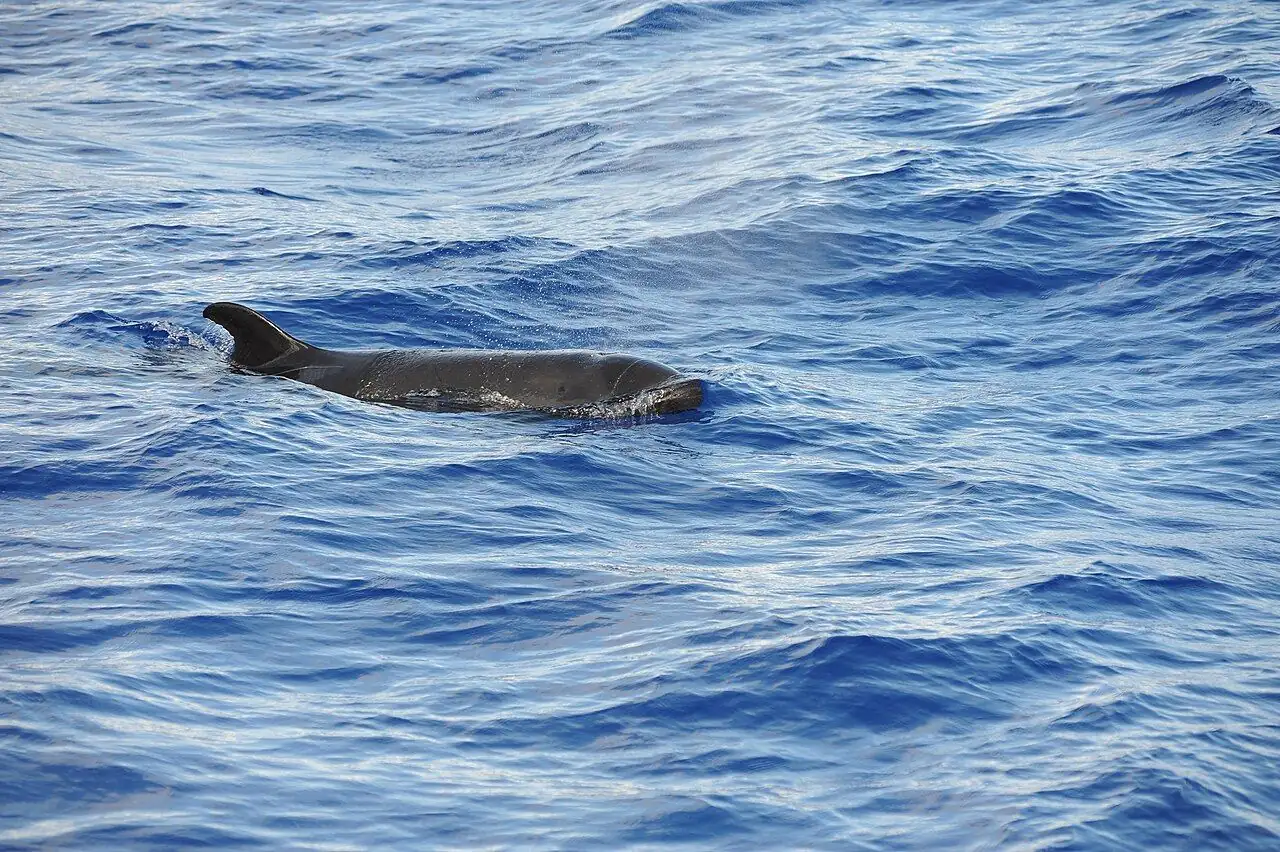
Pygmy Killer Whale
Feresa attenuata
A rarely seen oceanic dolphin, once known only from two skulls, whose small island-bound groups off Hawaii have been tracked for decades.
Photo: Stephane Lesbats (Ifremer) / CC BY 4.0
3 things to know
- For more than a century it was known only from two skulls, until a live one was found in 1954.
- Off the island of Hawaii, some individuals have been photographed over a span of 21 years.
- A 2026 genetic study found that pygmy killer whales from the Sulu Sea may be a separate, unrecognized taxon.
- Scientific name
- Feresa attenuata
- Depth
- 0 m – 368 m
0 – 1,207 ft - Size
- Up to about 2.6 m (8.5 ft) long
- Weight
- Up to about 225 kg (496 lb)
- Lifespan
- Unknown
- Diet
- Poorly known; squid and fish have been reported
- Where
- Deep tropical and subtropical waters worldwide, from about 40° N to 35° S
- IUCN status
- Least Concern
- Depth zones
- Sunlight · Twilight
For more than a century the pygmy killer whale was known from just two skulls, until a live animal turned up in 1954. It is in fact a small member of the oceanic dolphin family. It is dark gray to black, with small white areas on the lips and belly, a rounded head with no beak, a tall dorsal fin and long, pointed flippers. NOAA Fisheries gives a maximum length of about 2.6 meters (8.5 feet) and weight of 225 kilograms (496 pounds). It is easily confused with the melon-headed whale; paired white tooth rakes on its skin and a crisp edge between its dark cape and paler sides are the best clues.
It lives in deep tropical and subtropical water worldwide and is naturally rare. Groups usually number 12 to 50, and they often rest together at the surface, all facing the same way. Their lifespan is unknown, little is known about how they breed, and the few reports of their diet mention squid and fish. Two rehabilitated males tagged after release in the Gulf of Mexico in 2016 dove mostly at night, the deepest to 368 meters (1,207 feet).
Daniel McSweeney, Robin Baird and colleagues photographed pygmy killer whales off the island of Hawaii from 1985 to 2007, alongside surveys around all the main islands from 2000. The species made up only 1.2 percent of dolphin and toothed whale sightings, yet 80 percent of the distinctive individuals off Hawaii Island were seen more than once, some over 21 years, in stable groups of both sexes. Survey sightings came over water 113 to 2,862 meters (370 to 9,390 feet) deep, and in 72 encounters nobody saw them feed, which suggests they hunt deep or at night. NOAA recognizes resident groups off Oahu, Penguin Bank and Hawaii Island, plus US stocks in the northern Gulf of Mexico and the western North Atlantic.
In 2026, Brittany Hancock-Hanser, Baird and colleagues compared mitochondrial DNA from 89 pygmy killer whales worldwide. Three from the Sulu Sea were as different from all the others as some sister species are from each other, pointing to an unrecognized group.
The IUCN's assessment, published in 2018, lists the species as Least Concern. It can drown in gillnets, is hunted in harpoon fisheries outside the United States, and the 2026 study notes that it is highly vulnerable to bycatch in small-scale fisheries in some areas.
Sources
- fisheries.noaa.gov/species/pygmy-killer-whale
- Study: doi:10.1111/j.1748-7692.2008.00267.x
- cascadiaresearch.org/files/McSweeney-et-al-Feresa.pdf
- Study: doi:10.1111/mms.70127
- Study: doi:10.1578/AM.44.5.2018.555
- pubs.usgs.gov/publication/70199563
- iucnredlist.org/species/8551/50354433
- sealifebase.se/summary/Feresa-attenuata.html



