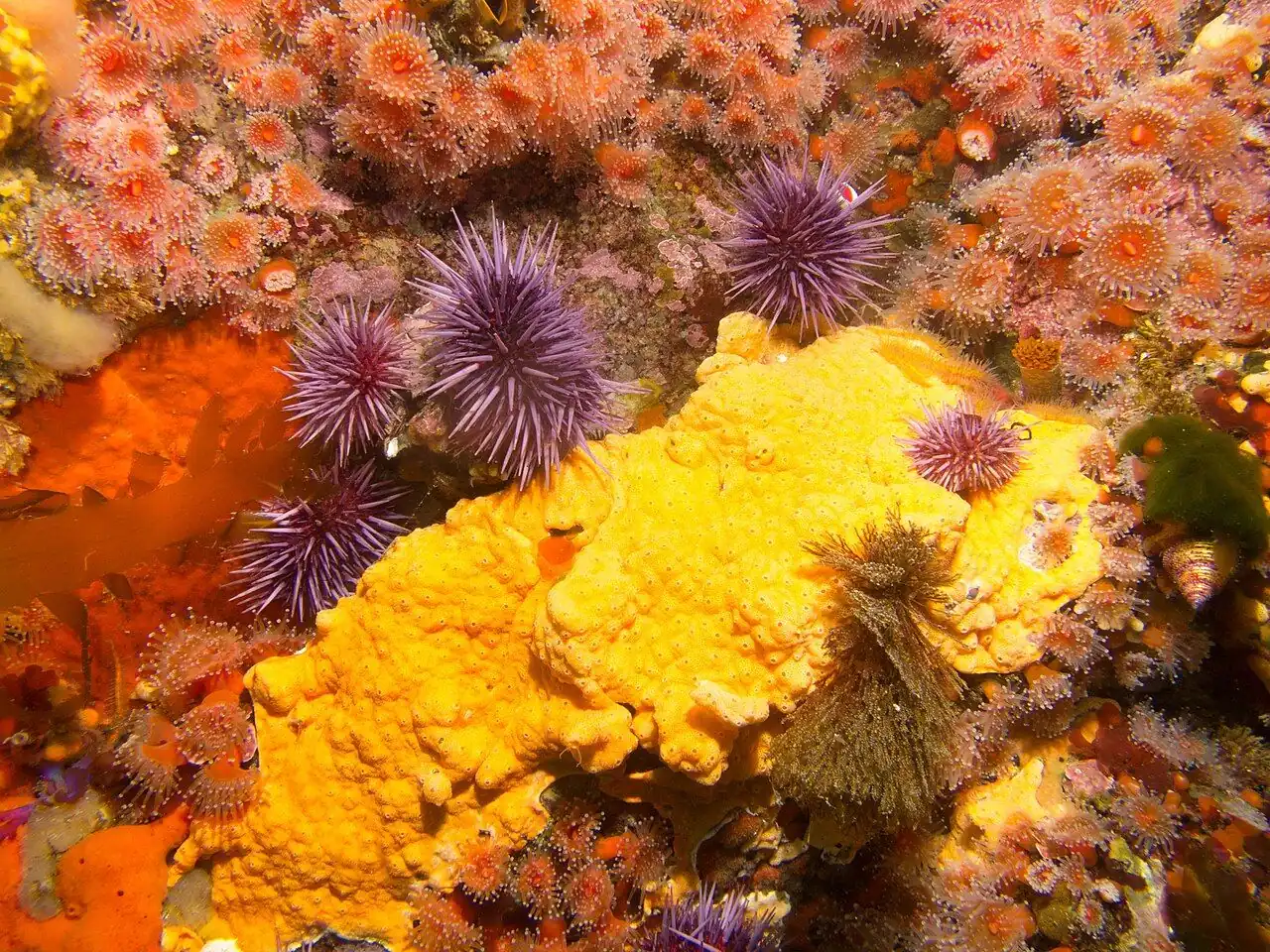
Purple Sea Urchin
Strongylocentrotus purpuratus
A Pacific coast urchin that bores into rock, can live 50 years or more and, in huge numbers, can mow kelp forests down to bare urchin barrens.
Photo: Ed Bierman / CC BY 2.0
3 things to know
- Sea otters that eat many purple urchins end up with purple-tinted bones and teeth.
- Young purple urchins have green spines.
- In northern California, purple urchins increased about 60-fold in 2015 as the kelp forests collapsed.
- Scientific name
- Strongylocentrotus purpuratus
- Depth
- 0 m – 161 m
0 – 528 ft - Size
- Shell up to about 7 cm (3 in) across; SeaLifeBase gives a maximum of 8.5 cm (3.3 in)
- Weight
- Unknown
- Lifespan
- Estimated at more than 50 years
- Diet
- Red, brown and green algae, including kelp
- Where
- Pacific coast of North America, from Vancouver Island, Canada (SeaLifeBase: Alaska), to Isla Cedros, Baja California, Mexico
- IUCN status
- Not Evaluated
- Depth zones
- Sunlight
Sea otters that eat a lot of purple sea urchins end up with purple-tinted bones and teeth, the Monterey Bay Aquarium says. The urchin itself is a round shell, called a test, about 7 centimeters (3 inches) across, covered in purple spines that pivot on ball-and-socket joints. Young urchins have green spines. Between the spines are tube feet for walking and tiny pincers for defense, and on the underside is a mouth with five teeth, known as Aristotle's lantern.
Strongylocentrotus purpuratus lives on rocky shores along the Pacific coast of North America, from Vancouver Island to Isla Cedros in Baja California by the aquarium's count. SeaLifeBase records it down to 161 meters (528 feet), but it is mostly found from the low intertidal zone to about 10 meters (33 feet). Using its teeth and spines, an urchin can dig a hollow into rock, and some outgrow the entrance and stay inside for life, eating whatever drifts in. In the intertidal zone, purple urchins also cover themselves with shells, pebbles and bits of algae.
They eat red, brown and green algae, including kelp. Below the tide line they gather in hordes, and a horde can chew through the stalks of giant kelp and leave an urchin barren. That happened on a huge scale in northern California. Sea stars died off from 2013, a marine heat wave began in 2014, and purple urchins increased about 60-fold in 2015, according to a 2019 study by scientists at UC Davis and the California Department of Fish and Wildlife. Bull kelp canopy fell by more than 90% along more than 350 kilometers (220 miles) of coast. How much of the urchin boom came from warming and how much from the loss of sea stars is still an open question. Sea otters, sunflower stars and California sheephead all prey on purple urchins.
Individuals can be long-lived; Thomas Ebert's population studies put the maximum life expectancy at more than 50 years. The species is also a laboratory workhorse in developmental biology. In 2006 a large consortium of scientists published its genome, about 814 million DNA letters long with some 23,300 genes, including many once thought to be found only in vertebrates. The IUCN has not evaluated the purple sea urchin.



