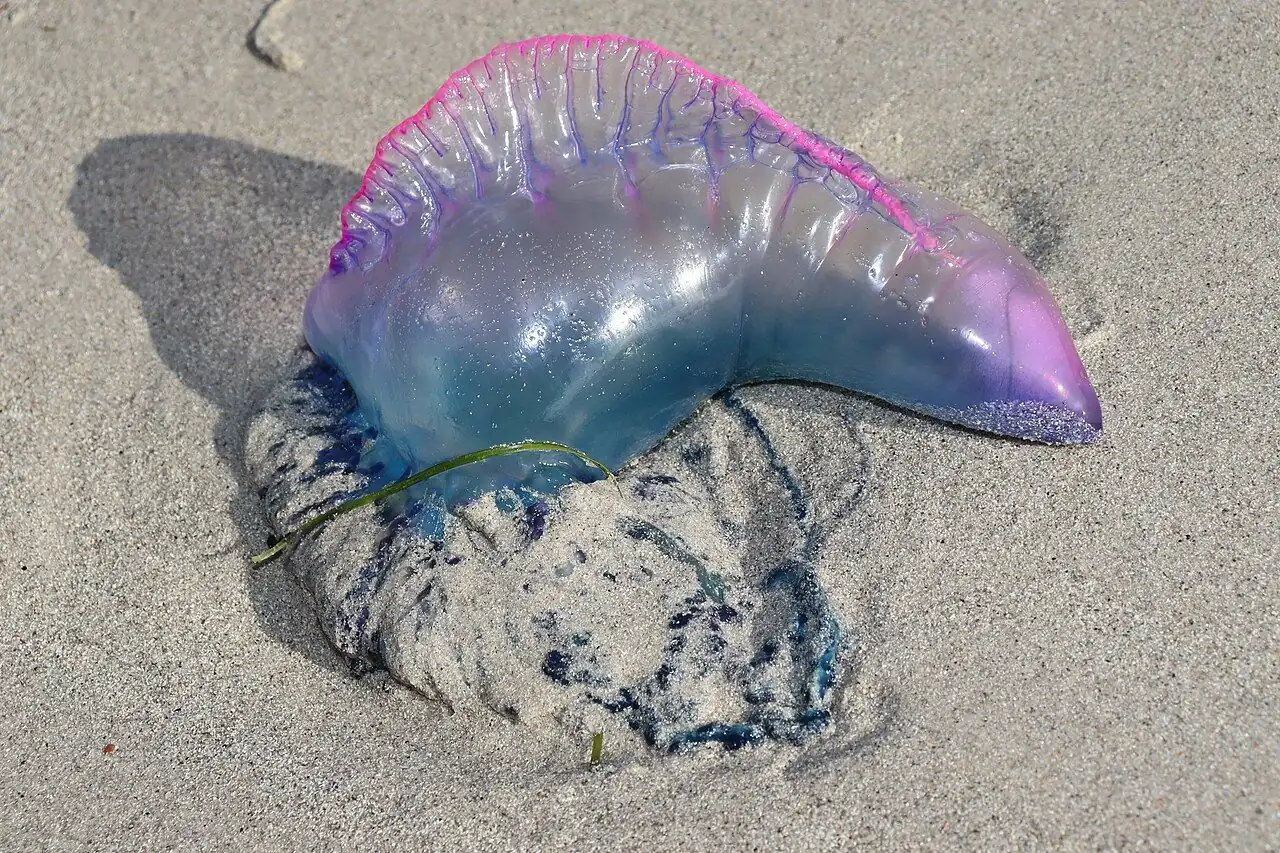
Portuguese Man O' War
Physalia physalis
Not a jellyfish but a drifting colony of clones under a gas-filled sail, and since 2025 one of at least four man o' war species.
Photo: Fernando Losada Rodríguez / CC BY-SA 4.0
3 things to know
- Each man o' war is a colony of genetically identical zooids with four specialized kinds of parts.
- Its float can rise about 15 centimeters (6 inches) above the waterline.
- A man o' war can still sting weeks after washing ashore.
- Scientific name
- Physalia physalis
- Depth
- At the surface
- Size
- Float rises up to about 15 cm (6 in) above the water; tentacles average about 10 m (30 ft) and can reach 30 m (100 ft)
- Weight
- Unknown
- Lifespan
- Unknown
- Diet
- Small fish and crustaceans
- Where
- North and southwest Atlantic for P. physalis as split in 2025; NOAA describes men o' war as mostly tropical and subtropical
- IUCN status
- Not Evaluated
- Depth zones
- Sunlight
A balloon of blue, violet or pink riding up to about 15 centimeters (6 inches) above the waves is the part of a Portuguese man o' war that beachgoers notice. NOAA's National Ocean Service traces the name to its resemblance to an 18th-century Portuguese warship under full sail. Under the float hang tentacles that average about 10 meters (30 feet) and can stretch to 30 meters (100 feet).
It is often called a jellyfish, but it is a siphonophore, a colony of genetically identical individuals called zooids. Four specialized kinds of parts handle floating, catching prey, feeding and reproduction. It cannot swim anywhere on purpose. Wind and currents carry it, sometimes in groups of 1,000 or more, and NOAA describes men o' war as found mostly in tropical and subtropical seas. The tentacles are packed with stinging capsules whose venom can paralyze and kill small fish and crustaceans.
For people the sting is rarely deadly, but it is painful and raises welts. NOAA warns that a man o' war can still sting weeks after washing ashore.
The bigger surprise came from genetics. The man o' war was long treated as one species spread across the world's oceans, and open-ocean drifters like it were assumed to form huge, well-mixed populations. In 2025, Samuel Church of Yale University and colleagues published whole genomes from 151 specimens in Current Biology. They found five distinct lineages that showed strong signs of not interbreeding, even where their ranges overlap. By scoring thousands of photos that members of the public had posted to iNaturalist, they matched four recognizable body forms to four of the lineages and concluded there are at least four species: P. physalis, P. utriculus, P. megalista and a newly named P. minuta, found near New Zealand and Australia. In that scheme, P. physalis itself is the man o' war of the North and southwest Atlantic. Three of those names had been proposed in the 18th and 19th centuries and later dismissed. Ocean modeling showed that even within each species, regional subpopulations line up with the prevailing currents and winds.
The man o' war has not been assessed for the IUCN Red List.



