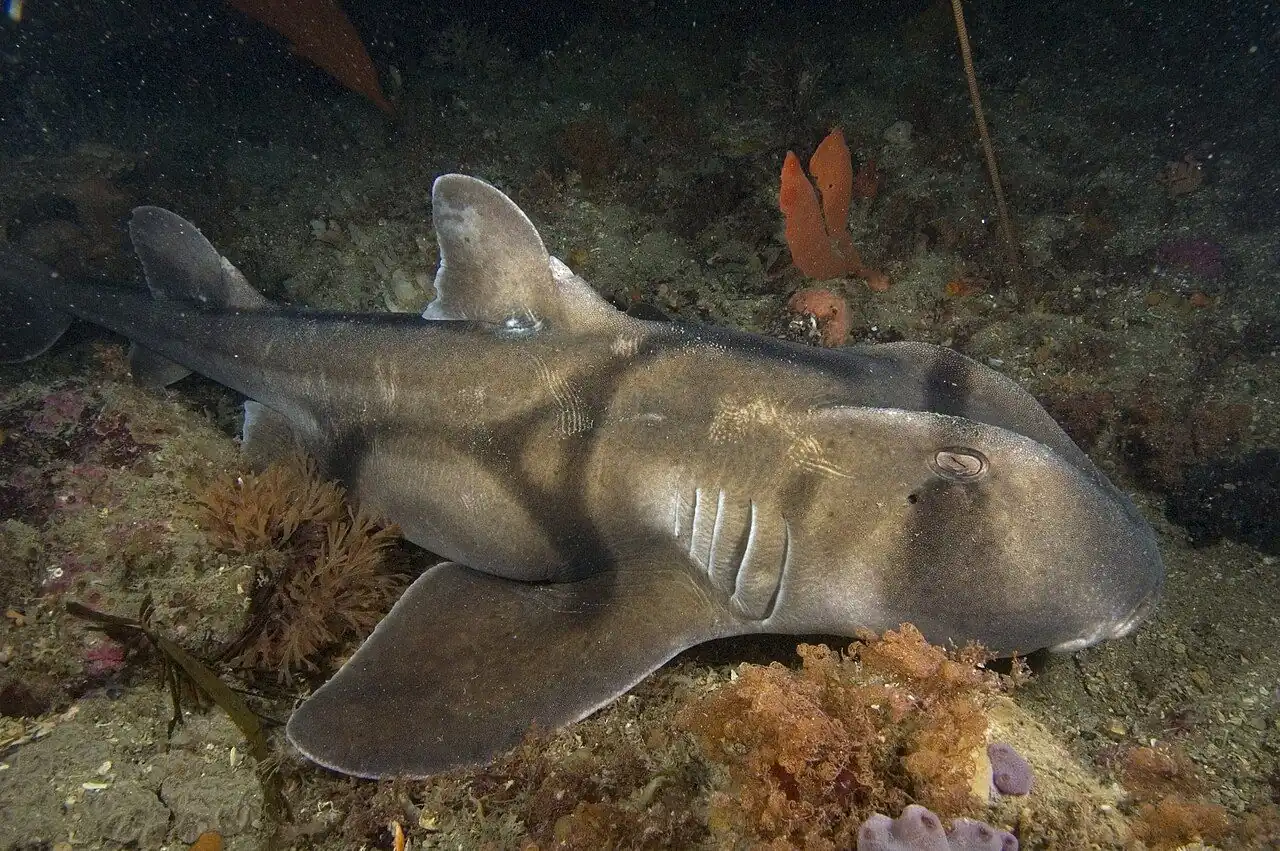
Port Jackson Shark
Heterodontus portusjacksoni
A blunt-headed shark of southern Australia that crushes sea urchins, comes back to the same reefs every year and can learn simple cues.
Photo: Mark Norman, Museums Victoria / CC BY 4.0
3 things to know
- Dark harness-like bands cross its eyes, run along its back and wrap down its sides.
- A female lays up to 16 spiral egg cases a season and uses her mouth to wedge them into rock crevices.
- In a Macquarie University experiment, young Port Jackson sharks learned to link a light or a stream of bubbles with food within five days.
- Scientific name
- Heterodontus portusjacksoni
- Depth
- 0 m – 275 m
0 – 902 ft - Size
- Males commonly about 75 cm (2.5 ft) and females 80–95 cm (2.6–3.1 ft); up to 1.65 m (5.4 ft)
- Weight
- Not well known
- Lifespan
- Reportedly more than 30 years
- Diet
- Sea urchins, molluscs, crustaceans and fishes
- Where
- Southern Australia, from southern Queensland to Tasmania and west to central Western Australia; one record from New Zealand
- IUCN status
- Least Concern
- Depth zones
- Sunlight · Twilight
Sydney's harbor, Port Jackson, gave this shark its name. It has a big blunt head, a spine at the front of each of its two dorsal fins, and dark bands shaped like a harness that cross the eyes, run along the back to the first dorsal fin and then wrap down the sides of a light gray-brown body. The largest grow to 1.65 meters (5.4 feet), but males are more commonly about 75 centimeters (2.5 feet) and females 80 to 95 centimeters (2.6 to 3.1 feet).
It is found only around southern Australia, from southern Queensland to Tasmania and west to the central coast of Western Australia, and has been recorded from the intertidal zone down to 275 meters (902 feet). It usually stays on or near rocky bottoms, hiding in caves and gullies by day and foraging at night. Adults eat sea urchins, molluscs, crustaceans and fish, and the black sea urchin is a regular meal.
The breeding season runs from late August to mid-November. A female lays a pair of eggs every 10 to 14 days, up to 16 in a season. Each case is a dark brown spiral about 15 centimeters (6 inches) long. It is soft when laid, and the female uses her mouth to wedge it into a rock crevice, where it hardens. A single pup emerges 10 to 12 months later. Most never get that far: the Florida Museum of Natural History cites research suggesting that 89 percent of egg cases are lost, mainly to predators.
Port Jacksons travel to breed and come back to the same places. Nathan Bass, Culum Brown and colleagues tagged sharks at Jervis Bay, New South Wales, between 2012 and 2014 and followed them for up to four years. Both males and females returned to Jervis Bay, and to the site where they were tagged, year after year, and about half migrated south, some as far as Bass Strait. In an earlier Macquarie University experiment, Tristan Guttridge and Brown trained 30 young Port Jacksons to link an underwater light or a stream of bubbles with food. The sharks learned within about 30 trials over five days, and when tested later without food, one shark still bit at the bubbles after 20 days and another after 40.
The IUCN lists the species as Least Concern, in an assessment from 2015.
Sources
- australian.museum/learn/animals/fishes/port-jackson-shark-heterodontus-portusjacksoni-m…
- floridamuseum.ufl.edu/discover-fish/species-profiles/port-jackson-shark
- fishbase.se/summary/Heterodontus-portusjacksoni.html
- iucnredlist.org/species/39334/68625721
- Study: doi:10.1071/MF16122
- Study: doi:10.1007/s10071-013-0673-4



