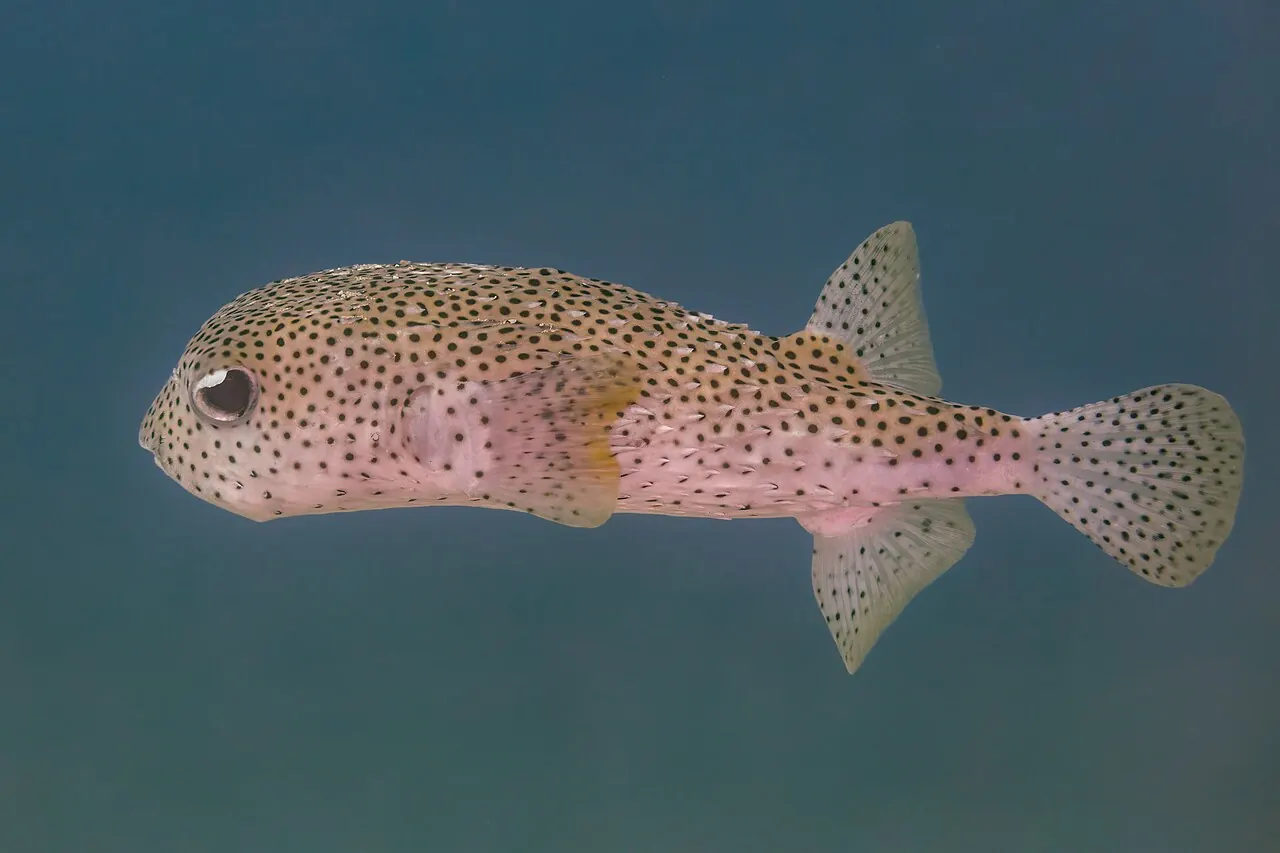
Porcupinefish
Diodon hystrix
The largest spiny puffer, a night-hunting reef fish that swallows water to inflate and raise its spines, and cracks sea urchins with a beak.
Photo: Diego Delso / CC BY-SA 4.0
3 things to know
- Its spines are modified scales that lie flat until it inflates.
- Its teeth are fused into a beak strong enough to crack sea urchins and snail shells.
- Young porcupinefish drift in the open sea until they are about 20 centimeters (8 inches) long.
- Scientific name
- Diodon hystrix
- Depth
- 2 m – 50 m
7 – 164 ft - Size
- Up to about 91 cm (36 in) long; adults usually around 40 cm (16 in)
- Weight
- Up to about 2.8 kg (6 lb), the heaviest published
- Lifespan
- Not well known; one lived 10 years in an aquarium
- Diet
- Hard-shelled invertebrates such as sea urchins, snails and hermit crabs
- Where
- Tropical and subtropical seas worldwide; in US waters from Massachusetts and the northern Gulf of Mexico in the Atlantic, and from San Diego south in the Pacific
- IUCN status
- Least Concern
- Depth zones
- Sunlight
When a porcupinefish is threatened, it takes in water until its body swells, and its long spines, which normally lie flat against its sides, stand straight out. The Florida Museum of Natural History explains that the spines are modified scales and stick out only when the fish is inflated. This species, also called the spot-fin porcupinefish, is the largest of the spiny puffers. It can reach 91 centimeters (36 inches), although adults are usually around 40 centimeters (16 inches). It is grayish tan with small black spots on the body and fins, a white belly, and about 20 spines in a row between its snout and its dorsal fin.
It lives in warm seas around the world. In US waters it is found from Massachusetts to the northern Gulf of Mexico in the Atlantic, and from San Diego south toward Chile in the Pacific. Adults keep to lagoons and seaward reefs, mostly between 2 and 50 meters (7 and 164 feet) deep, and spend the day in caves, holes, ledges and shipwrecks.
It hunts alone at night. The genus name, Diodon, means two teeth: the teeth in each jaw are fused into a single beak-like plate, strong enough to crack the shells of snails, hermit crabs and sea urchins.
Its eggs drift with the current and hatch after about five days. The young stay out in open water until they are about 20 centimeters (8 inches) long, often among floating clumps of sargassum seaweed, and only then settle on the reef. Dolphinfish (mahi-mahi), billfishes, wahoo and sharks all eat porcupinefish. Its natural lifespan is unknown, but FishBase reports one that lived 10 years in an aquarium.
Because its skin carries a toxin, it is generally treated as poisonous and rarely caught to eat, although it has been eaten in Hawaii and Tahiti. Dried, inflated porcupinefish are sold as tourist souvenirs, and on some Pacific islands the dried skins were once worn as war helmets. Collectors also catch it for home and public aquariums. The IUCN lists the species as Least Concern, from a 2011 assessment.



