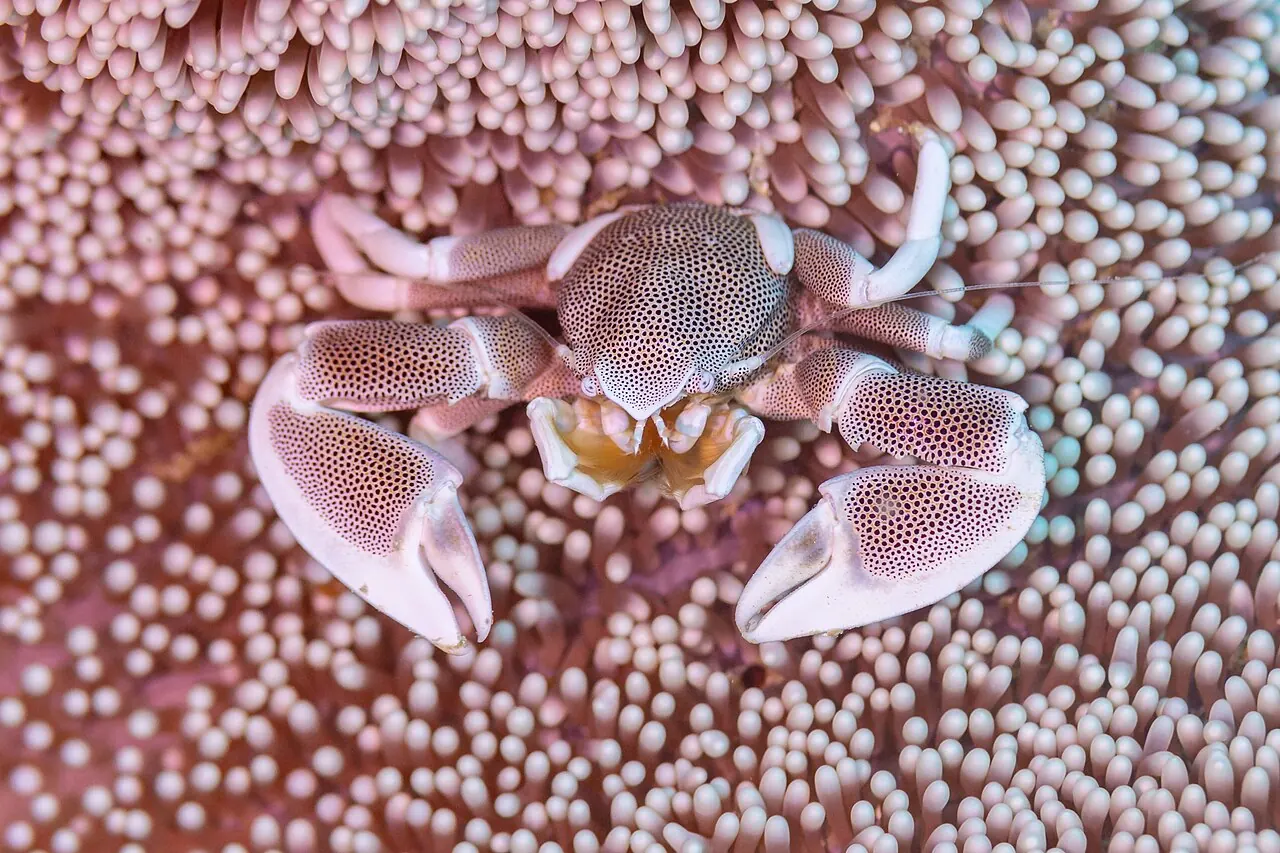
Porcelain Crab
Many species, family Porcellanidae
Small, flat crab look-alikes, closer kin to hermit crabs, that filter plankton with feathery mouthparts and drop a claw to escape.
Photo: Diego Delso / CC BY-SA 4.0
3 things to know
- Porcelain crabs evolved a crab-like body independently and are more closely related to hermit crabs than to true crabs.
- They feed by sweeping feathery mouthparts through the water like fine nets.
- Up to 860 have been counted in one square meter (about 11 sq ft) of mussel bed in California.
- Scientific name
- Many species, family Porcellanidae
- Depth
- 0 m – 110 m
0 – 361 ft - Size
- Small; Pacific coast tide-pool species are less than 2.5 cm (1 in) wide
- Weight
- Unknown
- Lifespan
- Not well known
- Diet
- Plankton such as diatoms, filtered from the water with feathery mouthparts
- Where
- Atlantic, Pacific and Indian oceans; several species along North America's Pacific coast from Alaska to Baja California
- IUCN status
- Not Evaluated (for the species we checked)
- Depth zones
- Sunlight
Porcelain crabs have the look of crabs without the family ties. The Western Australian Museum describes them as a lineage that evolved a crab-like body on its own and is more closely related to hermit crabs. They are small and flattened, built to squeeze between stones and coral rubble, and the ones in Pacific Coast tide pools are less than 2.5 centimeters (1 inch) wide, according to the Monterey Bay Aquarium. The family, Porcellanidae, lives in the Atlantic, Pacific and Indian oceans, and the species we checked range from the tide line down to about 110 meters (360 feet).
Their big claws play no part in feeding. Porcelain crabs are filter feeders that sweep feathery mouthparts through the water like fine nets to catch diatoms and other drifting plants and animals. The claws are mainly for defense, and the crabs give them up readily: a threatened porcelain crab can drop a claw or a leg to distract an attacker and escape, and the limb grows back. The museum adds that they can flick the abdomen to swim backward like a shrimp.
They can live in crowds. The aquarium reports up to 860 porcelain crabs in a single square meter (about 11 square feet) of mussel bed off Pacific Grove, California, and a female less than an inch long may carry nearly 1,600 eggs, though most carry around 600. Some species live on other animals. The anemone porcelain crab of the Indo-Pacific, Neopetrolisthes maculatus, sits in sea anemones and feeds partly on their mucus, though it does not depend on it.
Porcelain crabs have also helped show which animals warming may hurt most. In a study published in Science in 2003, Jonathon Stillman of Stanford University's Hopkins Marine Station gradually warmed four porcelain crab species, two from cool Oregon waters and two from warm waters off Puerto Peñasco, Mexico. According to a National Wildlife magazine report on the work, the cool-water crabs adjusted their upper heat limits better than the warm-water crabs did. Stillman suggested an evolutionary trade-off: species that already survive high summer heat may have given up some ability to adjust, leaving them more vulnerable to further warming.
Lifespans are not well known, and the species we checked have not been assessed by the IUCN.
Sources
- museum.wa.gov.au/online-collections/names/Petrolisthes-militaris
- montereybayaquarium.org/animals/animals-a-to-z/porcelain-crab
- sealifebase.se/summary/Neopetrolisthes-maculatus.html
- sealifebase.se/summary/Porcellana-sayana.html
- sealifebase.se/summary/Petrolisthes-armatus.html
- Study: doi:10.1126/science.1083073
- pubmed.ncbi.nlm.nih.gov/12843385
- nwf.org/Magazines/National-Wildlife/2003/Cool-Crabs-Take-the-Heat
- en.wikipedia.org/wiki/Porcelain_crab



