Porbeagle
Lamna nasus
A warm-bodied Atlantic cousin of the great white whose mature females swim far south to a pupping ground in the Sargasso Sea.
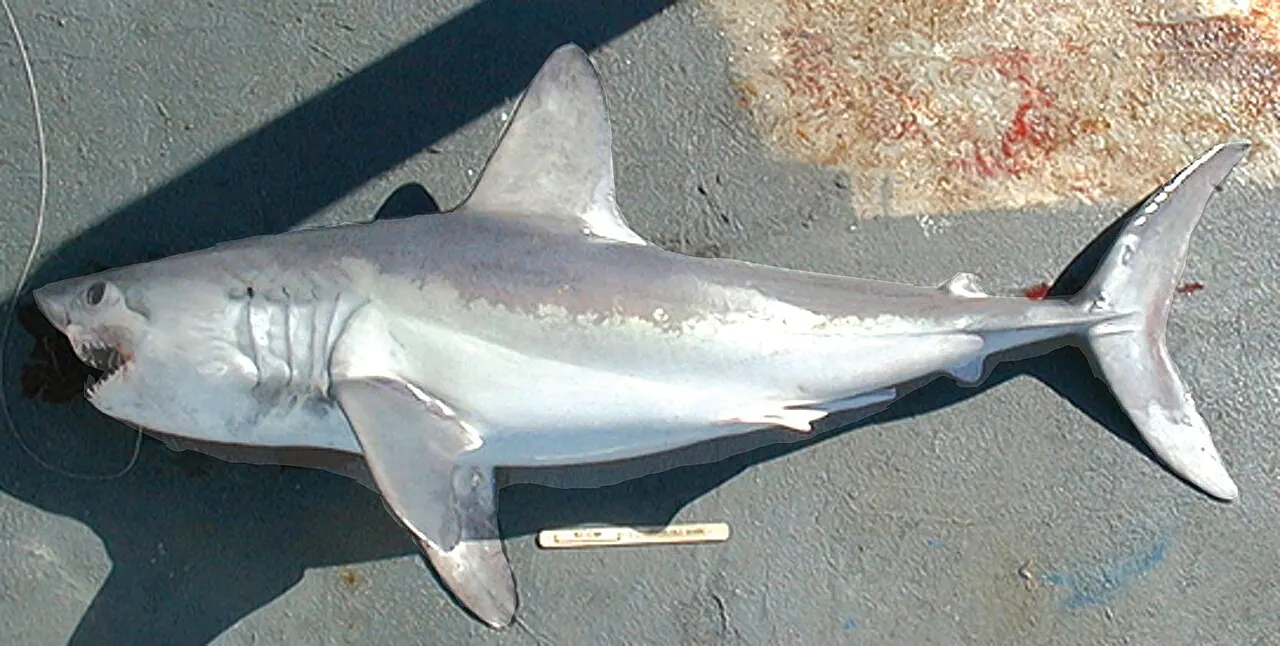
Photo: NOAA / Public domain
3 things to know
- A porbeagle can keep its body as much as 7 to 10 °C (12.5 to 18 °F) warmer than the water around it.
- Mature females tagged off eastern Canada swam up to 2,356 km (1,464 mi) to a pupping ground in the Sargasso Sea.
- Litters are usually four pups, which feed on unfertilized eggs inside the mother.
- Scientific name
- Lamna nasus
- Depth
- 0 m – 300 m
0 – 984 ft - Size
- Commonly about 2.4 m (8 ft); up to about 3.5 m (11.5 ft)
- Weight
- Up to about 230 kg (507 lb)
- Lifespan
- At least 26 years in the North Atlantic; probably up to 65 years in the Southern Hemisphere
- Diet
- Schooling fish, squid, small sharks and bottom fish such as cod, hake and haddock
- Where
- Cold temperate waters of the North Atlantic, including the Mediterranean, and a band around the Southern Hemisphere; absent from equatorial seas
- IUCN status
- Vulnerable
- Depth zones
- Sunlight · Twilight
Stout and spindle-shaped, the porbeagle has a sharp, conical snout, large black eyes and a crescent tail with a short second keel at its base. It is dark gray above and white below, and the rear tip of its first dorsal fin is abruptly white. Adults are commonly about 2.4 meters (8 feet) long and can reach about 3.5 meters (11.5 feet) and 230 kilograms (507 pounds), and females grow larger than males.
It is a shark of cold water, found across the North Atlantic, including the Mediterranean, and in a band around the Southern Hemisphere, but not in equatorial seas. In the Northwest Atlantic it is mostly found in water of 5 to 10 °C (41 to 50 °F), and FishBase describes that stock moving between Newfoundland and Massachusetts with the seasons. Porbeagles usually stay in the top 300 meters (980 feet), where they hunt schooling fish, squid, other small sharks and bottom fish such as cod, hake and haddock. Porbeagles tagged off southern England have been caught again in northern Norway, 2,370 kilometers (1,470 miles) away.
Like the great white and the makos, the porbeagle belongs to the mackerel shark family, whose members have networks of blood vessels that hold in heat made by their muscles. The Florida Museum of Natural History says porbeagles can keep their bodies as much as 7 to 10 °C (12.5 to 18 °F) warmer than the water around them, and FishBase calls the porbeagle one of the most cold-tolerant sharks.
For a long time nobody knew where porbeagles gave birth. Steven Campana and colleagues fitted pop-up satellite tags to 21 porbeagles off eastern Canada. Males and young sharks mostly stayed on the continental shelf, but mature females swam up to 2,356 kilometers (1,464 miles) through the winter, as deep as 1,360 meters (4,460 feet) beneath the Gulf Stream, to the Sargasso Sea. In 2010 the team described it as a subtropical pupping ground far south of the species' known range, in international waters that are largely unregulated. Litters are usually four pups, which feed on unfertilized eggs in the womb, and in the Northwest Atlantic females first mature at about 13 years.
Porbeagles have long been fished for their meat, which is said to taste like swordfish, and for their fins. The IUCN lists the species as Vulnerable, with a decreasing population, in an assessment from 2018.



