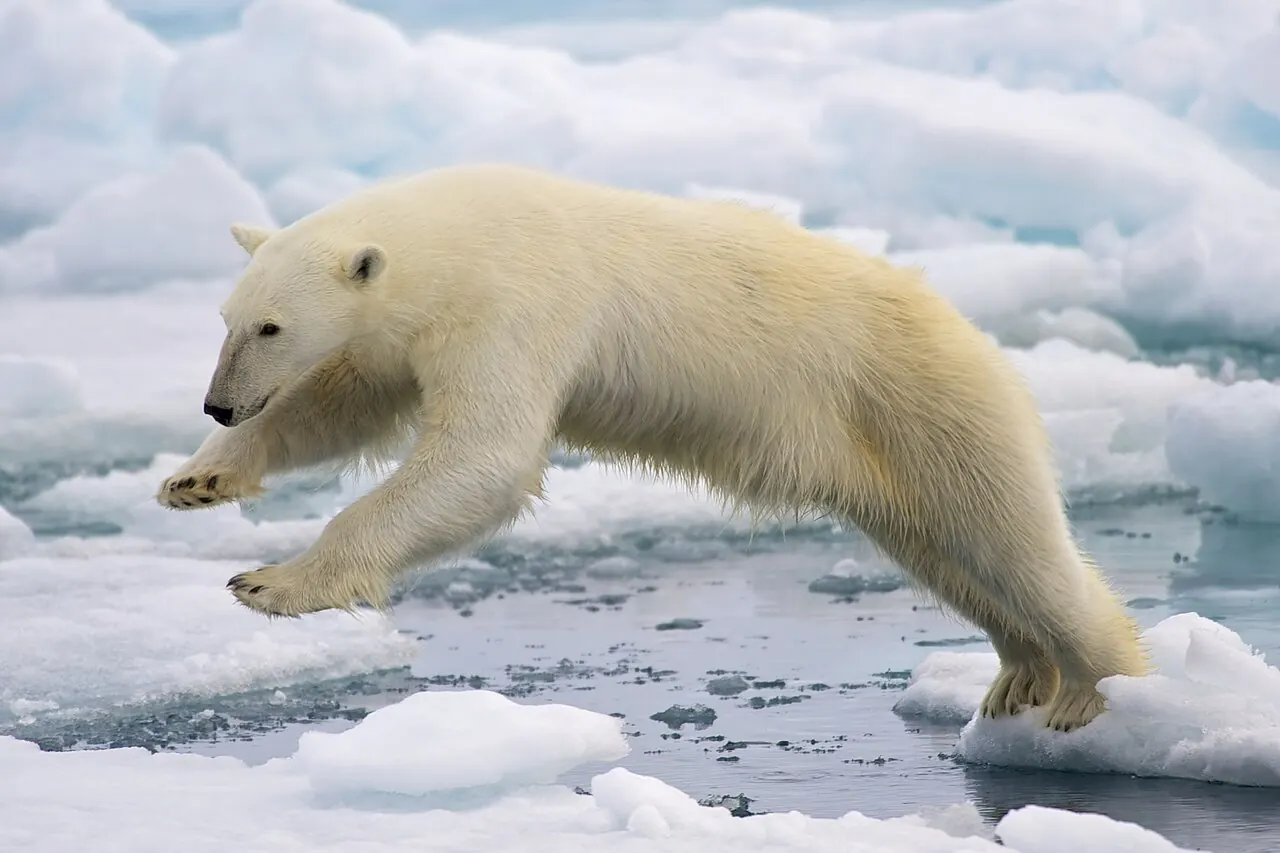
Polar Bear
Ursus maritimus
The sea-ice bear of the Arctic, a strong swimmer that hunts seals from the ice and is listed as threatened as that ice shrinks.
Photo: Arturo de Frias Marques / CC BY-SA 4.0
3 things to know
- Its skin is black under the white fur.
- One radio-collared female swam nonstop for 687 km (427 miles) over 9 days.
- Its main prey is the ringed seal, often caught at a breathing hole.
- Scientific name
- Ursus maritimus
- Depth
- 0 m – 5 m
0 – 16 ft - Size
- Males about 2.4–3 m (8–10 ft) long
- Weight
- Males usually 270–545 kg (600–1,200 lb), the largest over 770 kg (1,700 lb); females 180–320 kg (400–700 lb)
- Lifespan
- About 25 years
- Diet
- Mainly ringed seals; also bearded seals, walruses, belugas and carcasses
- Where
- Arctic sea ice and coasts of Canada, Greenland, Norway, Russia and Alaska
- IUCN status
- Vulnerable
- Depth zones
- Sunlight
Polar bears live on the sea ice and hunt from it. Ringed seals are the main prey, caught by waiting at their breathing holes, by stalking seals resting on the ice, or by breaking into the snow dens where seals have their pups. The bears also take bearded seals, walruses and belugas, and scavenge carcasses.
Compared with other bears, a polar bear has a longer neck, a narrower head and smaller ears. Its white or yellowish coat is water-repellent hair over a dense undercoat, with black skin beneath, and its big feet, furred on the soles, help it swim and walk on thin ice. Males usually weigh 270 to 545 kilograms (600 to 1,200 pounds) and measure 2.4 to 3 meters (8 to 10 feet), and the largest top 770 kilograms (1,700 pounds). Females weigh 180 to 320 kilograms (400 to 700 pounds).
They are strong swimmers. In 2008 a radio-collared female in the Beaufort Sea swam nonstop for 687 kilometers (427 miles) over 9 days, then swam and walked another 1,800 kilometers (1,100 miles) across the ice. George Durner of the US Geological Survey and colleagues reported that she lost 22 percent of her body mass and her yearling cub. Diving is more modest. Collars on adult females in the Barents Sea showed most swimming at the surface, with dives to 3 or 4 meters (10 to 13 feet) common and the deepest at 13.9 meters (46 feet).
Polar bears occur all around the Arctic, in 19 recognized populations. Two of them are in Alaska: the Southern Beaufort Sea population, estimated at about 900 bears in 2015 and declining, and the Chukchi Sea population. In 2022 Kristin Laidre and colleagues described a genetically distinct group in Southeast Greenland that hunts from freshwater glacial ice where sea ice is scarce, meeting the criteria for a 20th population.
Bears mate from March through May, and the pregnant female digs a snow den in October or November. Cubs, usually twins, are born in December or January weighing about 0.5 to 0.9 kilograms (1 to 2 pounds) and stay with their mother about two and a half years. Polar bears live about 25 years.
Because the sea ice they depend on is declining, polar bears are listed as threatened under the US Endangered Species Act. They are also protected by the Marine Mammal Protection Act, and the IUCN lists them as Vulnerable.



