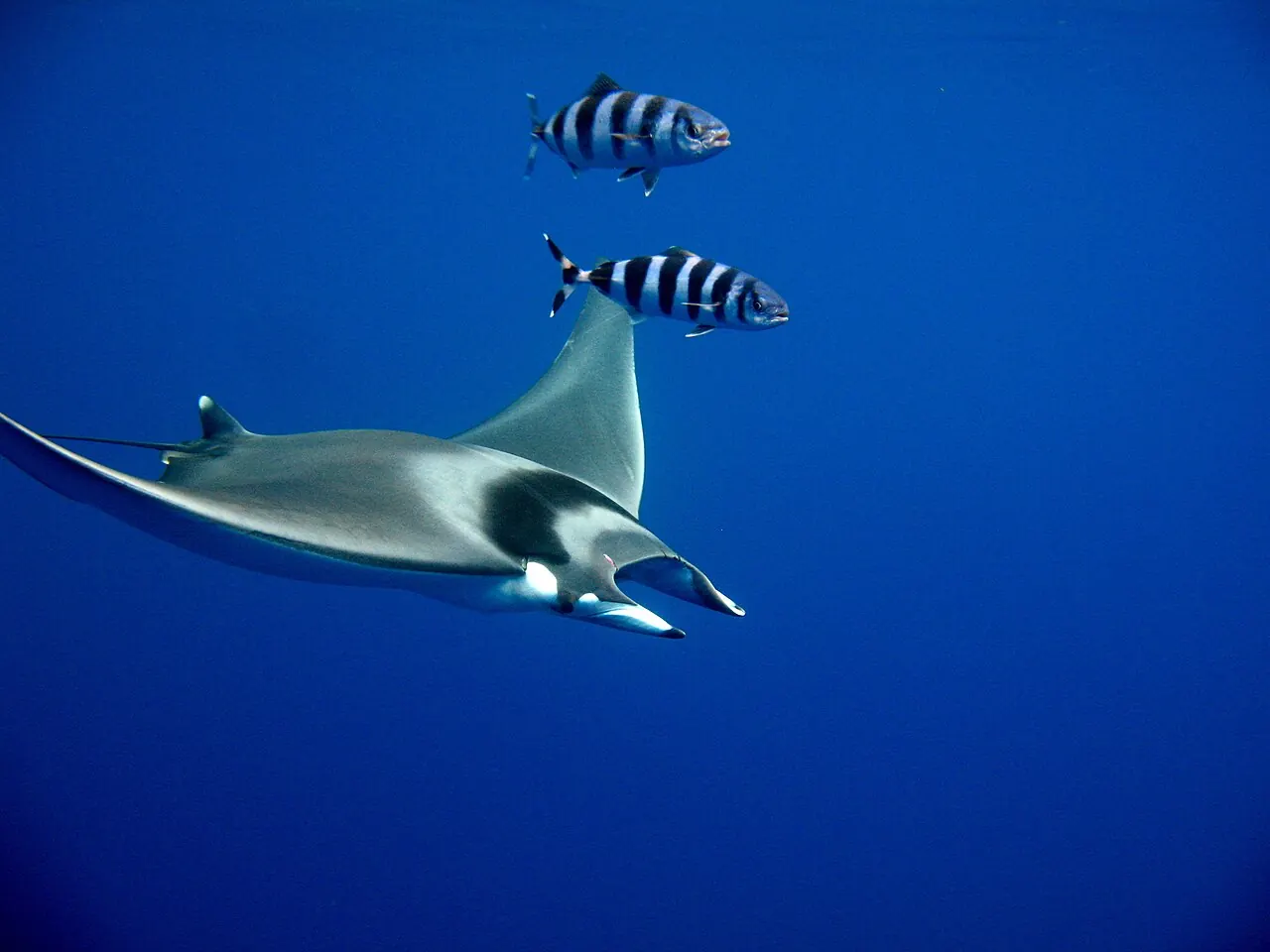
Pilot Fish
Naucrates ductor
A banded open-ocean jack that travels with sharks, rays and turtles and seems to guard its host like a moving territory.
Photo: sarahfaulwetter (iNaturalist) / CC BY 4.0
3 things to know
- Young pilot fish shelter under jellyfish and drifting seaweed.
- When rival pilot fish chase each other, the chaser's black bars can fade away.
- Pilot fish belong to the jack family, Carangidae.
- Scientific name
- Naucrates ductor
- Depth
- 0 m – 300 m
0 – 984 ft - Size
- Up to 70 cm (28 in); usually about 40 cm (16 in)
- Weight
- Not well known
- Lifespan
- Unknown
- Diet
- Scraps from its host's meals, parasites and host droppings; also small fish and invertebrates
- Where
- Tropical and warm seas worldwide; in the western Atlantic from Nova Scotia to Argentina, and in the eastern Pacific from Vancouver Island to Chile
- IUCN status
- Least Concern
- Depth zones
- Sunlight · Twilight
Bold black bars make a pilot fish easy to recognize, even from a distance. The body is bluish to silver, crossed by six or seven broad dark bands, and the tips of the tail are white. It is a member of the jack family and grows to about 70 centimeters (28 inches), though most are around 40 centimeters (16 inches). Pilot fish live in warm seas worldwide, in the open ocean within about 300 meters (980 feet) of the surface, and range along the Americas from Nova Scotia to Argentina and from Vancouver Island to Chile.
FishBase calls the adults' tie to sharks, rays, large bony fish and sea turtles semi-obligate, meaning they usually live with a host, while the young shelter under jellyfish and drifting seaweed. They eat leftovers from their host's meals, parasites and even the host's droppings, along with small fish and invertebrates they catch themselves.
The best close look at that partnership came from under a raft. Near the equator in the central Pacific, from 11 to 13 March 1964, John Magnuson and Reginald Gooding watched through underwater windows in a drifting raft as oceanic whitetip sharks cruised past with one to seven pilot fish each, 8 to 20 centimeters (3 to 8 inches) long. When fish from two sharks mixed, the larger ones chased the smaller, and as they chased, their black bars faded and they turned silvery white with bluish patches on the back. The bars came back when the chase stopped. This never happened when only one shark was present. Writing in Copeia in 1971, the two researchers suggested that pilot fish defend their shark as a moving territory. They never saw the fish eat the many parasites on the sharks, but did see them hunt small fish and zooplankton on their own, and once watched pilot fish chased by a dolphinfish flee to the raft and then to their shark. Protection from predators, they concluded, was probably the biggest benefit.
The IUCN lists the pilot fish as Least Concern, in an assessment from 2013. Its hosts are in more trouble: the oceanic whitetip shark, the one Magnuson and Gooding watched, was listed as threatened under the US Endangered Species Act in 2018.



