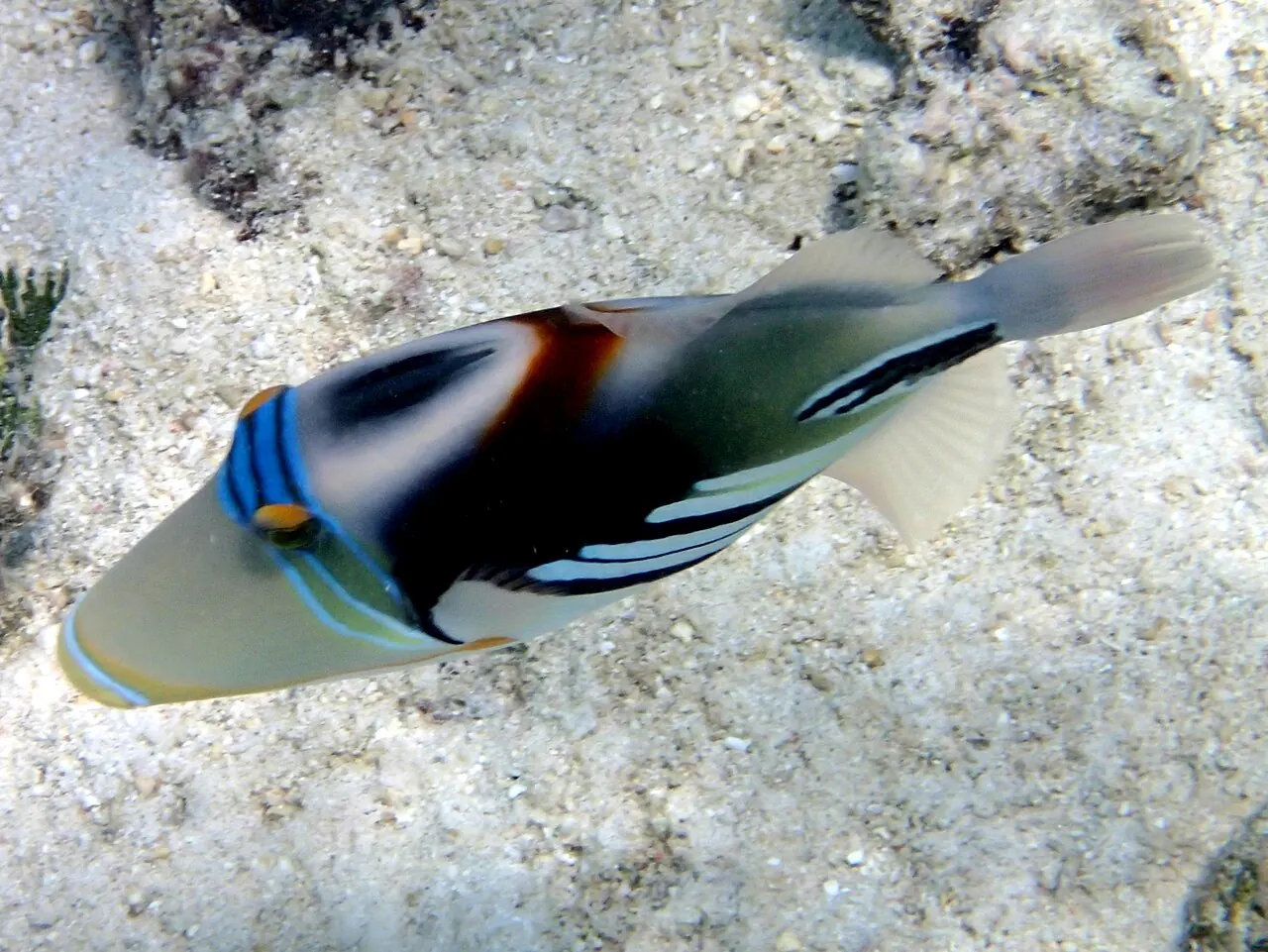
Picasso Triggerfish
Rhinecanthus aculeatus
A shallow-lagoon triggerfish of the Indo-Pacific and Hawaii that drums with its fins and is a common subject of vision research.
Photo: dr.scott.mills / CC BY-SA 2.0
3 things to know
- It makes drum-roll sounds by sweeping its pectoral fins to push bony plates against its swim bladder.
- Females guard the eggs alone.
- It sleeps lying on its side.
- Scientific name
- Rhinecanthus aculeatus
- Depth
- 0 m – 50 m
0 – 164 ft - Size
- Up to about 30 cm (12 in) long; usually about 15 cm (6 in)
- Weight
- Not well known
- Lifespan
- Unknown
- Diet
- Almost anything: algae, detritus, mollusks, crustaceans, worms, sea urchins, small fishes, corals, tunicates and eggs
- Where
- Indo-Pacific from East Africa to Hawaii, the Marquesas and the Tuamotus, north to southern Japan
- IUCN status
- Least Concern
- Depth zones
- Sunlight
Shallow, protected lagoons and reef flats are the home ground of the Picasso triggerfish, a fish up to 30 centimeters (12 inches) long, though most are about half that. It ranges across the Indo-Pacific from East Africa to the Hawaiian, Marquesas and Tuamotu islands and north to southern Japan, from the surface to about 50 meters (165 feet). In Hawaii it lives alongside a relative in the same genus, the reef triggerfish (Rhinecanthus rectangulus), which is the official state fish. FishBase calls the Picasso triggerfish the white-banded triggerfish, and it also goes by lagoon triggerfish and blackbar triggerfish.
It eats almost anything it can find: algae, detritus, mollusks, crustaceans, worms, sea urchins, small fishes, corals, tunicates and eggs. Juveniles keep to patches of rubble, while adults swim in the open but tend to be shy. The fish is territorial, sleeps lying on its side, and makes a whirring noise when alarmed.
Its sounds have been studied closely. In 2017 Eric Parmentier and colleagues described the triggerfish's sounds as short drum rolls, averaging 85 milliseconds. The sounds are made as the left and right pectoral fins sweep back and forth in turn, pushing a set of three bony plates, called scutes, against the wall of the swim bladder. High-speed video showed that each pulse of sound comes from the plates buckling inward and then springing back. The team suggested that many other triggerfishes probably make sound the same way, since they have the same plates.
The species has also become a workhorse for vision research, used in many behavioral studies of how fish see and find their way. A 2022 study led by Karen Cheney mapped its visual genes and found at least nine cone opsin genes, the light-sensitive proteins of color vision, though only five were switched on. In behavioral tests the fish resolved finer detail in black-and-white patterns than in colored ones, and both measures were about twice as high as earlier reports.
Breeding falls mostly on the females. FishBase describes a mating system in which a male usually has several female partners, while the females hold territories and alone tend and guard the eggs. The IUCN lists the species as Least Concern, from a 2022 assessment.
Sources
- fishbase.se/summary/Rhinecanthus-aculeatus.html
- fishbase.se/ComNames/CommonNamesList.php
- Study: doi:10.1242/jeb.146514
- Study: doi:10.1242/jeb.243907
- data.capitol.hawaii.gov/hrscurrent/Vol01_Ch0001-0042F/HRS0005/HRS_0005-0011_0005.htm
- commons.wikimedia.org/wiki/File:Rhinecanthus_aculeatus_-_Picasso_triggerfish_(110065547…



