Sunlight Zone · 0–200 m
The Shrimp That Punches So Fast the Water Around It Tears Apart
The peacock mantis shrimp strikes faster than almost anything in nature, and every punch lands twice.
Odontodactylus scyllarus
A brightly colored reef crustacean with one of the fastest, hardest-hitting strikes in nature.
Photo: Diego Delso / CC BY-SA 4.0
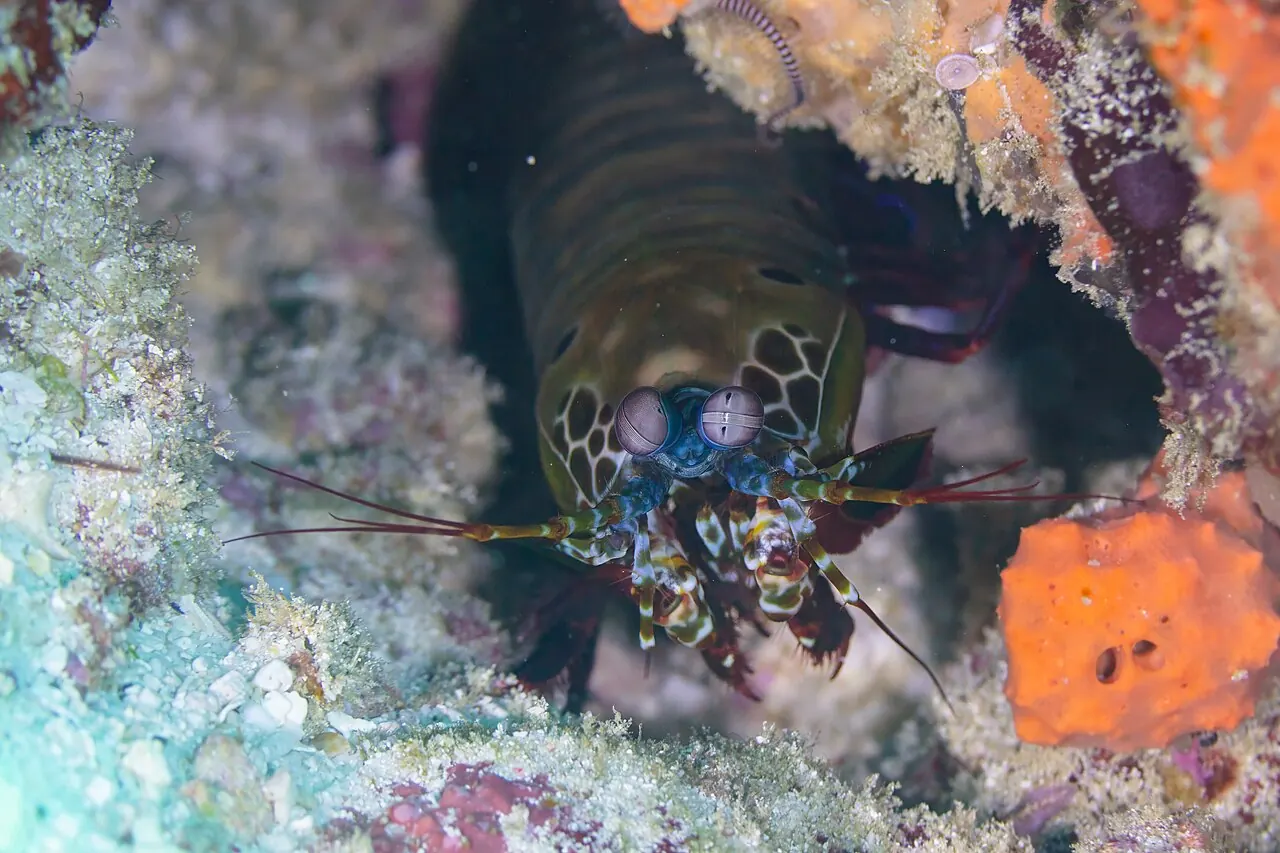
The peacock mantis shrimp is a stomatopod, one of several hundred species of mantis shrimp, and one of the most brightly colored. Its body is olive or green, with orange antennal scales, red striking limbs, red bristles on the tail fan, and leopard-like spots along the sides of the carapace. Males are brighter than females. Adults measure 3 to 18 centimeters (1 to 7 inches).
It lives on sand, gravel and shell bottoms near coral reefs across the Indo-Pacific, from East Africa to the Mariana Islands, 3 to 40 meters (10 to 130 feet) down and most often at 10 to 30 meters. It builds a U-shaped burrow, often at the base of a coral, and keeps digging new ones and abandoning old ones. It hunts by day and by night, taking snails, clams and scallops, though crabs are its preferred prey.
It is a smasher, and its clubs are spring-loaded. In 2004, Sheila Patek and colleagues at UC Berkeley filmed strikes with a high-speed camera the BBC rented for them and measured the club moving at up to 23 meters per second (about 50 miles per hour), with accelerations up to 8,000 times gravity, driven by a saddle-shaped spring in the exoskeleton. A year later Patek and Roy Caldwell had shrimp hit a force sensor and found that each strike produces two force peaks less than half a thousandth of a second apart: the club hitting at 400 to 1,501 newtons, then the collapse of vapor bubbles created by the swing. In aquariums, the largest animals can chip or break the glass.
Its stalked compound eyes pick up ultraviolet and polarized light as well as color, and some mantis shrimp have 12 types of color receptor. In tests published in 2014, Hanne Thoen and colleagues at the University of Queensland found the animals surprisingly poor at telling similar colors apart, and suggested they recognize colors by scanning their eyes across a scene.
Pairs are usually monogamous and are thought to breed all year, most often in the warmer months. The female holds her mass of eggs in her front limbs inside the burrow, cleaning and aerating it, and does not usually eat until the eggs hatch. Peacock mantis shrimp are reported to live 4 to 6 years in the wild, and the IUCN has not evaluated the species.



