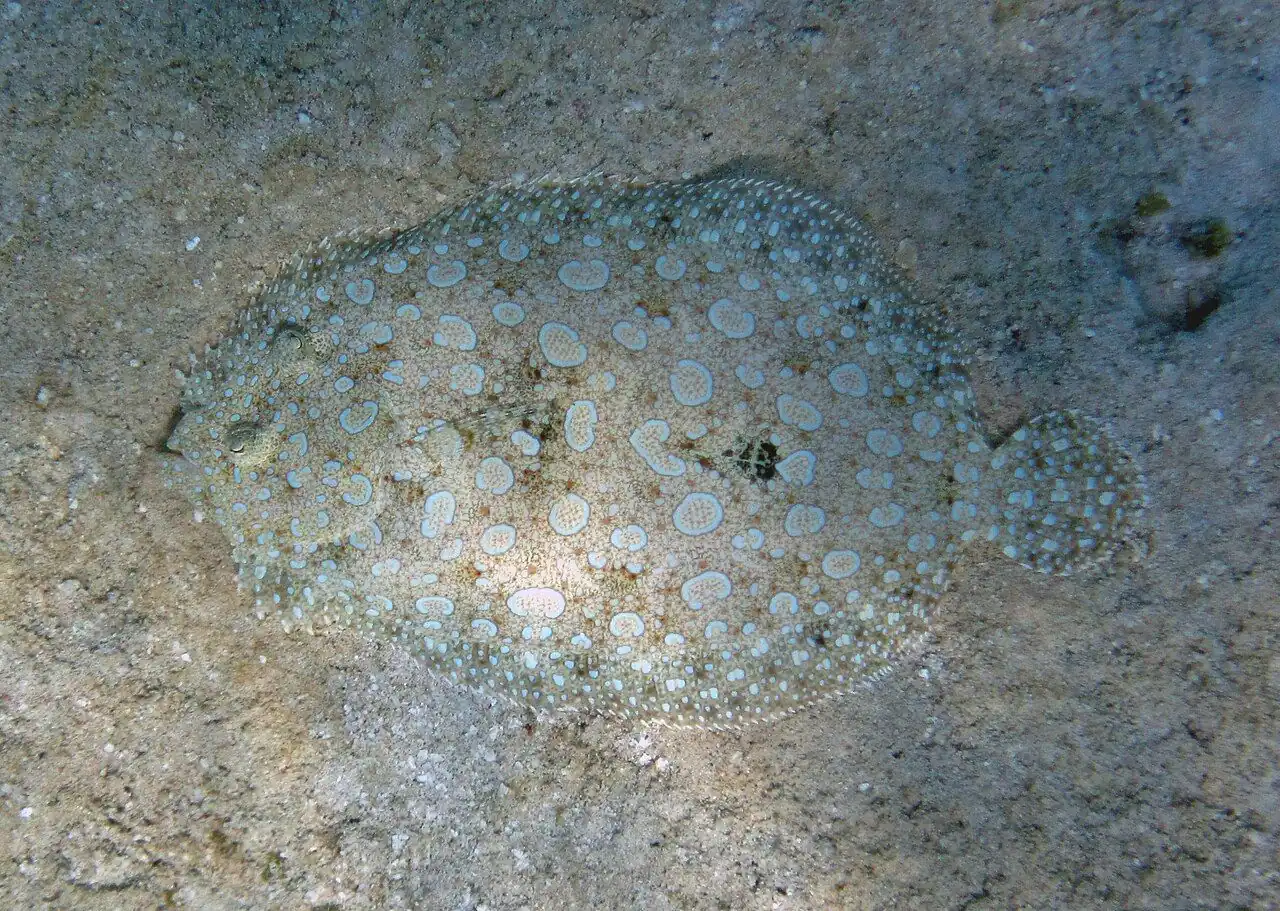
Peacock Flounder
Bothus lunatus
A reef flatfish covered in pale blue rings, with both eyes on one side of its head and a body that fades into the sand.
Photo: James St. John / CC BY 2.0
3 things to know
- Both eyes sit on the left side of its head, because the right eye migrates across as the young fish grows.
- It is the most common flounder around coral reefs in its range.
- Males defend territories that hold several females, about six on average.
- Scientific name
- Bothus lunatus
- Depth
- 0 m – 20 m
0 – 66 ft - Size
- Up to 46 cm (18 in); more commonly about 35 cm (14 in)
- Weight
- Unknown
- Lifespan
- Unknown
- Diet
- Mainly small fishes, plus crustaceans and octopuses
- Where
- Western Atlantic from Florida, Bermuda and the Bahamas to Brazil (not in the Gulf of Mexico); in the eastern Atlantic at Ascension Island and in the Gulf of Guinea
- IUCN status
- Least Concern
- Depth zones
- Sunlight
Lying on the sand, a peacock flounder is a gray to brown disk covered in circles, curved spots and dots of light blue, with two or three large, blurry dark spots along the middle of its side. Both eyes sit on its upper, left side. Like every flounder it hatches as an ordinary-looking fish with an eye on each side of its head, and as it grows its right eye travels over to join the left. The Florida Museum notes that the eyes are set wide apart, wider still in males, and that males carry a strong spine on the snout where females have a bony knob.
It lives in the western Atlantic from Florida, Bermuda and the Bahamas south to Brazil, but not in the Gulf of Mexico, and across the ocean at Ascension Island and in the Gulf of Guinea. FishBase calls it the most common flounder around coral reefs. It settles on clear sand near mangroves, in seagrass and among coral and rubble, usually no deeper than 20 meters (66 feet), though it has been found to 100 meters (330 feet). It grows to 46 centimeters (18 inches).
It often rests on the bottom, sometimes partly buried, waiting for small fish to come within reach, and it also eats crustaceans and octopuses. To move, it ripples its fins and glides just above the bottom. Its colors can change quickly to match the ground underneath. The Florida Museum notes that a flounder that is blind, or has a damaged eye, has trouble doing this, because it cannot see its background.
Members of its genus can change in seconds. In a 1996 paper in Nature, V.S. Ramachandran and colleagues showed that a close relative, the eyed flounder, Bothus ocellatus, matched a wide range of background textures in just 2 to 8 seconds by adjusting the contrast of different sets of blotches on its skin.
Peacock flounders live in harems. According to Animal Diversity Web, each male holds a territory that does not overlap with other males' and mates with about six females on average. Mating starts just before dusk: a pair approaches with pectoral fins raised, the male slides under the female, and the two rise off the bottom together, release eggs and sperm, and drop back down. The IUCN lists the species as Least Concern, from a 2012 assessment.
Sources
- fishbase.se/summary/Bothus-lunatus.html
- floridamuseum.ufl.edu/discover-fish/species-profiles/peacock-flounder
- animaldiversity.org/accounts/Bothus_lunatus
- Study: doi:10.1038/379815a0
- iucnredlist.org/species/190102/16510777
- commons.wikimedia.org/wiki/File:Bothus_lunatus_(peacock_flounder)_(San_Salvador_Island,…



