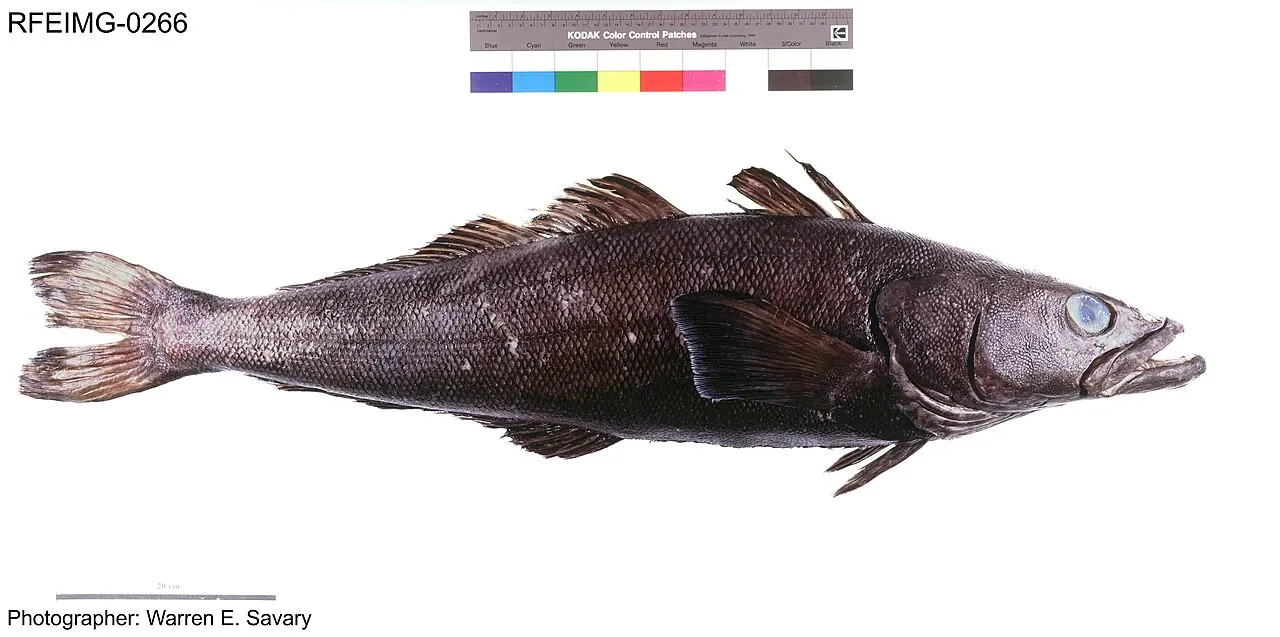
Patagonian Toothfish
Dissostichus eleginoides
A big, slow-growing Southern Ocean fish sold in the US as Chilean seabass, once so heavily poached that illegal catches outweighed legal ones.
Photo: U.S. Food and Drug Administration / Public domain
3 things to know
- In the US it is commonly marketed as Chilean seabass.
- Unlike its close relative the Antarctic toothfish, it has no antifreeze proteins in its blood, because it lives in warmer water.
- In 1997-98 the estimated illegal catch, about 32,000 tonnes, was nearly three times the legal catch.
- Scientific name
- Dissostichus eleginoides
- Depth
- 70 m – 1,500 m
230 – 4,922 ft - Size
- Commonly about 70 cm (28 in); up to about 2 m (6.6 ft), and FishBase lists 215 cm (7 ft)
- Weight
- Up to about 100 kg (220 lb), per the Australian Antarctic Division; Australia's fisheries agency gives up to 200 kg (440 lb)
- Lifespan
- Australian agencies give 45 to 50 years; FishBase's oldest reported Patagonian toothfish was 31
- Diet
- Squid and small fish in midwater; fish, crabs and prawns on the bottom
- Where
- Sub-Antarctic waters: southern Chile and Argentina, the Falkland Islands, South Georgia, Macquarie Island, and sub-Antarctic islands and seamounts in the Indian Ocean sector
- IUCN status
- Not Evaluated
- Depth zones
- Sunlight · Twilight · Midnight
On US menus and fish counters, Patagonian toothfish often goes by another name. A 2024 federal rule describes toothfish as commonly marketed as Chilean seabass, though the fish belongs to the family Nototheniidae, not to any bass family. It is big: according to the Australian Antarctic Division, toothfish can reach about 2 meters (6.6 feet) and 100 kilograms (220 pounds).
It lives in sub-Antarctic waters, on the shelves around islands and undersea banks, from southern Chile and Argentina to the Falklands, South Georgia, Macquarie Island and islands in the Indian Ocean sector. FishBase gives a usual depth of 70 to 1,500 meters (230 to 4,920 feet). According to FishBase, young fish drift in midwater, settle on the bottom at 150 to 400 meters (490 to 1,310 feet), and move deeper than 1,000 meters (3,280 feet) as adults. Toothfish feed on squid and small fish in midwater and on fish, crabs and prawns near the seafloor. Its close relative the Antarctic toothfish lives farther south and carries antifreeze proteins in its blood; the Patagonian toothfish lacks them, because its water is warmer.
Growth is slow. The Australian Antarctic Division says toothfish mature at 70 to 95 centimeters, when they are 8 to 10 years old. It gives a lifespan of up to 45 years, and Australia's fisheries agency up to 50. Their eggs and larvae drift near the surface. Elephant seals, sperm whales and killer whales eat them, and killer whales have been filmed taking toothfish off longlines around Crozet Island.
A fish this valuable drew illegal fishing. The Commission for the Conservation of Antarctic Marine Living Resources (CCAMLR) says toothfish are sometimes called white gold. According to the Australian Antarctic Division, about 11,000 metric tons were caught legally in the CCAMLR area in the 1997-98 season while the illegal catch was estimated at 32,000 metric tons, and in some areas stocks dropped sharply. Enforcement by countries such as Australia and France has since pushed illegal fishing to near zero in waters under national jurisdiction, the division says, though it persists elsewhere. Licensed boats now set bottom longlines at 1,200 to 1,800 meters (3,940 to 5,910 feet) under catch limits reviewed every year.
The United States takes part in CCAMLR's catch documentation scheme, which tracks toothfish from harvest through trade, and frozen toothfish cannot be imported without a NOAA Fisheries preapproval certificate. The IUCN has not assessed the species.
Sources
- fishbase.se/summary/Dissostichus-eleginoides.html
- antarctica.gov.au/about-antarctica/animals/fish
- afma.gov.au/species/toothfish
- ccamlr.org/en/fisheries/toothfish-fisheries
- govinfo.gov/content/pkg/FR-2024-03-21/pdf/2024-05936.pdf
- api.gbif.org/v1/species/2385957/iucnRedListCategory
- commons.wikimedia.org/wiki/File:Dissostichus_eleginoides_(RFEIMG-0266).jpg



