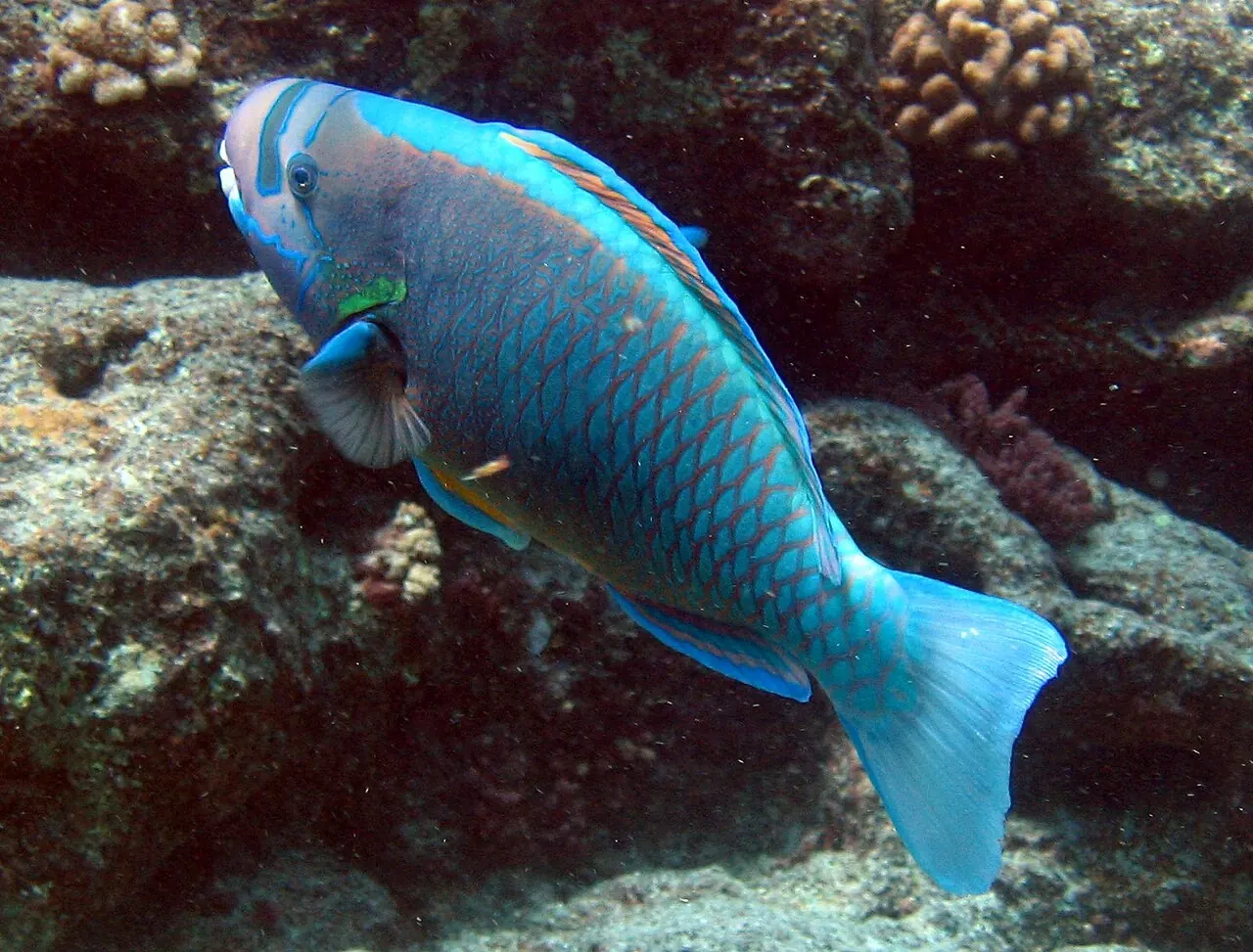
Parrotfish
Scaridae
Beaked reef fish that scrape algae off dead coral, grind the rock in their throats and pass it as fine white sand.
Photo: Dr. Dwayne Meadows, NOAA/NMFS/OPR / Public domain
3 things to know
- Their teeth are fused into a hard, bird-like beak.
- One large Hawaiian parrotfish can wear away up to 380 kg (838 lb) of reef a year.
- Some species sleep inside a cocoon of mucus that protects them from blood-feeding parasites.
- Scientific name
- Scaridae
- Depth
- 0 m – 45 m
0 – 148 ft - Size
- Varies by species; Hawaii's two large parrotfishes reach about 60–70 cm (2–2.3 ft), the bumphead parrotfish up to 130 cm (4.3 ft)
- Weight
- Varies by species; up to 7 kg (15 lb) for the spectacled parrotfish, 46 kg (101 lb) for the bumphead
- Lifespan
- Varies; the redlip parrotfish has a reported maximum age of 20 years
- Diet
- Algae scraped off dead coral and rock, swallowed along with bits of the rock
- Where
- Tropical coral reefs of the Atlantic, Indian and Pacific oceans
- IUCN status
- Varies by species (bumphead parrotfish Vulnerable; Hawaii's spectacled and redlip parrotfishes Least Concern)
- Depth zones
- Sunlight
A parrotfish's teeth are fused into a hard, bird-like beak that scrapes algae off dead coral, and each bite takes a little limestone with it. A second set of teeth sits in the throat, where it grinds the rock down. The fish digests the food and passes the rest as fine white sand.
They live on tropical reefs around the world, from the striped parrotfish of the Bahamas to the bumphead parrotfish of the Indo-Pacific, mostly in clear lagoons and on seaward reefs from the shallows down to about 45 meters (150 feet). Sizes vary widely. Hawaii's spectacled parrotfish grows to about 61 centimeters (2 feet) and 7 kilograms (15 pounds), the redlip parrotfish to about 70 centimeters, and the bumphead, the largest of the group, to 130 centimeters (4.3 feet) and 46 kilograms (101 pounds). The bumphead sometimes rams corals with its head while feeding.
Many parrotfishes change sex. Both Hawaiian species studied for reef erosion start breeding life as females, and the biggest can become males; FishBase records the redlip parrotfish changing sex at about 37 centimeters and 13 years old, and lists a maximum age of 20 years. At night some species wrap themselves in a cocoon of mucus. In a 2011 study, Alexandra Grutter and colleagues found that parrotfish in cocoons were attacked less by gnathiid isopods, small blood-feeding crustaceans, than fish without them.
Status depends on the species. The bumphead parrotfish is listed as Vulnerable, and FishBase notes assessments showing how easily it is overfished, while Hawaii's spectacled and redlip parrotfishes are Least Concern. In Hawaii, where parrotfish are called uhu, Maui has limited each person to two a day since November 2014, citing falling numbers on its nearshore reefs.
In Hawaii, Ling Ong and Kim Holland calculated in 2010 that the biggest redlip parrotfish can each wear away up to 380 kilograms (838 pounds) of reef a year. In the Maldives, a team led by Chris Perry of the University of Exeter estimated in 2015 that parrotfish make more than 85 percent of the new sand-sized grains on the outer reef flat around one small island, sand that helps keep the island supplied.
Sources
- fishbase.se/summary/Chlorurus-perspicillatus.html
- fishbase.se/summary/Scarus-rubroviolaceus.html
- fishbase.se/summary/Bolbometopon-muricatum.html
- pbs.org/wgbh/nova/nature/beaches-fish-poo.html
- Study: doi:10.1098/rsbl.2010.0916
- Study: doi:10.1007/s00227-010-1411-y
- marineinfo.org/id/publication/256537
- Study: doi:10.1130/G36623.1
- nas.er.usgs.gov/queries/FactSheet.aspx
- news-archive.exeter.ac.uk/2015/april/title_448166_en.html
- dlnr.hawaii.gov/blog/2014/10/30/nr14-135



