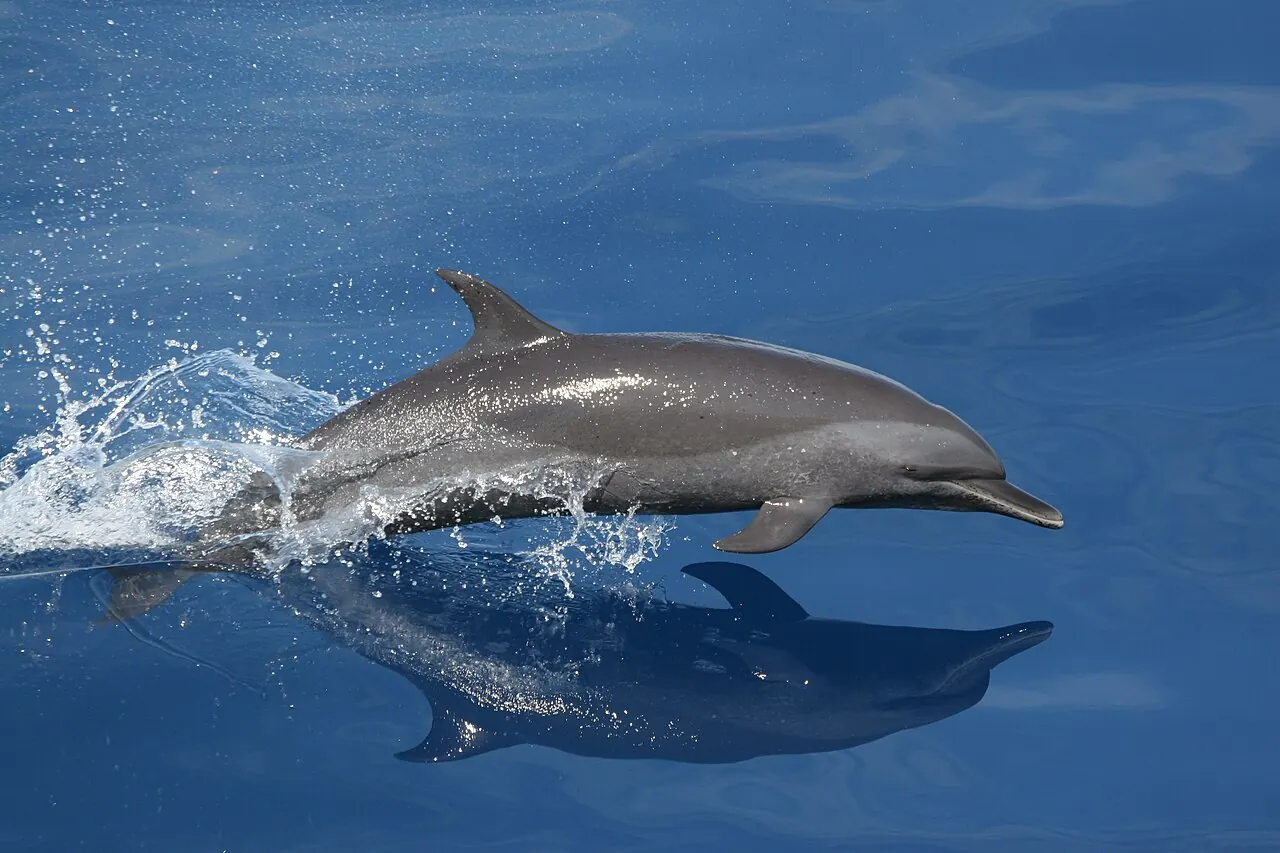
Pantropical Spotted Dolphin
Stenella attenuata
A small tropical dolphin whose link with tuna schools led to the US dolphin-safe label, and which hunts deeper after dark.
Photo: NOAA Photo Library / Public domain
3 things to know
- Calves are born without spots, and adults can end up almost covered in them.
- Groups often number several hundred to 1,000 dolphins.
- Off Maui, tagged dolphins dived deeper at night, down to 213 m (699 ft).
- Scientific name
- Stenella attenuata
- Depth
- 0 m – 60 m
0 – 197 ft - Size
- About 1.8–2.1 m (6–7 ft) long
- Weight
- About 113 kg (250 lb)
- Lifespan
- Up to 46 years
- Diet
- Mainly squid and fish from the twilight zone
- Where
- Tropical and subtropical waters of all oceans
- IUCN status
- Least Concern
- Depth zones
- Sunlight
In the eastern tropical Pacific, tuna gather beneath groups of pantropical spotted dolphins far offshore. Purse-seine crews learned to encircle the dolphins to catch the fish below, and the dolphins caught as bycatch depleted the population. That northeastern offshore stock is still listed as depleted under the Marine Mammal Protection Act. The United States passed the Dolphin Protection Consumer Information Act in 1990, which sets the rules for the "dolphin-safe" label on tuna. A 2007 analysis by Paul Wade and colleagues found the stock had not recovered as expected, and their data gave equal support to two explanations: hidden effects of the fishery beyond the deaths observers counted, and changes in the ecosystem.
They are born without spots and collect them with age, until adults can be almost completely covered in overlapping spots. Other marks to look for are a long, slender beak with a white tip and a dark cape that runs from the head to about halfway between the dorsal fin and the tail. Adults are fairly small, about 1.8 to 2.1 meters (6 to 7 feet) long and about 113 kilograms (250 pounds).
The species lives in tropical and subtropical water in every ocean. In US waters it is common around Hawaii, where genetically distinct populations live off Hawaii Island, Maui Nui and Oahu, and it also turns up in deep offshore water of the Gulf of Mexico and the western Atlantic. Groups often number several hundred to 1,000 animals.
They feed mainly on squid and fish of the twilight zone. In 1999 Robin Baird and colleagues attached suction-cup depth recorders to six of these dolphins near Maui and Lanai. Daytime dives averaged about 13 meters (42 feet), while night dives averaged 57 meters (187 feet) and reached 213 meters (699 feet), which suggests the dolphins feed mostly at night on animals of the deep scattering layer as it rises toward the surface.
They mature around age 11, and females give birth after about 11 months of pregnancy, every 2.5 to 4 years. The oldest known lived to 46. Across its whole range the species is listed as Least Concern by the IUCN; it is also hunted for food in parts of Asia and the Pacific.



