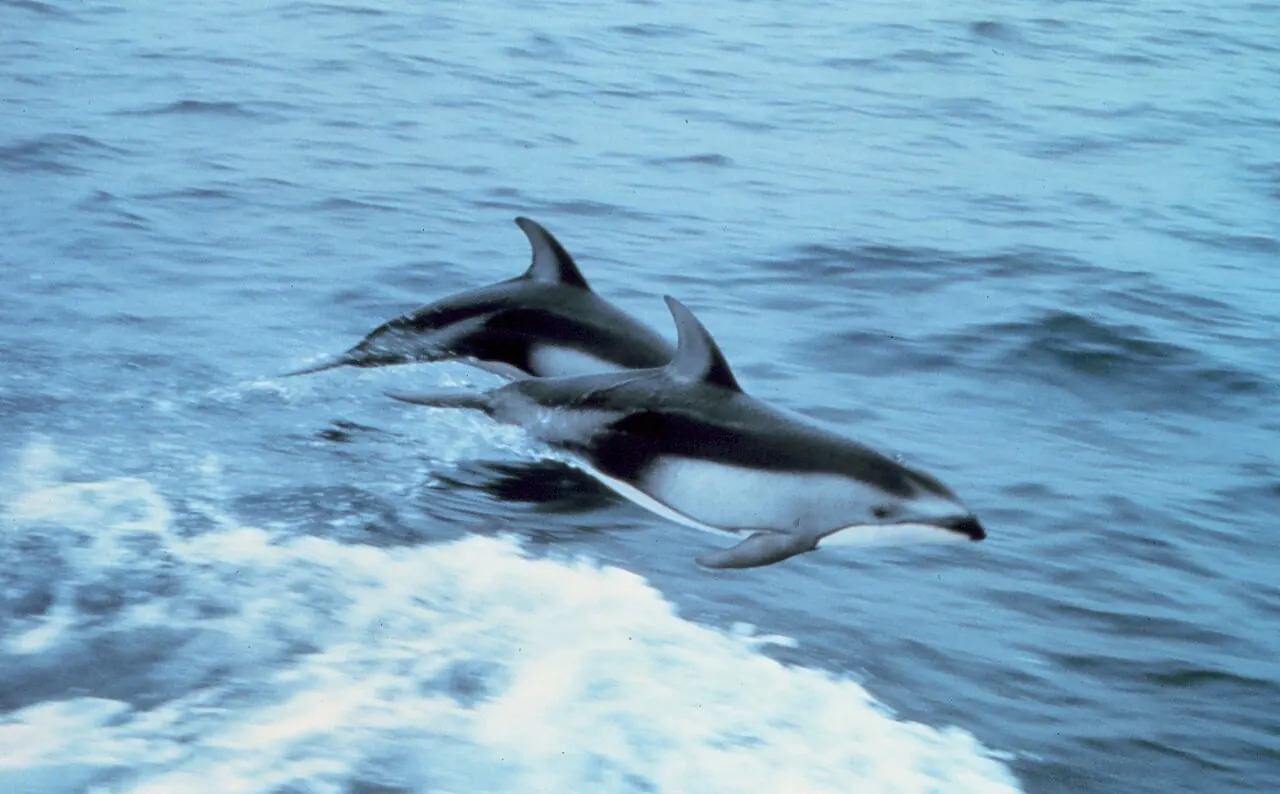
Pacific White-sided Dolphin
Aethalodelphis obliquidens
An acrobatic, hook-finned dolphin of the North Pacific that hunts alongside salmon-eating killer whales off British Columbia.
Photo: Captain Budd Christman, NOAA Corps / Public domain
3 things to know
- Its large, curved dorsal fin earned it the nickname hookfin porpoise.
- Each adult eats about 9 kg (20 lb) of food a day.
- In 2025 it was moved to a new genus, Aethalodelphis, meaning sooty or dusky dolphin.
- Scientific name
- Aethalodelphis obliquidens
- Depth
- 0 m – 100 m
0 – 328 ft - Size
- About 1.7–2.4 m (5.5–8 ft) long
- Weight
- About 135–180 kg (300–400 lb)
- Lifespan
- About 36–40 years; some live more than 40
- Diet
- Squid and small schooling fish such as capelin, sardines, herring and anchovies
- Where
- Temperate North Pacific, from California to the Bering Sea and across to Japan
- IUCN status
- Least Concern
- Depth zones
- Sunlight
A large, strongly curved dorsal fin earned the Pacific white-sided dolphin the nickname "hookfin porpoise," though it is not a porpoise. It has a robust body and a short snout. The back, flukes and lips are black, the sides, fin and flippers gray, and the belly white, with a pale stripe running along each side toward the tail. NOAA Fisheries gives adults a length of 1.7 to 2.4 meters (5.5 to 8 feet) and a weight of 135 to 180 kilograms (300 to 400 pounds).
These dolphins live in temperate waters across the North Pacific, off California, Oregon, Washington and Alaska and west to the Bering Sea, the Sea of Okhotsk and the seas around Japan. Most stay offshore, but some use inland waterways in British Columbia and southeast Alaska. Groups usually number 10 to 100 and sometimes thousands, and they bow-ride, leap and somersault. Each adult eats about 9 kilograms (20 pounds) a day of squid and small schooling fish, swallowing them head first, and groups work together to herd fish.
The species got a new scientific name in 2025. Using more than 3,000 nuclear genes, Anders Galatius and colleagues showed that it and the dusky dolphin of the Southern Hemisphere form their own branch, and they named a new genus for the pair, Aethalodelphis, meaning sooty or dusky dolphin. The Society for Marine Mammalogy's species list and the IUCN Red List use the new name, but the World Register of Marine Species still lists it as Sagmatias obliquidens, and older sources call it Lagenorhynchus obliquidens.
Off northern Vancouver Island in August 2020, Sarah Fortune, Andrew Trites and colleagues tagged fish-eating northern resident killer whales and filmed them from a drone as they hunted Chinook salmon. The whales often traveled with Pacific white-sided dolphins, followed them to depth and echolocated less when the dolphins were near. The hunting dolphins dove deeper than 60 meters (200 feet), though only the whales were heard echolocating below 100 meters (330 feet). The researchers suggested in 2025 that the whales may eavesdrop on the dolphins' sonar to find salmon too big for the dolphins to swallow, while the dolphins scavenge scraps when the whales break a catch apart.
The IUCN's 2018 assessment lists the species as Least Concern, with estimates totaling several hundred thousand. High-seas driftnets for salmon and squid killed thousands a year until those fisheries ended in the early 1990s.
Sources
- fisheries.noaa.gov/species/pacific-white-sided-dolphin
- iucnredlist.org/species/11145/50361866
- Study: doi:10.1016/j.ympev.2025.108299
- marinemammalscience.org/science-and-publications/list-marine-mammal-species-subspecies
- Study: doi:10.1038/s41598-025-22718-4
- adfg.alaska.gov/index.cfm
- marinespecies.org/aphia.php



