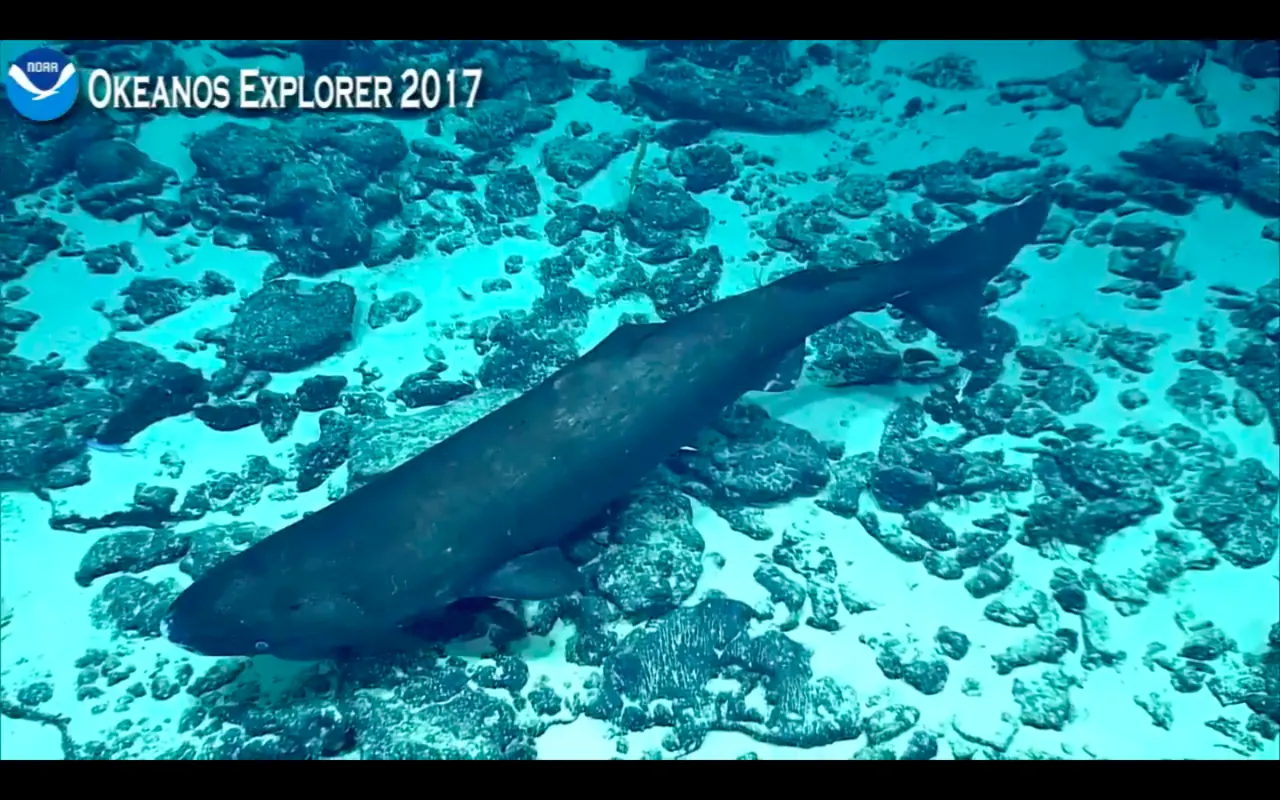
Pacific Sleeper Shark
Somniosus pacificus
A huge, slow-looking cousin of the Greenland shark that roams the cold North Pacific from the surface to at least 2,000 meters down.
Photo: NOAA Okeanos Explorer Program, 2017 CAPSTONE expedition / Public domain
3 things to know
- Camera arrays recorded one about 2,205 m (7,234 ft) deep in the Hawaiian Islands.
- Tagged sleeper sharks in the Gulf of Alaska rose and sank almost nonstop, with a median daily depth range of 184 m (604 ft).
- Its flesh contains a toxin that causes symptoms like drunkenness in people who eat it.
- Scientific name
- Somniosus pacificus
- Depth
- 0 m – 2,000 m
0 – 6,562 ft - Size
- Up to at least 4.4 m (14.4 ft); possibly more than 7 m (23 ft)
- Weight
- Not well known
- Lifespan
- Unknown
- Diet
- Fishes including salmon, octopus and squid, crabs, harbor seals and carrion such as dead whales
- Where
- North Pacific from Taiwan and Japan to the Bering Sea and Gulf of Alaska and south to Baja California; also the Chukchi and Beaufort seas
- IUCN status
- Near Threatened
- Depth zones
- Sunlight · Twilight · Midnight
Sleeper sharks are named for their small fins, which the naturalist Lesueur read as a sign of a sluggish animal. The Pacific sleeper shark belongs to the same genus as the Greenland shark of the North Atlantic, and it grows large: FishBase gives a maximum measured length of 4.4 meters (14.4 feet) and notes that it may pass 7 meters (23 feet).
It lives on continental shelves and slopes from Taiwan and Japan to the Gulf of Alaska and Baja California, and north into the Bering, Chukchi and Beaufort seas. A 2004 paper about one caught off Point Hope, Alaska, was titled "A second species of Arctic shark." At high latitudes it sometimes enters very shallow water, even the intertidal zone. Farther south it may never reach the surface, and it goes down to at least 2,000 meters (6,560 feet). Camera arrays recorded one about 2,205 meters deep in the Hawaiian Islands.
Females are thought to give birth to live young, which measure about 42 centimeters (17 inches) or less. How long the species lives is unknown, but IUCN assessors estimated its generation length at 50 to 75 years. The IUCN's 2019 assessment lists it as Near Threatened.
In a 2006 study, satellite tags fitted to sharks in the Gulf of Alaska by Hulbert, Sigler and Lunsford showed almost constant vertical travel. The sharks spent 61 percent of their time between 150 and 450 meters (490 and 1,480 feet), staying below the reach of sunlight by day and rising toward the surface at night. In a companion study, the team examined 198 stomachs. Fish were the main prey in August and octopus and squid in May. Marine mammals turned up in 15 percent, mostly from whales and other cetaceans, much of it probably scavenged, along with some harbor seals that may have been caught alive.
None of those stomachs held Steller sea lion. Yet in a 2014 study, Markus Horning of Oregon State University and Jo-Ann Mellish of the Alaska SeaLife Center reported that tags from 15 of 36 young sea lions they had implanted showed that all 15 were killed by predators. In three cases a tag was swallowed by a cold-blooded animal and recorded deep-water temperatures until it was regurgitated or passed 5 to 11 days later. The only known cold-blooded sea lion predator with a body core near water temperature is the Pacific sleeper shark.



