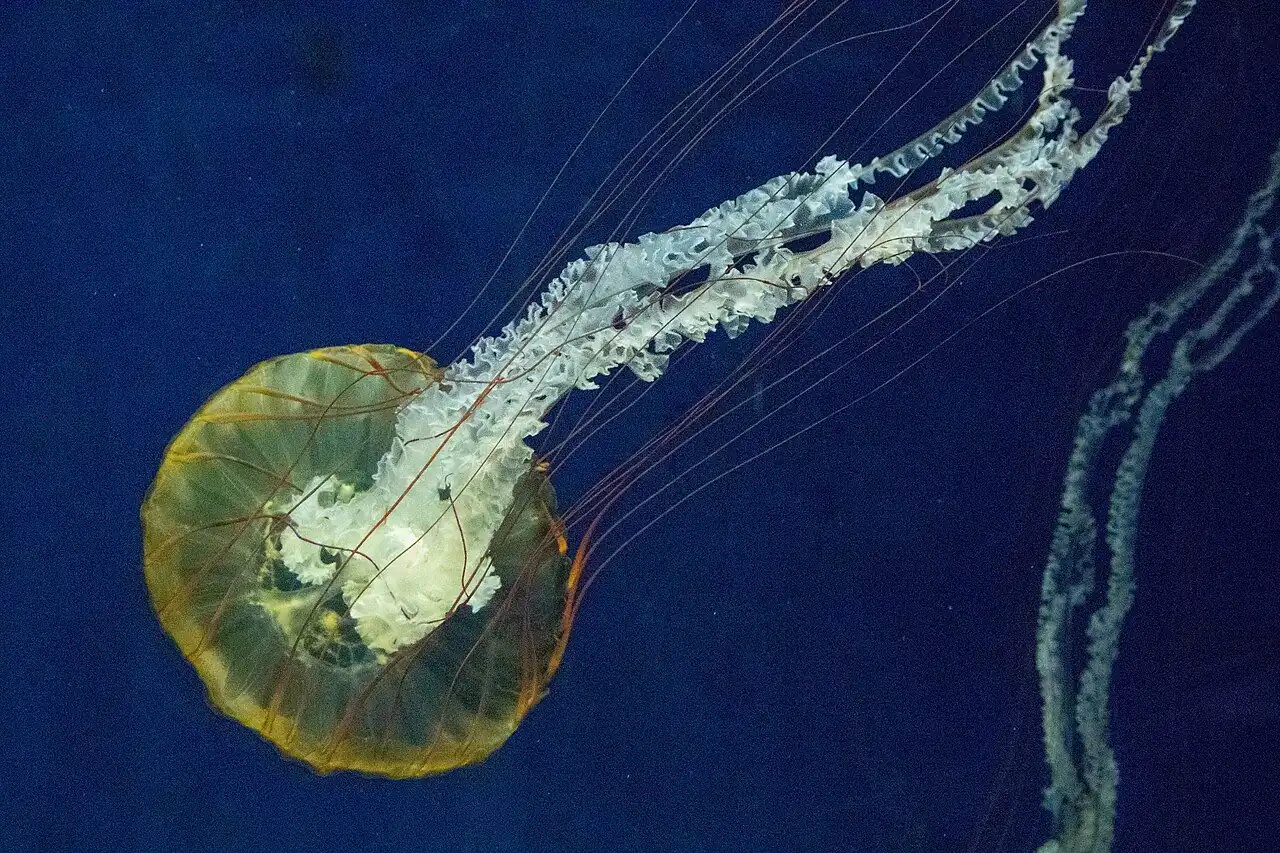
Pacific Sea Nettle
Chrysaora fuscescens
The golden-belled jellyfish of the US West Coast, whose summer swarms feed leatherback turtles and overlap with small fish.
Photo: Σ64 / CC BY 4.0
3 things to know
- Monterey Bay Aquarium gives its trailing mouth-arms as up to 4.6 m (15 ft) long.
- Off Oregon and Washington it is the most abundant large jellyfish.
- NOAA says leatherback turtles cross the Pacific to feed on West Coast jellies, especially this one.
- Scientific name
- Chrysaora fuscescens
- Depth
- 0 m – 200 m
0 – 656 ft - Size
- Bell up to about 30 cm (12 in) across, reported to 45 cm (18 in); mouth-arms up to about 4.6 m (15 ft)
- Weight
- Unknown
- Lifespan
- Usually about 6 months, some up to a year; up to 18 months in aquariums
- Diet
- Zooplankton, fish eggs and larvae, and other jellies
- Where
- Northeastern Pacific from Alaska to Mexico; most common off central California and Oregon
- IUCN status
- Not Evaluated
- Depth zones
- Sunlight
The Pacific sea nettle has an amber bell, darkest near the rim, with about two dozen long brown tentacles hanging from its edge and long, spiraling mouth-arms trailing behind. SeaLifeBase and Walla Walla University's invertebrate guide give a bell up to about 30 centimeters (12 inches) across. Monterey Bay Aquarium says up to 45 centimeters (18 inches), with mouth-arms 3.6 to 4.6 meters (12 to 15 feet) long.
It drifts in the coastal waters of the northeastern Pacific, from Alaska to Mexico, and is most common off central California and Oregon. No source we found gives a measured depth range. Walla Walla's guide calls it epipelagic, an animal of the upper ocean, and a 2013 University of Oregon thesis by Keats Conley, citing earlier surveys, places mature medusae mostly over the continental shelf, where the water is less than 200 meters (660 feet) deep. Prey that touches a tentacle is stung and paralyzed, then passed along the mouth-arms to the mouth. Off Oregon and Washington in the summer of 2014, Samantha Zeman, Richard Brodeur of NOAA Fisheries and colleagues found that copepods made up much of what the nettles ate, but the jellies took slow-moving prey such as fish eggs and other jellies more readily than their numbers in the water would predict. Near the mouth of the Columbia River, northern anchovy eggs made up 40% of their gut contents.
In the northern California Current, the productive upwelling waters off the Pacific Northwest, it is the most abundant large jellyfish. In seasonal trawl surveys there over 13 years, reported by Brodeur and colleagues in 2014, most of the jellyfish biomass came from this one species, usually peaking in late summer, and catches of herring, anchovy and sardine tended to be lower where nettles were plentiful. NOAA Fisheries says leatherback sea turtles that nest in Papua, Indonesia, travel more than 10,000 kilometers to the US West Coast, arriving in spring and summer to feed on jellies that bloom with coastal upwelling, especially this one.
For people, the Aquarium of the Pacific compares the sting to a bee sting, usually not serious. As of Conley's thesis, nobody had yet reported finding the polyp stage of this species in the wild. A medusa typically lives about six months, some reach a year, and in aquariums they have lived 18 months. The species has not been assessed for the IUCN Red List.
Sources
- montereybayaquarium.org/animals/animals-a-to-z/sea-nettle
- aquariumofpacific.org/onlinelearningcenter/species/pacific_sea_nettle
- inverts.wallawalla.edu/Cnidaria/Class-Scyphozoa/Order-Semaeostomeae/Family-Pelagiidae/C…
- sealifebase.se/summary/Chrysaora-fuscescens.html
- Study: doi:10.1093/plankt/fbw065
- Study: doi:10.3354/meps10810
- fisheries.noaa.gov/west-coast/science-data/leatherback-turtle-research
- scholarsbank.uoregon.edu//bitstreams/e1883115-f755-4d6d-bd63-d909a32c3ff5/download
- en.wikipedia.org/wiki/Chrysaora_fuscescens



