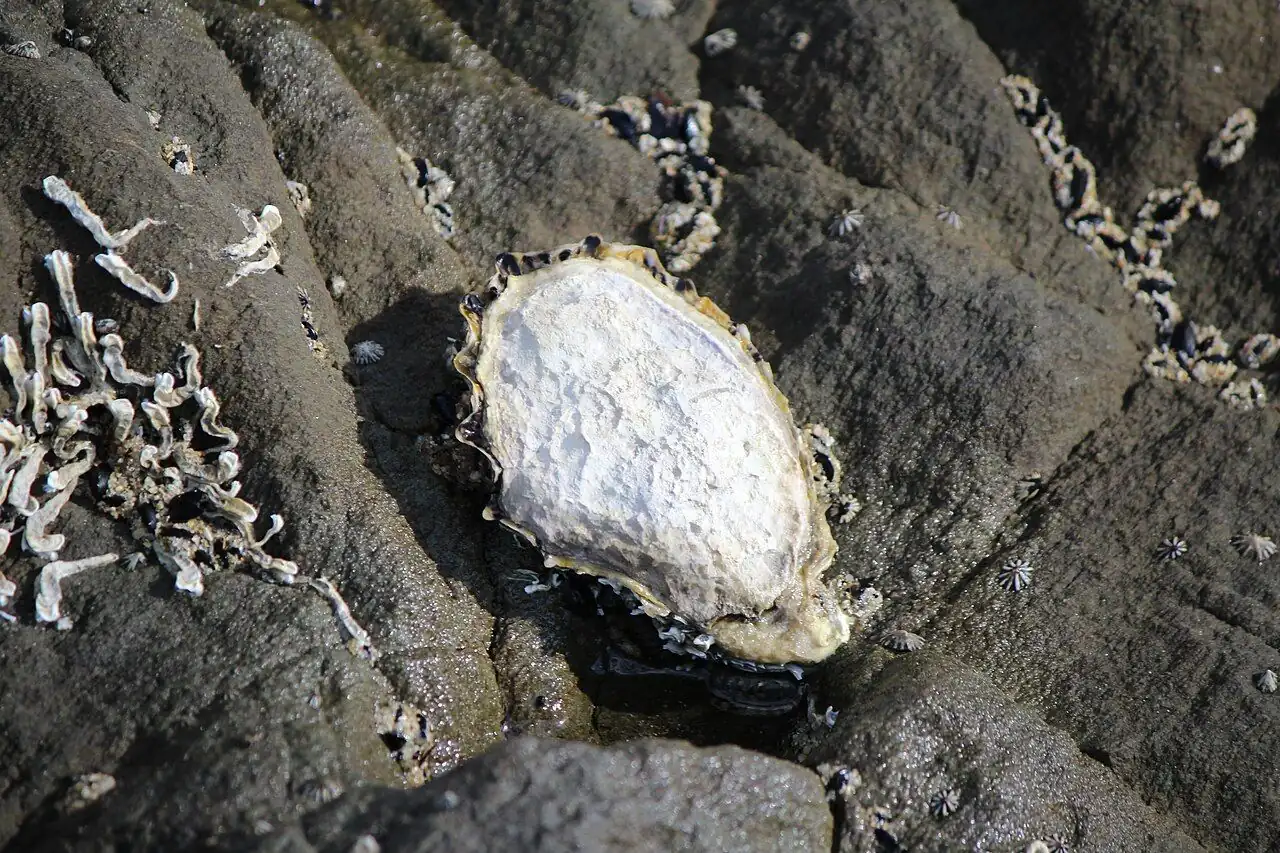
Pacific Oyster
Magallana gigas
A Japanese oyster now farmed and spreading worldwide, whose dying larvae in an Oregon hatchery became an early warning of ocean acidification.
Photo: Tim Binns / CC BY-SA 2.0
3 things to know
- Washington State's fisheries department brought Pacific oysters from Japan in the 1920s.
- Pacific oysters are male in their first year of life; some later become female.
- A female can release 50 to 200 million eggs into the water.
- Scientific name
- Magallana gigas
- Depth
- 0 m – 15 m
0 – 49 ft - Size
- Up to about 25–30 cm (10–12 in) long
- Weight
- Not well known
- Lifespan
- Not well known; NOAA says it can be long-lived
- Diet
- Phytoplankton filtered from the water
- Where
- Native to the northwest Pacific, from Hong Kong and Taiwan north to Kamchatka; introduced for farming in many countries, including the US West Coast, where it is naturalized in parts of Washington
- IUCN status
- Not Evaluated
- Depth zones
- Sunlight
A 2016 review led by Roger Herbert called the Pacific oyster one of the most "globalised" marine invertebrates. Magallana gigas (long known as Crassostrea gigas) is native to the northwest Pacific, from Hong Kong and Taiwan north to Kamchatka, and has been introduced for farming in many countries. Washington State's Department of Fisheries brought it over from Japan in the 1920s, and it has since gone wild in parts of the state, including Puget Sound. The shell can reach 25 to 30 centimeters (10 to 12 inches).
It settles on rock and other hard surfaces, and also on mud and sand, from the intertidal zone into shallow water; SeaLifeBase gives a depth range down to 15 meters (49 feet). Like other oysters it strains phytoplankton from the water, and NOAA says an adult can filter up to 190 liters (50 gallons) of seawater a day.
Pacific oysters are male in their first year. Some later develop female organs while their male organs shrink. Spawning often comes when warm water floods in on the tide, and a female can release 50 to 200 million eggs. After about 20 to 22 days in the plankton, the larvae are ready to settle.
Those larvae became an early warning. From 2006 to 2008, larvae at the Whiskey Creek Shellfish Hatchery on Netarts Bay, Oregon, one of the biggest suppliers of oyster seed on the West Coast, died in huge numbers. A 2012 study by Alan Barton, Oregon State oceanographer Burke Hales and colleagues tracked the hatchery's intake water through early summer 2009: larval production and growth fell when the water carried naturally high levels of carbon dioxide. That corrosive water arrives with summer upwelling along the Oregon coast, and ocean acidification makes it worse. Whiskey Creek and Taylor Shellfish began monitoring incoming water, and at Netarts Bay the hatchery found it could time its intake to avoid the worst of it.
The IUCN has not evaluated the species, and away from home it can cause trouble. Herbert's review, which focused on Europe, found that, at local scales, wild Pacific oysters that become established can significantly alter diversity, community structure and ecosystem processes. The oyster's genome, published in 2012 by a team led from the Chinese Academy of Sciences' Institute of Oceanology, showed an expanded set of heat shock protein 70 genes, which the authors linked to surviving the stress of life between the tides.
Sources
- fisheries.noaa.gov/species/pacific-oyster
- sealifebase.se/summary/Magallana-gigas.html
- marinespecies.org/aphia.php
- en.wikipedia.org/wiki/Pacific_oyster
- Study: doi:10.4319/lo.2012.57.3.0698
- par.nsf.gov/servlets/purl/10012684
- e360.yale.edu/features/northwest_oyster_die-offs_show_ocean_acidification_has_arrived
- nrdc.org/stories/great-oyster-crash
- Study: doi:10.1007/s10531-016-1209-4
- Study: doi:10.1038/nature11413
- api.gbif.org/v1/species/7820753/iucnRedListCategory



