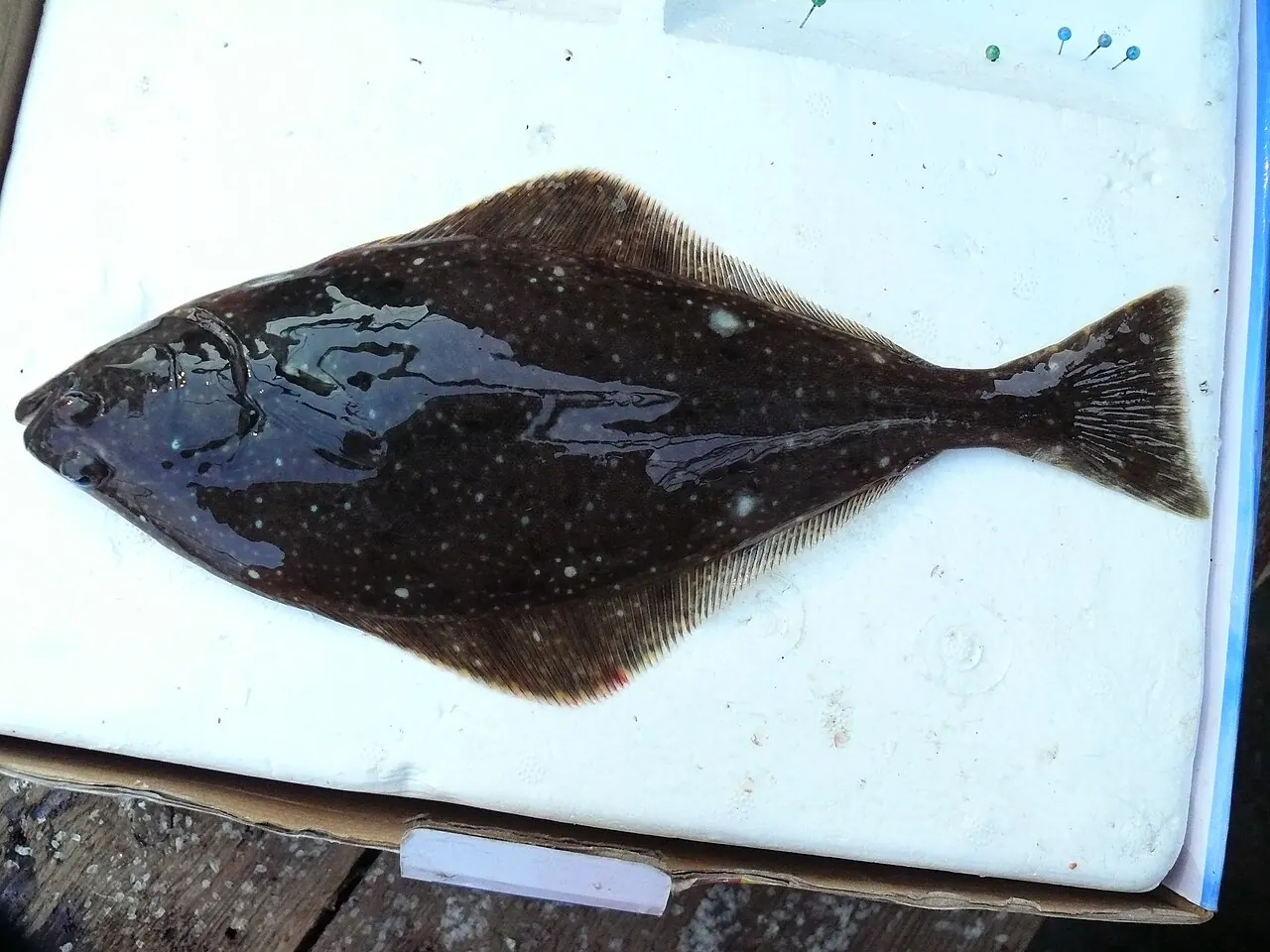
Pacific Halibut
Hippoglossus stenolepis
A giant North Pacific flatfish that hatches with an eye on each side of its head and can live for more than 50 years.
Photo: Баранчук-Червонный Лев (Lev Baranchuk-Chervonny) / CC BY-SA 3.0
3 things to know
- When a young halibut is about 2.5 cm (1 in) long, its left eye moves over to the right side of its head.
- One halibut tagged in the Aleutian Islands in 1967 was caught near Coos Bay, Oregon, 4,023 km (2,500 miles) away.
- The United States and Canada have managed Pacific halibut together since 1923.
- Scientific name
- Hippoglossus stenolepis
- Depth
- 30 m – 270 m
98 – 886 ft - Size
- Huge ones can pass 2.4 m (8 ft) long
- Weight
- Fish of about 230 kg (500 lb) have been documented
- Lifespan
- Up to 55 years; fish over 30 are rare
- Diet
- Fish such as cod, pollock, sablefish, sand lance and herring; also octopus, crabs and clams
- Where
- North Pacific and Bering Sea, from Santa Barbara, California, to Nome, Alaska, and from the Gulf of Anadyr, Russia, to Hokkaido, Japan
- IUCN status
- Least Concern
- Depth zones
- Sunlight · Twilight
A Pacific halibut hatches looking like any other fish, with an eye on each side of its head. When the drifting larva is about 2.5 centimeters (1 inch) long, its left eye moves over to the right side and the color fades from what becomes its underside. At about six months old it settles to the bottom in shallow water, eyeless side down. The upper side is mottled olive to dark brown, matching the seafloor, and the underside is white. The biggest are huge: the International Pacific Halibut Commission (IPHC) says several fish of about 230 kilograms (500 pounds), about 2.4 meters (8 feet) long and generally over 30 years old, have been documented in Alaska and Russia. Huge ones are sometimes called barn doors. The oldest on record was 55.
Pacific halibut live from Santa Barbara, California, to Nome, Alaska, and on the Asian side from Russia's Gulf of Anadyr to Hokkaido, Japan. They are most common in the central Gulf of Alaska, near Kodiak Island. Most are caught 30 to 270 meters (90 to 900 feet) down, but they have been taken as deep as 1,200 meters (4,000 feet). Big halibut eat cod, pollock, sablefish, sculpins, octopus, crabs and clams, and often leave the bottom to chase herring and sand lance.
Males mature at about 8 and females at about 11. From November to March, adults gather to spawn along the edge of the continental shelf, about 200 to more than 500 meters (600 to over 1,600 feet) deep, and a female can release between 500,000 and 4 million eggs, depending on her size. Currents sweep the eggs and larvae counterclockwise around the Gulf of Alaska, sometimes for thousands of miles, and the young halibut later migrate back against that drift.
The IPHC began tagging halibut in 1925 and has released more than 475,000 tagged fish. Most tagged fish are recaught within about 97 kilometers (60 miles) of where they were released, but a few travel far: one tagged near Atka Island in the Aleutians in 1967 was caught near Coos Bay, Oregon, in 1972, 4,023 kilometers (2,500 miles) south. The United States and Canada have managed the fishery together through the IPHC since 1923. NOAA Fisheries reports the stock is not overfished, and the IUCN lists the species as Least Concern in an assessment from 2020.



