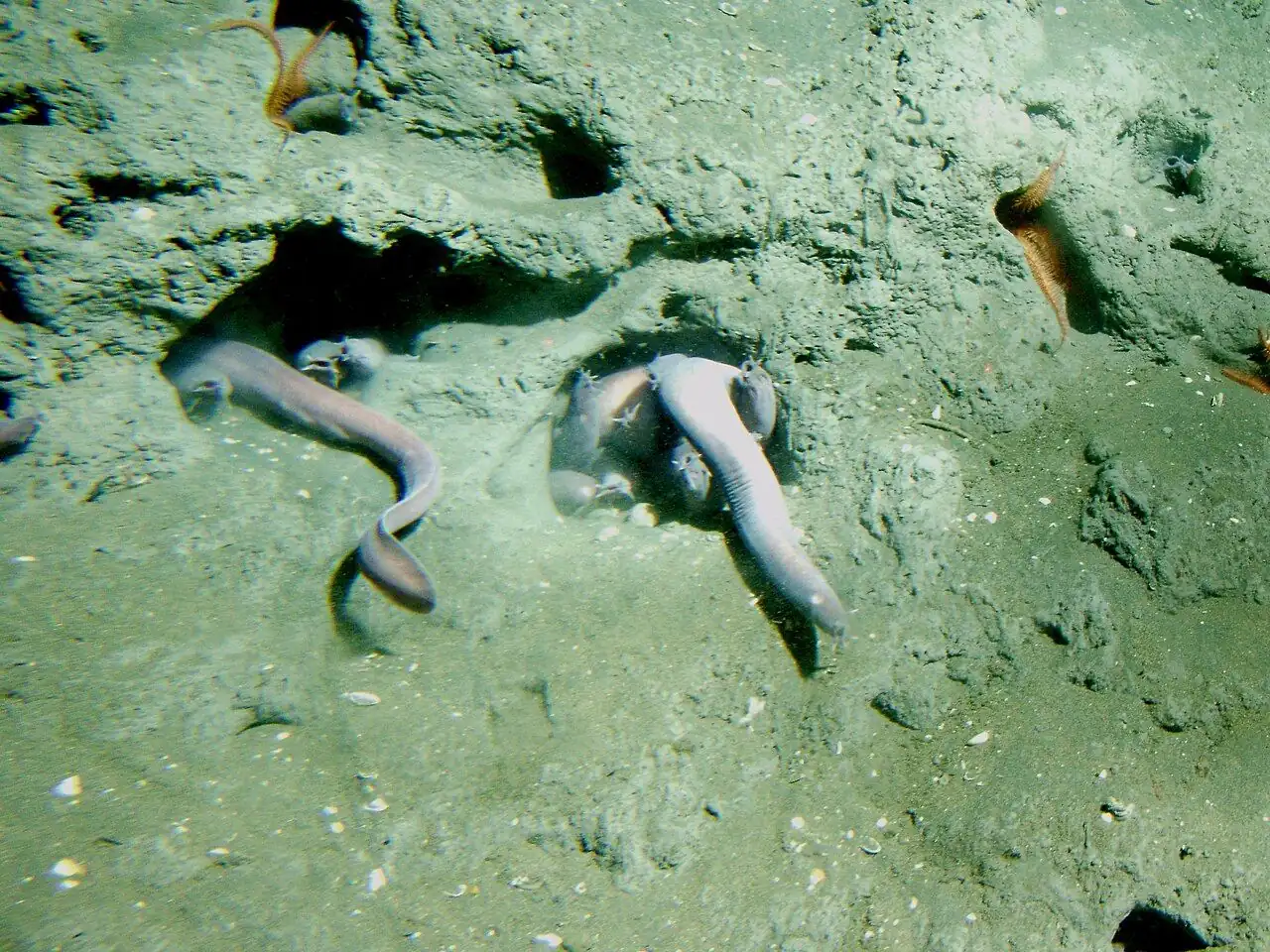
Pacific Hagfish
Eptatretus stoutii
A jawless, eel-shaped scavenger of the West Coast seafloor that floods attackers with slime, ties itself in knots and can absorb food through its skin.
Photo: Linda Snook, NOAA/CBNMS / Public domain
3 things to know
- It has no jaws; it feeds with two pairs of tooth-like rasps on its tongue.
- Pacific hagfish can absorb amino acids straight through their skin and gills, the first time this was shown in a vertebrate.
- In 2017 a truck carrying 7,500 pounds of hagfish overturned on Oregon's Highway 101, covering the road and other vehicles in slime.
- Scientific name
- Eptatretus stoutii
- Depth
- 18 m – 900 m
59 – 2,953 ft - Size
- Up to 63.5 cm (25 in)
- Weight
- Not well known
- Lifespan
- Not well known
- Diet
- Polychaete worms and other small invertebrates; also scavenges dead and dying animals, including whale carcasses
- Where
- Eastern Pacific, from southeastern Alaska to central Baja California, Mexico
- IUCN status
- Data Deficient
- Depth zones
- Sunlight · Twilight
A Pacific hagfish is a jawless fish. Living jawless fishes come in just two groups, the lampreys and the hagfishes, according to a 2021 book chapter by Fumiaki Sugahara. Instead of jaws, a hagfish has a mouth ringed with short, sensitive tentacles and a tongue carrying two pairs of tooth-like rasps for pulling and tearing. It is shaped like an eel, with no true fins, only low folds of skin, and 10 to 14 gill pores near the front of the body. The skin is tan, gray, brown or reddish, often tinged blue or purple. The eyes are rudimentary, but its senses of smell and touch are good.
It lives on the seafloor from southeastern Alaska to central Baja California, usually in temporary burrows in mud between about 18 and 900 meters (60 and 2,950 feet) down, according to the Aquarium of the Pacific. It eats polychaete worms and other small animals and scavenges dead and dying animals, and the aquarium says it is among the first animals to reach a whale carcass on the deep seafloor off California. To tear off a mouthful it ties a knot in its own body and slides through it for leverage, then burrows inside the carcass.
That habit may explain an ability first documented in this species. In 2011, Chris Glover, Carol Bucking and Chris Wood showed that Pacific hagfish absorb amino acids directly across their skin and gills, which may help them make the most of rare meals while buried in a rotting body.
Threatened, a hagfish releases slime from pores along its sides, and the slime swells in seawater into a sticky gel that can choke an attacker. Hagfish then knot themselves to wipe it off. Young hatch as miniature adults, with no larval stage.
The IUCN assessment says Pacific hagfish are heavily targeted in at least half their range for the Asian eel-skin leather market, and hagfish are also shipped from Oregon to Korea as food. In July 2017 a truck carrying 13 containers and 7,500 pounds of hagfish bound for Korea overturned on Highway 101 near Depoe Bay, Oregon, covering the road and other vehicles in slime. No one was seriously hurt. The IUCN lists the species as Data Deficient, in a 2009 assessment the Red List marks as needing an update.
Sources
- aquariumofpacific.org/onlinelearningcenter/species/pacific_hagfish
- fishbase.se/summary/Eptatretus-stoutii.html
- iucnredlist.org/species/196044/8997397
- Study: doi:10.1098/rspb.2010.2784
- Study: doi:10.1201/9781003217503-22
- opb.org/news/article/eels-truck-highway-oregon-slime-101
- commons.wikimedia.org/wiki/File:Eptatretus_stoutii.jpg



