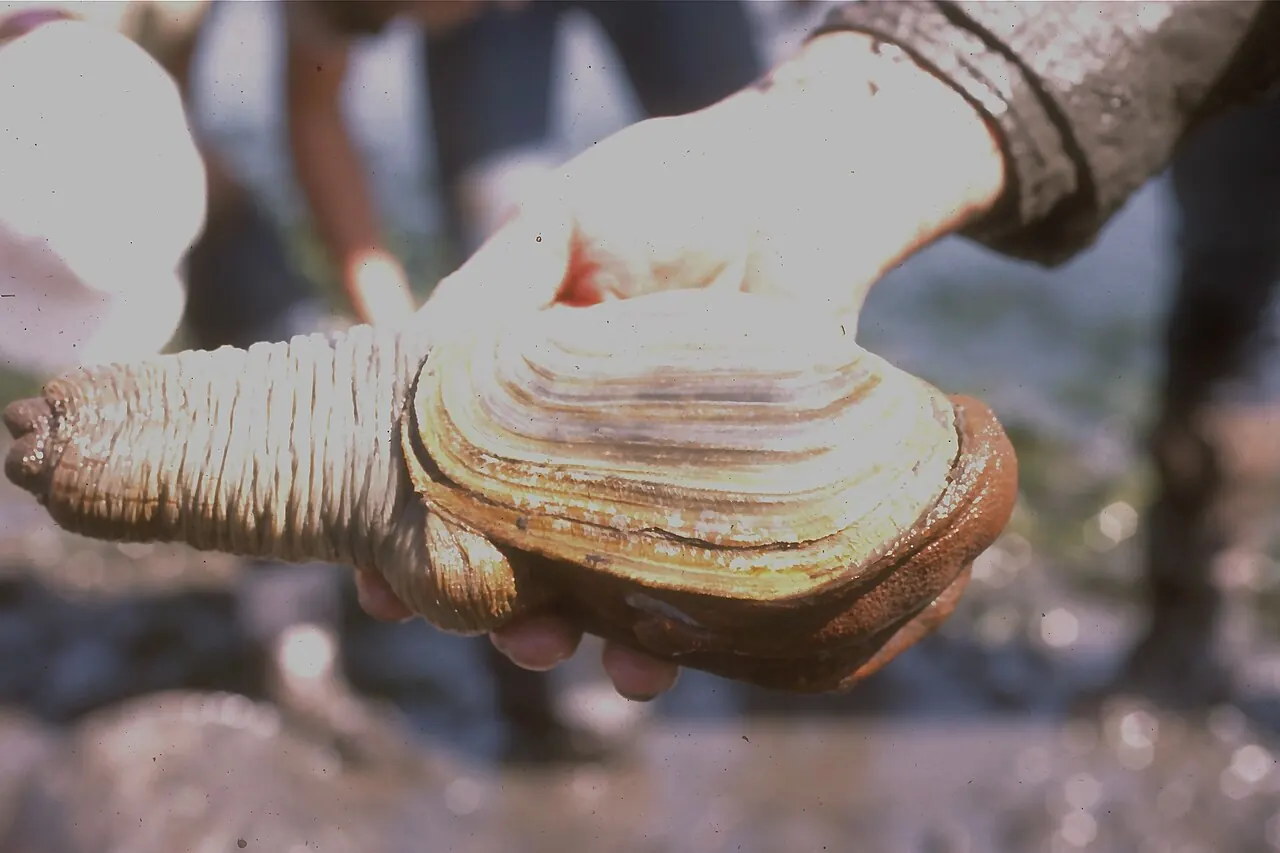
Pacific Geoduck
Panopea generosa
The world's largest burrowing clam lives up to a meter deep in Pacific mud, feeds through a siphon too big to pull in, and can pass 160 years old.
Photo: Jerry Kirkhart / CC BY 2.0
3 things to know
- Its siphon and mantle are so large that they cannot be pulled back inside the shell.
- Washington's Department of Fish and Wildlife says geoducks can live at least 168 years.
- In 1960, Navy divers searching Puget Sound for lost torpedoes found geoducks living far below the tide line in Hood Canal.
- Scientific name
- Panopea generosa
- Depth
- 0 m – 110 m
0 – 361 ft - Size
- Shell up to about 21 cm (8 in) long; the siphon can stretch about 1 m (3 ft)
- Weight
- Averages about 0.9 kg (2 lb) in Puget Sound's subtidal beds; the largest verified by state biologists weighed 3.7 kg (8.16 lb)
- Lifespan
- At least 168 years, according to Washington's WDFW; the Encyclopedia of Puget Sound reports one aged 173, and SeaLifeBase gives 100 as the maximum reported age
- Diet
- Phytoplankton filtered through its siphon
- Where
- Eastern North Pacific, from Alaska to Baja California
- IUCN status
- Not Evaluated
- Depth zones
- Sunlight
Most of a Pacific geoduck never sees daylight. Its shell, up to about 21 centimeters (8 inches) long, sits 60 to 90 centimeters (2 to 3 feet) down in mud, sand or gravel, and the clam reaches the seafloor through a muscular siphon that can stretch about a meter (3 feet). The siphon and mantle are so large they cannot be pulled back inside the shell. Washington's Department of Fish and Wildlife (WDFW) calls it the world's largest burrowing clam. The name, said "GOO-ee-duk," comes from the Lushootseed word gʷidəq; the Encyclopedia of Puget Sound glosses it as "dig deep," though the word's origin is disputed.
Geoducks live in the eastern North Pacific from Alaska to Baja California, from the low-tide line to about 110 meters (360 feet), the depth at which underwater video cameras have recorded them in Puget Sound. A geoduck feeds by extending its siphon into the water and filtering out phytoplankton. The IUCN has not evaluated the species.
They grow fast, then stop. WDFW says geoducks generally reach 0.7 kilograms (1.5 pounds) in three to five years and their full size by about 15. In the subtidal beds of Puget Sound the average geoduck weighs 0.94 kilograms (2.07 pounds) with its shell, and the biggest one WDFW biologists have weighed and verified was 3.7 kilograms (8.16 pounds), though commercial harvesters report larger ones. Then they keep living: WDFW says for at least 168 years, and the Encyclopedia of Puget Sound reports one from Puget Sound that was 173 years old. Alaska's Department of Fish and Game reports geoducks still producing eggs and sperm at 107 years old; it cites British Columbia studies that put spawning in June and July, with a female releasing one to two million eggs at a time. In many parts of Southeast Alaska, sea otters are cutting into geoduck numbers.
In 1960, Robert Sheats and a team of Navy divers, searching Puget Sound for lost torpedoes, found geoducks living far below the tide line deep in Hood Canal, and in May 1970 Sheats and his wife Margaret dove to start the commercial harvest. Washington's wild harvest is split evenly between tribal and non-tribal harvesters; before Judge Edward Rafeedie's 1994 ruling on tribal treaty rights, no tribes had a commercial shellfish program. Farms, using methods state biologists began developing in 1987, take about a third of the total geoduck harvest.



