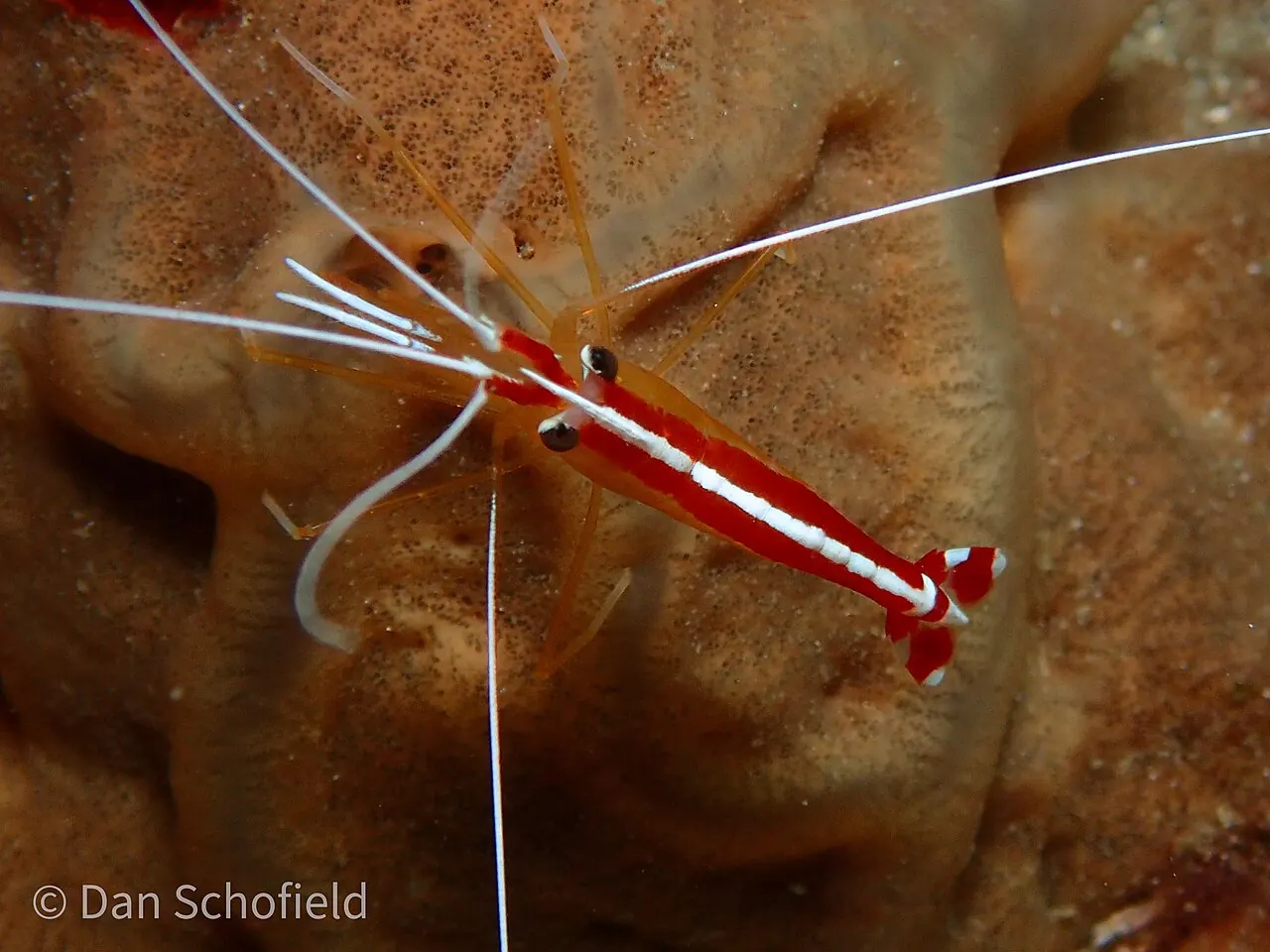
Pacific Cleaner Shrimp
Lysmata amboinensis
A red-and-white striped reef shrimp that picks parasites off fish, including fish big enough to eat it, and signals to predators by rocking its legs.
Photo: Dan Schofield / CC BY 4.0
3 things to know
- It cleans parasites and dead tissue off reef fish at cleaning stations.
- Toward predatory fish it rocks its white front legs, possibly to show it is a cleaner.
- Female-phase shrimp are simultaneous hermaphrodites, male and female at once.
- Scientific name
- Lysmata amboinensis
- Depth
- 1 m – 120 m
3 – 394 ft - Size
- 5 to 6 cm (2 to 2.4 in) long
- Weight
- Unknown
- Lifespan
- Unknown
- Diet
- Parasites and dead tissue picked from fish, plus scavenged food
- Where
- Coral reefs of the Indo-Pacific, including the Red Sea
- IUCN status
- Not Evaluated
- Depth zones
- Sunlight
A white stripe runs down the back of the Pacific cleaner shrimp between two scarlet bands, on an amber body 5 to 6 centimeters (about 2 inches) long, and its white antennae are as long as the body. The World Association of Zoos and Aquariums describes those colors as signals both to other shrimp and to the fish it cleans. It lives on coral reefs across the Indo-Pacific, including the Red Sea, in pairs, and waits at cleaning stations for fish to visit. It eats parasites and dead tissue from their skin and scavenges the rest of its food.
Many of its clients could swallow it. In the summer of 2016, Eleanor Caves, Catherine Chen and Sönke Johnsen of Duke University left cameras at two cleaning stations on a reef at Eilat, Israel, and recorded 31.4 hours of video. The shrimp cleaned fish that eat crustaceans in a smaller share of visits than harmless fish. Almost only toward those predators, they performed leg rocking, a quick back-and-forth swaying of the white front legs that the authors suggest may advertise the shrimp as a cleaner. In lab tests at Duke, dark shapes and dimming light set off the rocking.
The cleaning may help injured fish too. In a 2018 lab study, David Vaughan, Alexandra Grutter and colleagues gave sea goldies a small, shallow skin wound and let the shrimp work on them. The shrimp reduced the redness around the wounds, a sign of inflammation, and did not make any injury worse.
Young shrimp start out as males, WAZA says, and the title of a 1998 paper by G. Fiedler reports functional, simultaneous hermaphroditism in female-phase shrimp, which are male and female at once. According to WAZA, a shrimp can spawn every 11 to 15 days, carrying 200 to 500 greenish eggs, and the larvae drift for 5 to 6 months before settling at about 2 centimeters long. It is a favorite in home aquariums, and Jacques, the cleaner shrimp in Pixar's Finding Nemo, is this species. It has not been evaluated for the IUCN Red List.



