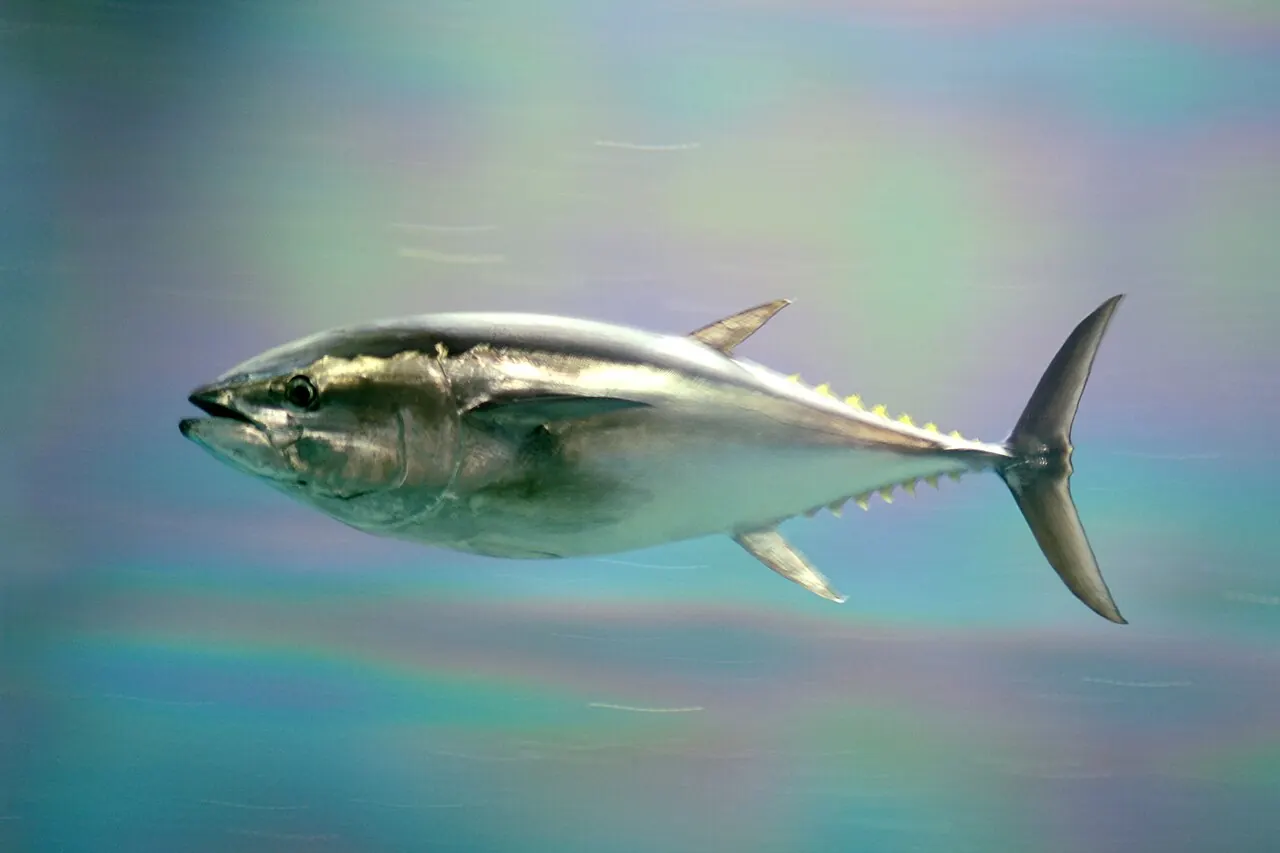
Pacific Bluefin Tuna
Thunnus orientalis
A North Pacific giant that spawns near Asia and can cross the whole ocean to California while still a juvenile.
Photo: aes256 / CC BY 2.1 jp
3 things to know
- Of all the tunas, it has the largest geographic range.
- Tagged fish have crossed the Pacific in as little as 55 days.
- Fish caught off San Diego in 2011 carried a radioactive trace of the Fukushima accident from Japan.
- Scientific name
- Thunnus orientalis
- Depth
- 0 m – 550 m
0 – 1,805 ft - Size
- Adults about 1.5 m (4.9 ft); up to 3 m (9.8 ft) long
- Weight
- Adults about 60 kg (130 lb); up to 450 kg (990 lb)
- Lifespan
- Up to 26 years; about 15 years on average
- Diet
- Squid and fish such as sardines, anchovies, saury, herring and mackerel; sometimes red crabs and krill
- Where
- Mainly the North Pacific, from the Gulf of Alaska to Baja California and from the southern Sea of Okhotsk to the northern Philippines
- IUCN status
- Near Threatened
- Depth zones
- Sunlight · Twilight
Pacific bluefin hatch in the western Pacific, and some cross the entire ocean before they are two years old. NOAA says the trip can take as little as 55 days. Of all the tunas, this one has the largest geographic range, mostly in the North Pacific from the Gulf of Alaska to Baja California and from the Sea of Okhotsk to the Philippines.
The back is black or dark blue with a grayish-green sheen, and the belly carries silver or gray spots and bands. A row of small yellow finlets edged in black runs to the tail. One quick check separates it from other tunas: the tips of its pectoral fins do not reach the front of the second dorsal fin. Its eyes are small for a tuna. Adults average about 1.5 meters (4.9 feet) and 60 kilograms (130 pounds), and the largest reported reached 3 meters (9.8 feet) and 450 kilograms (990 pounds). FishBase gives a depth range down to 550 meters (1,800 feet).
Bluefin eat squid and schooling fish such as sardines, anchovies, saury, herring, mackerel and hake, other tunas included, and now and then red crabs and krill. They mature at about 5 years old and can live 26 years, though about 15 is more typical.
The ocean crossing was confirmed in an unusual way. After the Fukushima nuclear accident in 2011, Daniel Madigan of Stanford's Hopkins Marine Station and Zofia Baumann and Nicholas Fisher of Stony Brook University tested young bluefin caught by anglers off San Diego that August. All 15 fish carried cesium-134, an isotope missing from bluefin caught before the accident and from yellowfin tuna caught off California after it. The fish had picked it up in Japanese waters and carried it across the Pacific. The authors reported levels more than ten times below Japan's safety limit.
The species was fished down hard. When the IUCN moved it from Vulnerable to Near Threatened in 2021, citing newer stock assessments, it still described the population as below 5% of its original biomass. NOAA, which declared the stock overfished in 2013, says a later 2024 stock assessment showed it rebuilt, no longer overfished or subject to overfishing. Most of the US catch comes from within about 100 nautical miles of California.



