Midnight Zone · 1,000–4,000 m
Some Deep-Sea Fish Are So Black They Absorb 99.5% of Light
Scientists from the Smithsonian and Duke found 16 species of ultra-black fish in Monterey Bay and the Gulf of Mexico.
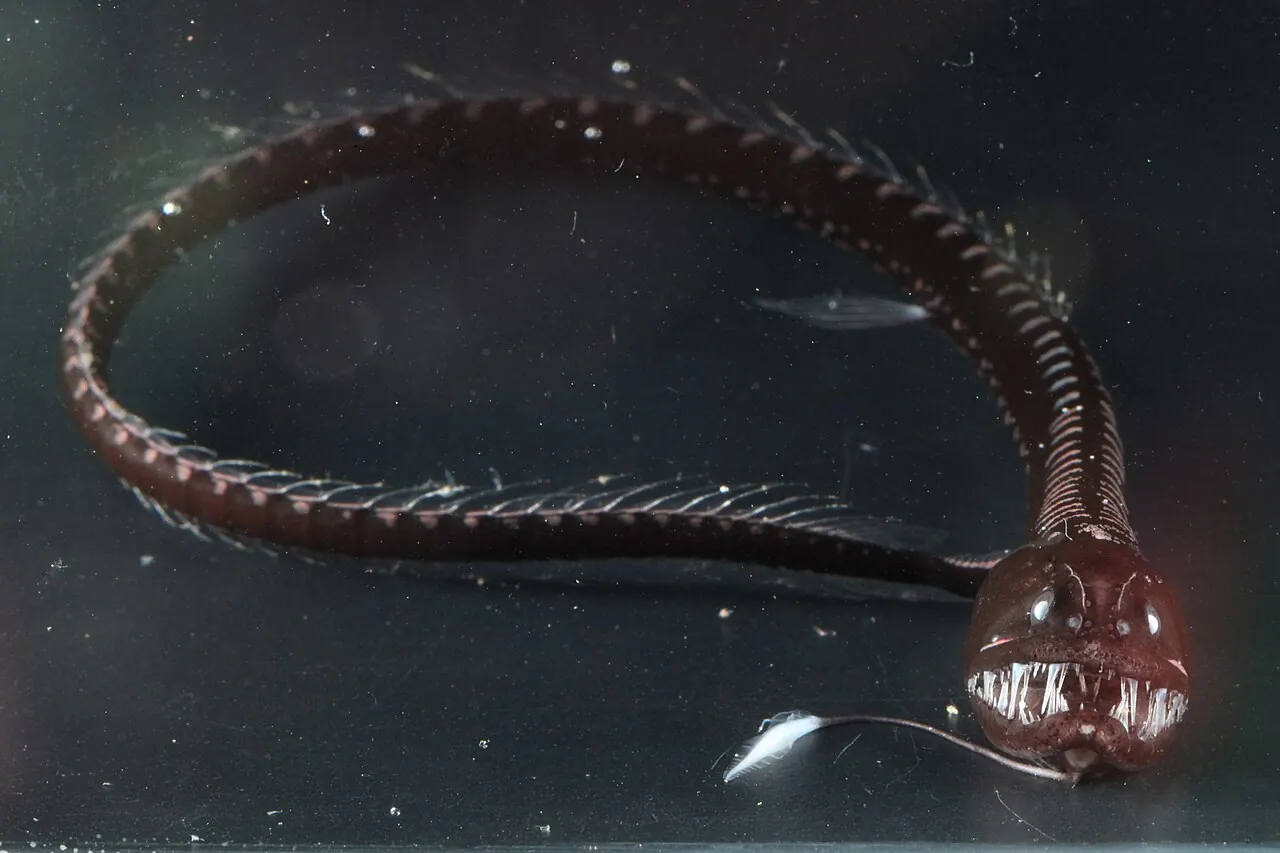
Idiacanthus antrostomus
A slender eastern Pacific dragonfish with ultra-black skin, whose adult males are a fraction of the females' size.
Photo: J. Stone, N. Mallick, A. Barth, R. Rykaczewski and A. Schmidt, Smithsonian National Museum of Natural History / CC0
Idiacanthus antrostomus is a long, slender, black dragonfish of the eastern Pacific, and its two sexes barely look like the same animal. FishBase lists females to 38 centimeters (15 inches), and another species account cites a female of 61 centimeters (24 inches). Males reach only about 7.6 centimeters (3 inches). FishBase calls the males larvoid, meaning they keep a larva-like body as adults.
A relative in the same genus shows how far that can go. In the black dragonfish, the Australian Museum says males lack teeth, a chin barbel and a working gut, while females have long fang-like teeth and a chin barbel with a glowing tip that may lure prey. Its larvae are transparent and carry their eyes on stalks up to half the length of the body.
The Pacific blackdragon ranges from British Columbia to Chile and has been reported off Japan. FishBase gives a depth range from the surface to about 1,100 meters (3,600 feet), and other records reach 2,161 meters (7,088 feet). It migrates toward the surface at night and returns to the depths at dawn, feeding mainly on small fish and crustaceans. It spawns eggs that drift with the plankton, as do its larvae.
In a 2020 study, researchers from the Smithsonian and Duke University measured the skin of deep-sea fish caught in Monterey Bay and the Gulf of Mexico and found 16 species that reflect less than 0.5 percent of the light that hits them. A Pacific blackdragon caught in Monterey Bay was among the fish whose skin they imaged, and Science News pictured it as an example of ultra-black skin that absorbs almost all light. The effect comes from melanosomes, tiny packets of pigment in the skin, which in ultra-black fish are shaped and arranged differently from those in ordinary black fish. Duke University's release describes such skin as able to absorb the bioluminescent light that might otherwise give a fish away.
How long it lives is not known. The IUCN Red List rates it as Least Concern.



