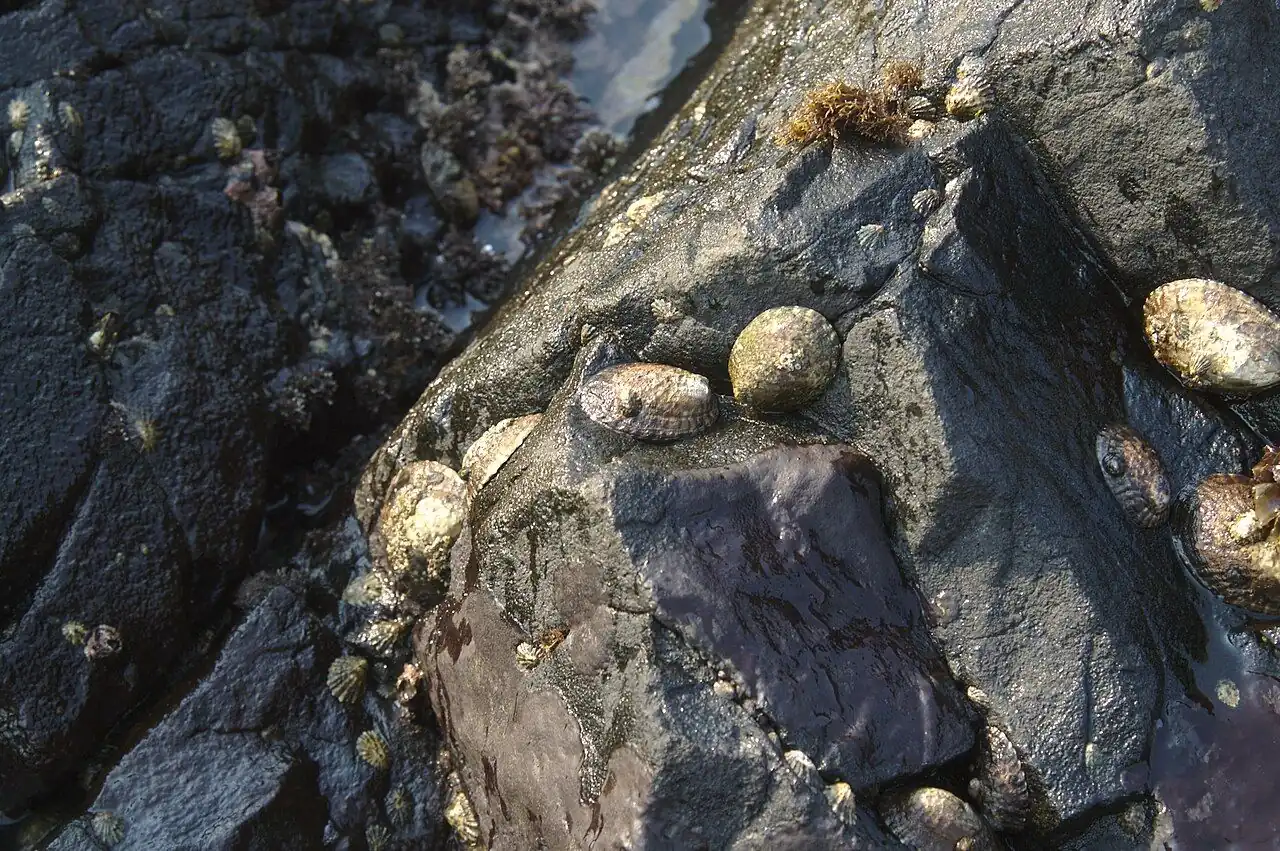
Owl Limpet
Lottia gigantea
North America's largest limpet, a territorial grazer that farms its own patch of rock, shoves intruders off it and changes from male to female.
Photo: Jerry Kirkhart / CC BY 2.0
3 things to know
- A large owl limpet defends a grazing patch of about 1,000 square centimeters (1 sq ft).
- Owl limpets start adult life as males and become females as they grow.
- People collect the biggest ones, so limpets on busy shores tend to be smaller.
- Scientific name
- Lottia gigantea
- Depth
- At the surface
- Size
- Shell up to about 10 cm (4 in) long
- Weight
- Not well known
- Lifespan
- Not well known; the largest limpets in one southern California study were estimated at more than 8 years old
- Diet
- Films of microscopic algae and diatoms scraped from rock with its radula
- Where
- Pacific coast of North America, mainly from northern California to southern Baja California, Mexico (the National Park Service extends it north to Washington)
- IUCN status
- Not Evaluated
- Depth zones
- Sunlight
North America's largest limpet has a low, oval shell up to about 10 centimeters (4 inches) long, light brown with whitish checks around the edge. The name comes from inside the empty shell, where a bluish-brown stain resembles the outline of an owl. The owl limpet lives on bare rock in the middle and high intertidal zone of the Pacific coast, mostly from northern California to southern Baja California, Mexico. Comparing museum and field records spanning about 140 years, Phillip Fenberg and Marcelo Rivadeneira reported in 2011 that its northern limit has pulled back by about 2.4 degrees of latitude since 1963, and that adults are sparse north of Monterey Bay.
Each big limpet keeps a garden. A 1970 study in the journal Ecology found that an owl limpet lives on a patch of algal film about 1,000 square centimeters (1 square foot) in area, marked with its grazing scars, while the surrounding rock stays almost bare. It shoves off intruders: other owl limpets, smaller limpets, predatory snails, and anemones and barnacles trying to settle. When the owners were removed, other limpets moved in within two to three weeks and the film disappeared. The territorial limpets are the large females, which wedge the edge of their shell under an intruder's and pry it off the rock.
Owl limpets begin adult life as males and become females as they grow, so the largest animals are mostly female. That makes them vulnerable, because people take the biggest ones to eat. The National Park Service noted in 2017 that commercial harvest is illegal throughout California and collecting is banned in marine protected areas, but elsewhere in the state recreational collectors may take 35 a day. At Cabrillo National Monument in California, surveys every winter since 1990 show the population growing while average size shrinks. At eight southern California sites, Kido and Murray found in 2003 that no limpet exceeded 79 millimeters (3.1 inches), that mean size fell as visitor numbers rose, and that the largest were more than 8 years old.
A 2010 genetic study by Fenberg and colleagues found no significant genetic differences among populations and concluded that harvested ones could recover if collecting is curbed and given time. Its genome was also one of three published in Nature in 2012 to trace how animals with bilateral bodies evolved. It has not been assessed by the IUCN.
Sources
- sealifebase.se/summary/Lottia-gigantea.html
- aquariumofpacific.org/reportcard/info/owl_limpet
- nps.gov/cabr/blogs/species-spotlight-owl-limpet-lottia-gigantea.htm
- Study: doi:10.2307/1933604
- Study: doi:10.1111/j.1365-2699.2011.02572.x
- Study: doi:10.3354/meps257111
- Study: doi:10.1111/j.1439-0485.2010.00386.x
- Study: doi:10.1038/nature11696
- api.gbif.org/v1/species/2297856/iucnRedListCategory



