Orca (Killer Whale)
Orcinus orca
The largest member of the dolphin family, whose populations learn their own hunting methods and calls and pass them down.
Photo: Callan Carpenter / CC BY-SA 4.0
3 things to know
- It is the largest member of the dolphin family.
- Each population's pulsed calls are its own, learned from other whales and passed down.
- Female orcas are among the few animals known to go through menopause.
- Scientific name
- Orcinus orca
- Depth
- 0 m – 767 m
0 – 2,517 ft - Size
- Up to about 9.8 m (32 ft); males larger than females
- Weight
- Up to about 10,000 kg (22,000 lb)
- Lifespan
- Females typically about 50 years, up to at least 90; males about 30, up to at least 60
- Diet
- Fish, squid, seals, sea lions, dolphins and whales, depending on the population
- Where
- Every ocean, most abundant in cold waters
- IUCN status
- Data Deficient
- Depth zones
- Sunlight · Twilight
Mostly black on top and white underneath, with a white patch near each eye and a gray or white saddle behind the dorsal fin, the orca is the largest member of the dolphin family. Males grow larger flippers, dorsal fins and flukes than females, and the largest reach about 9.8 meters (32 feet) and roughly 10,000 kilograms (11 tons). They live in every ocean, most abundantly in cold waters.
Orcas eat a wider range of food than any other whale or dolphin, but each population specializes, and what it eats depends mainly on hunting methods its members learn. In the US Pacific Northwest, according to NOAA Fisheries, Residents live on fish, mainly salmon, while Transients, also called Bigg's killer whales, hunt marine mammals and squid in the same area. Their pulsed calls also differ from one population to the next and are learned, working as family badges.
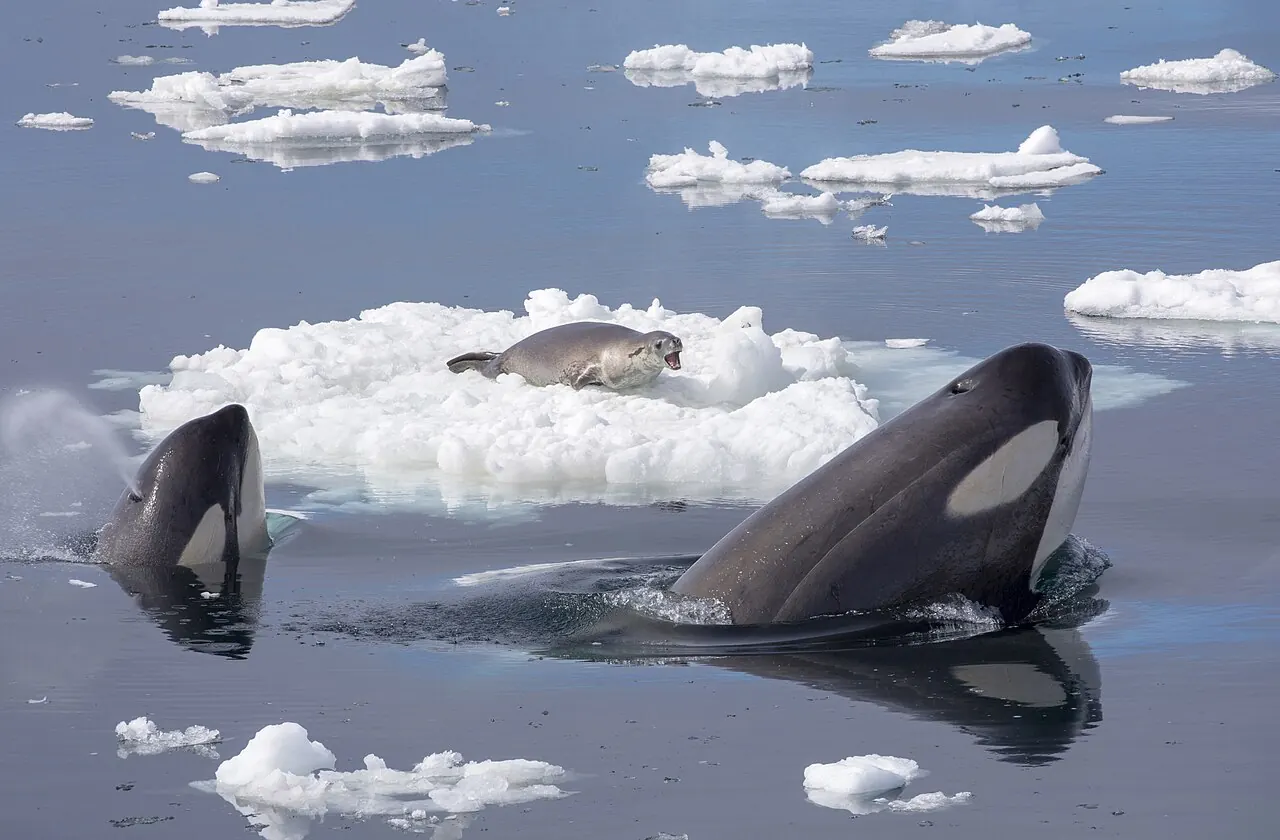
Some methods take teamwork. In January 2009, Robert Pitman and John Durban spent 75 hours watching pack ice killer whales off the western Antarctic Peninsula. The whales took 12 of 14 seals off ice floes by swimming together to make waves that washed them into the sea, and they chose Weddell seals almost every time, even though crabeater seals were far more common on the ice. Orcas also dive deep. The record set off the Prince Edward Islands in 2013 was 767 meters (2,516 feet). Then one tagged off South Georgia while stealing toothfish from fishing lines reached 1,087 meters (3,566 feet), though each of its deep dives was followed by hours of diving shallower than 100 meters.
Females mature at 10 to 13 and can live to at least 90, long after they stop breeding. Drawing on long-term records of wild Residents, Lauren Brent of the University of Exeter and colleagues found in 2015 that females past breeding age led their groups through salmon foraging grounds, most of all in years when salmon were scarce.
The IUCN lists the orca as Data Deficient, noting evidence that it may comprise several distinct forms, perhaps separate species, and rates the small population in the Strait of Gibraltar as Critically Endangered. In the US, the Southern Residents, which range from central California to southeast Alaska, have been listed as endangered since 2005. The July 2025 census counted 74 of them. Their threats include scarce Chinook salmon, chemical contaminants, and noise and disturbance from vessels.
Sources
- fisheries.noaa.gov/species/killer-whale
- Study: doi:10.2305/IUCN.UK.2017-3.RLTS.T15421A50368125.en
- iucn-csg.org/red-list-status-of-cetaceans
- en.wikipedia.org/wiki/Orca
- Study: doi:10.1111/j.1748-7692.2010.00453.x
- Study: doi:10.1016/j.cub.2015.01.037
- Study: doi:10.1093/icesjms/fsy118
- hakaimagazine.com/news/a-record-breaking-dive-by-a-hungry-killer-whale



