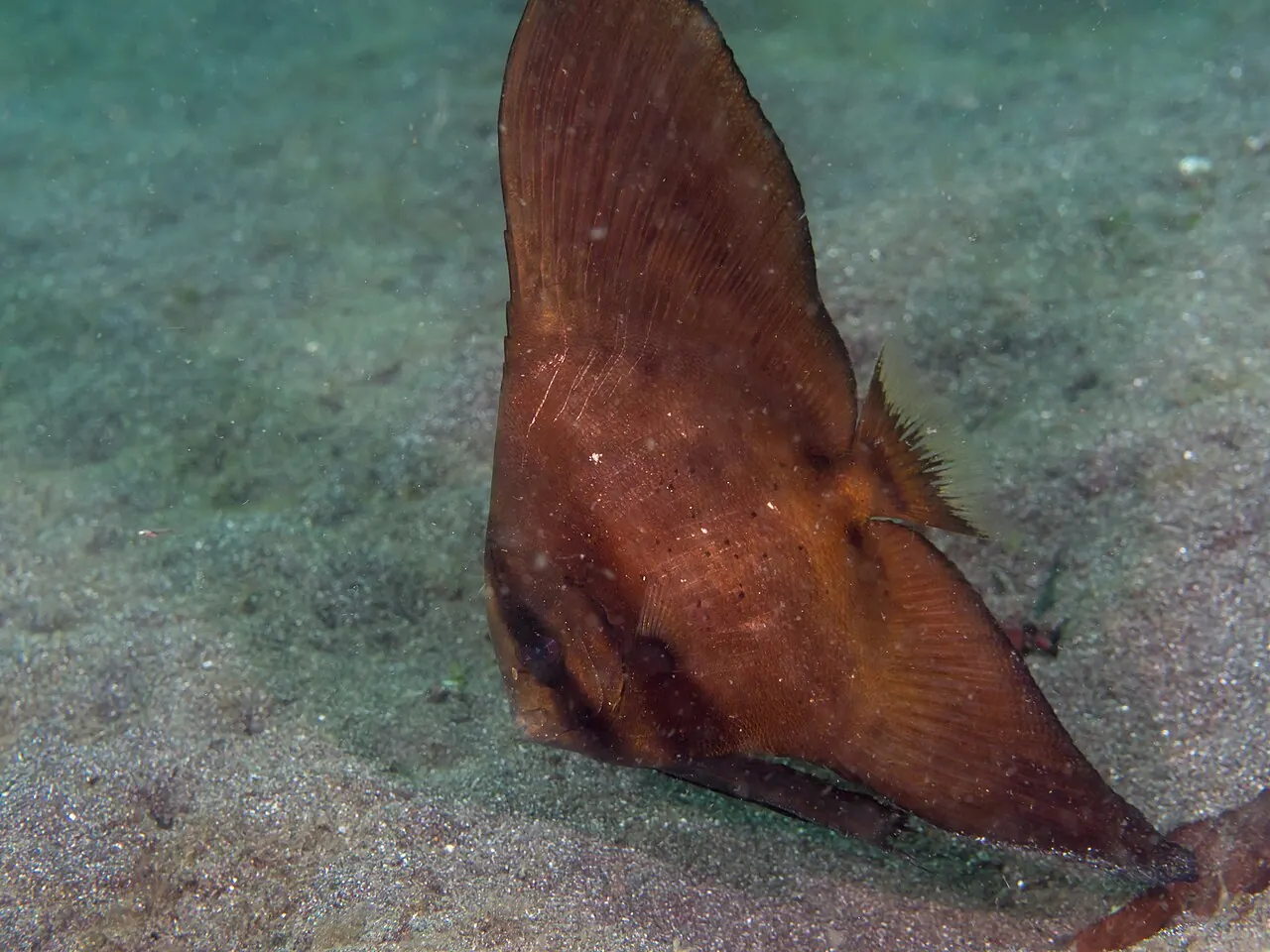
Orbicular Batfish
Platax orbicularis
A round, silvery Indo-Pacific reef fish whose young drift like dead leaves among mangroves until they outgrow the disguise.
Photo: Rickard Zerpe / CC BY 2.0
3 things to know
- Juveniles drift like dead leaves among mangroves and floating debris.
- The leaf disguise ends when the young fish reach about 13 to 14 centimeters.
- Adults can grow to about 60 centimeters (2 feet) long.
- Scientific name
- Platax orbicularis
- Depth
- 0 m – 30 m
0 – 98 ft - Size
- Up to about 60 cm (24 in) long
- Weight
- Not well known
- Lifespan
- Unknown
- Diet
- Algae, invertebrates and small fish
- Where
- Indo-Pacific, from the Red Sea, East Africa and the Persian Gulf to the Tuamotus, north to southern Japan and south to northern Australia and New Caledonia
- IUCN status
- Least Concern
- Depth zones
- Sunlight
An adult orbicular batfish is a nearly round, flat disk, silvery yellow to dusky, with a dark bar through the eye, another just behind the head, black pelvic fins and yellowish fins edged in black at the back. Large fish over 40 centimeters develop a concave snout profile with a bony swelling between the eyes. It reaches about 60 centimeters (2 feet).
The species ranges across the Indo-Pacific, from the Red Sea, East Africa and the Persian Gulf to the Tuamotu Islands, north to southern Japan and south to northern Australia and New Caledonia. FishBase also lists a record off Florida. Adults live over sandy areas of deep lagoons, channels and seaward reefs to at least 30 meters (100 feet), alone, in small groups or occasionally in large schools, and they are often seen around deep shipwrecks. They eat algae, invertebrates and small fish.
The young look like something else entirely. Small juveniles are reddish brown with irregular dark blotches, and they hide in mangroves and sheltered lagoons among floating debris, mimicking dead leaves. Fishes of Australia links video of one passing as a mangrove leaf in Cairns Harbour, Queensland. In a 2015 study of fish from southern Japan and French Polynesia, Barros and colleagues measured how the disguise fades. Leaf-mimicking juveniles in their sample averaged about 3.6 centimeters long, and the mimicry lasted until about 13 to 14 centimeters, as the tall fins shrank relative to the body and the oblong outline rounded into a disk.
The disguise can be switched off. In 2012 Barros and colleagues had reported that juveniles meeting another of their kind sometimes dropped the leaf coloring and flashed conspicuous colors such as stripes across the body, mostly the smaller fish, while larger juveniles spent less time displaying.
Before all this, the young drift in open water. In Opunohu Bay on Moorea, French Polynesia, Leis and colleagues released 72 young reared fish in open water and followed them, reporting in 2013 that the smallest swam at the surface, middle-sized ones in midwater and the largest went to the bottom, where many lay on their sides. The species is farmed in parts of its range, juveniles are popular in aquariums, and the IUCN lists it as Least Concern, from a 2018 assessment.



