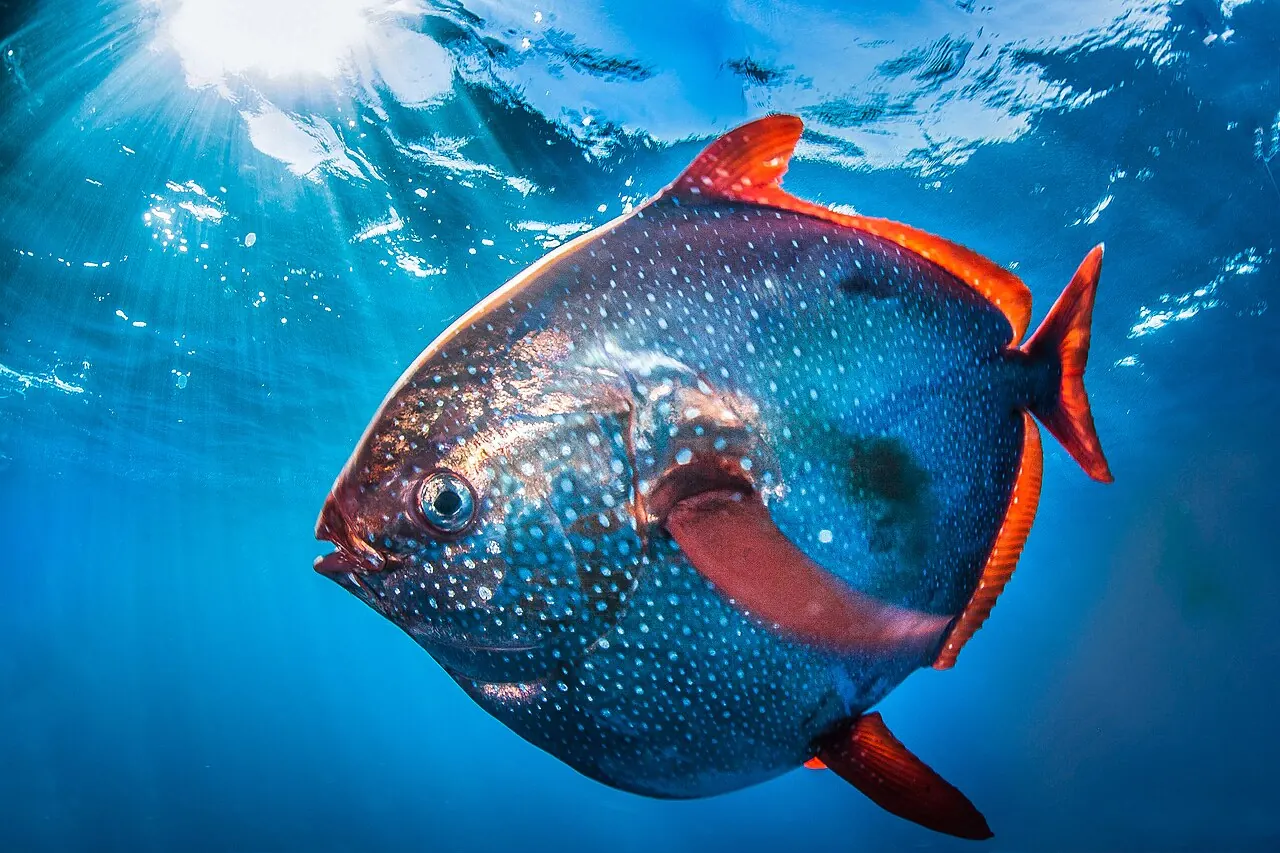
Opah
Lampris spp. (six species, including Lampris guttatus)
A round, red-finned fish of the open ocean that keeps nearly its whole body warmer than the water, and turned out to be six species, not one.
Photo: Ralph Pace (NOAA Fisheries) / Public domain
3 things to know
- The opah was the first fish found to keep nearly its whole body warmer than the surrounding water.
- It swims by flapping its long red pectoral fins like wings.
- A fish buyer at a Honolulu auction noticed differences that led scientists to recognize six opah species.
- Scientific name
- Lampris spp. (six species, including Lampris guttatus)
- Depth
- 45 m – 400 m
148 – 1,312 ft - Size
- Typically about 1 m (3 ft) across
- Weight
- Average about 45 kg (100 lb); FishBase lists 270 kg (595 lb) as the maximum published weight, from a 1990 source that predates the 2018 species split, so which species it applies to is unclear
- Lifespan
- Not well known; most opah caught in longline fisheries are estimated at 1 to 6 years old
- Diet
- Midwater fishes and invertebrates, mainly squid
- Where
- Tropical and temperate oceans worldwide
- IUCN status
- Varies by species (Lampris guttatus Least Concern; the three species named in 2018 Not Evaluated)
- Depth zones
- Sunlight · Twilight
Opah are shaped like a big silver plate, with red fins and a red mouth. NOAA Fisheries describes the body as silvery gray shading to rose red toward the belly, dotted with white spots, with large eyes ringed in gold. An average fish weighs about 45 kilograms (100 pounds) and measures roughly 1 meter (3 feet) across. An opah swims by flapping its long pectoral fins like wings.
That flapping makes heat. In 2015, Nicholas Wegner of NOAA's Southwest Fisheries Science Center in La Jolla, California, and his colleagues reported in Science that the opah keeps nearly its whole body warmer than the surrounding water, the first fish found to do so. The heat is saved in the gills, where blood vessels carrying warm blood from the body wind around vessels bringing cold blood back from the gill surfaces, so the heat is passed along instead of lost to the sea. Fat around the gills, heart and muscles adds insulation. Opah studied off the West Coast kept their muscle about 5°C (9°F) warmer than the water while swimming 45 to 300 meters (150 to 1,000 feet) down. Tuna and some sharks warm parts of their bodies, but their hearts cool off on deep dives. Wegner said the warmth lets the opah chase down quick prey such as squid.
Satellite tags showed opah spending most of their time between about 45 and 400 meters (150 to 1,300 feet) without regularly coming to the surface. They live in tropical and temperate seas around the world and eat midwater fishes and invertebrates, mostly squid.
For a long time, scientists treated opah as one or two species. Then Garrett Kitazaki, a fish buyer at the United Fishing Agency auction in Honolulu, noticed that some had much bigger eyes and different spots. Karen Underkoffler and Meagan Luers measured and sampled the fish, and John Hyde of NOAA examined their DNA. Their 2018 review recognized six species, three of them new, including Lampris megalopsis, which has the biggest eyes of the six, and the smaller-eyed Lampris incognitus. The warm-blood study, done earlier, used the older name Lampris guttatus.
No US fishery targets opah, but Hawaii longliners fishing for bigeye tuna and California swordfish gillnetters catch them, and Hawaii landed 460,000 pounds in 2021. NOAA has never assessed the stock and says there is no evidence of decline.
Sources
- fisheries.noaa.gov/species/opah
- fisheries.noaa.gov/feature-story/warm-blood-makes-opah-agile-predator
- Study: doi:10.1126/science.aaa8902
- fisheries.noaa.gov/feature-story/clues-fish-auction-reveal-several-new-species-opah
- Study: doi:10.11646/zootaxa.4413.3.9
- fishbase.se/summary/Lampris-guttatus.html
- fishbase.se/summary/Lampris-incognitus.html
- Study: doi:10.2305/IUCN.UK.2015-4.RLTS.T195038A19929436.en
- api.gbif.org/v1/species/9756644/iucnRedListCategory
- iucnredlist.org/species/195038/115338069



