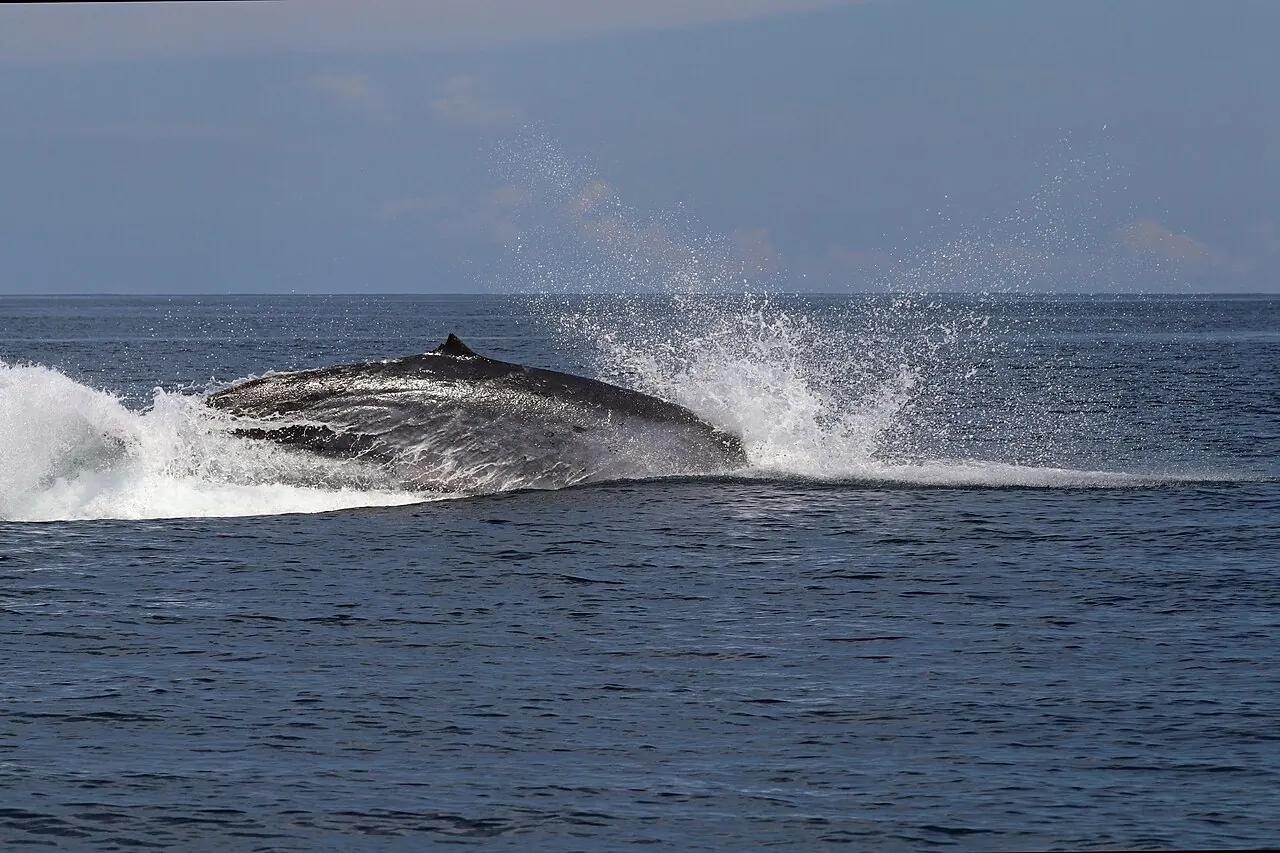
Omura's Whale
Balaenoptera omurai
A small tropical rorqual with a lopsided white jaw, named as a species in 2003 and first studied alive off Madagascar.
Photo: Charles J. Sharp / CC BY-SA 4.0
3 things to know
- It was named as a new species only in 2003.
- Its right lower jaw is white and its left lower jaw dark, like a fin whale's.
- The first living Omura's whales confirmed by DNA were studied off Madagascar between 2011 and 2014.
- Scientific name
- Balaenoptera omurai
- Depth
- 0 m – 25 m
0 – 82 ft - Size
- Measured specimens about 9.6–10.1 m (31–33 ft); whales at sea estimated at 8–12 m (26–39 ft)
- Weight
- Unknown
- Lifespan
- Unknown
- Diet
- Probably small zooplankton; whales taken near the Solomon and Cocos islands had eaten krill
- Where
- Tropical and warm waters of the Indian and western Pacific oceans, with a genetic record from Mauritania in the Atlantic
- IUCN status
- Data Deficient
- Depth zones
- Sunlight
Omura's whale got its scientific name only in 2003. Shiro Wada, Masayuki Oishi and Tadasu Yamada described it in the journal Nature from whales taken by Japanese research whaling and from strandings, animals that had been lumped with Bryde's whale until then. Genetic work soon showed it to be an old, separate branch of the rorqual family.
Up close it looks like a shrunken fin whale. The coloring is lopsided: the right lower jaw is white or very pale and the left one dark, while the lining of the mouth is the reverse. Two measured specimens were 10.1 meters (33 feet) and 9.6 meters (31 feet) long. Records come from tropical and warm waters of the Indian and western Pacific oceans, from the Sea of Japan and the Solomon Sea to northwest Australia, plus a genetic record from Mauritania in the Atlantic.
For years nobody had studied a living one. Then a team led by Salvatore Cerchio, of the New England Aquarium and the Woods Hole Oceanographic Institution, kept meeting a small rorqual off northwest Madagascar, which they first took for Bryde's whales in August 2011. Biopsies from 18 adults proved otherwise, and in 2015 the team published the first field description of the species, based on 44 sightings between 2011 and 2014. They estimated the whales at 8 to 12 meters (26 to 39 feet). The animals stayed on the shallow shelf, mostly over water 10 to 25 meters (33 to 82 feet) deep (where they were found, not a measured dive depth), with the surface at 27 to 30°C (81 to 86°F). They lunge fed often, rolling onto one side, but the researchers never saw fish in the water and suspected small zooplankton. Whales taken decades earlier near the Solomon and Cocos islands had eaten krill. Four mothers with young calves turned up, and a hydrophone picked up a low call at 15 to 50 hertz, repeated every 170 to 180 seconds, that the team thinks is song.
All 18 Madagascar whales shared a single mitochondrial DNA type, a hint that the population may be small. The IUCN lists the species as Data Deficient, with no reliable population estimates. Japanese research whaling and artisanal whaling in the Philippines' Bohol Sea have taken some, bycatch in fishing gear has been reported in Thailand, and Cerchio's team warned that oil and gas seismic surveys overlap the Madagascar whales' range.



