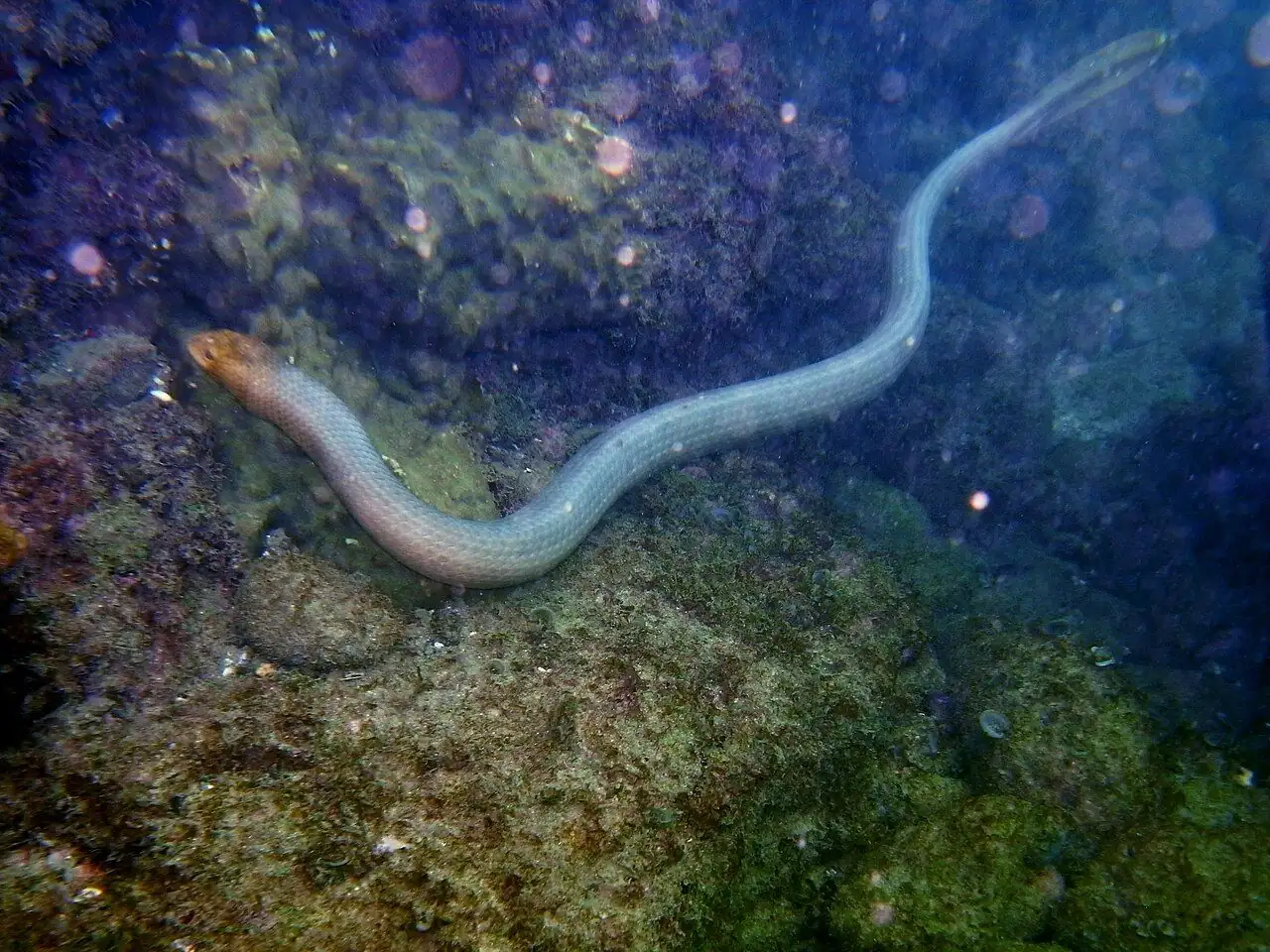
Olive Sea Snake
Aipysurus laevis
A large, curious reef sea snake of northern Australia whose tail skin can sense light, prompting it to tuck the tail out of sight.
Photo: Sylke Rohrlach from Sydney / CC BY-SA 2.0
3 things to know
- It pulls its tail under cover when light shines on the tail's skin.
- Females give birth to 1 to 5 live young after a pregnancy of about nine months.
- On the Great Barrier Reef it lives to about 15 years or more.
- Scientific name
- Aipysurus laevis
- Depth
- 0 m – 50 m
0 – 164 ft - Size
- Commonly about 1.5 m (5 ft), up to about 2 m (6.5 ft); females are larger than males
- Weight
- Unknown
- Lifespan
- About 15 years or more
- Diet
- Small reef fish such as snappers and catfish, plus shrimp, taken near the seabed
- Where
- Coral reefs of northern Australia, New Guinea, eastern Indonesia and New Caledonia
- IUCN status
- Least Concern
- Depth zones
- Sunlight
One of the bigger reef sea snakes, the olive sea snake is commonly about 1.5 meters (5 feet) long and can reach 2 meters (6.5 feet), with females larger than males. Adults are usually plain gray to olive-gray; juveniles are grayish brown with fine pale rings that fade with age. SeaLifeBase describes it as curious and relatively unaggressive but potentially dangerous, especially active at night and apt to strike at anything bright and moving. Its fangs can be 7 millimeters (about a quarter inch) long.
It lives on coral reefs around northern Australia, New Guinea, eastern Indonesia and New Caledonia, usually in water less than 50 meters (165 feet) deep, and the Reptile Database cites records from 130 to 140 meters. It hunts along the bottom, swallowing small reef fish such as snappers and catfish, and shrimp. Tiger sharks eat it. On the Great Barrier Reef, Burns and Heatwole counted about 0.7 to 0.86 snakes per meter of reef edge. Males matured in their third year and females in their fourth or fifth, and the snakes lived about 15 years or more. Females bear 1 to 5 live young after a pregnancy of around nine months, and only about half are pregnant at once, which suggests most breed every other year.
Its tail can sense light. Zimmerman and Heatwole described this skin sense in 1990 as a new sensory mechanism for reptiles. In 2019 Jenna Crowe-Riddell and colleagues shone white and colored lights on the tails and midbodies of 17 wild-caught sea snakes of eight species. Olive sea snakes and two close relatives pulled their tails away, responding most to blue and green light, while five other species did not react. The tail skin contained melanopsin, a light-sensitive protein, but none of the opsins that eyes use for vision. Animals with this sense are thought to use it to keep a tail from sticking out of cover where predators could see it.
The IUCN lists the species as Least Concern. At Ashmore Reef, off northwest Australia, sea snake surveys recorded 42 to 46 snakes a day in 1973 and 1994 but only 1 to 7 a day from 2005, when the olive sea snake was one of just two species still found in significant numbers.



