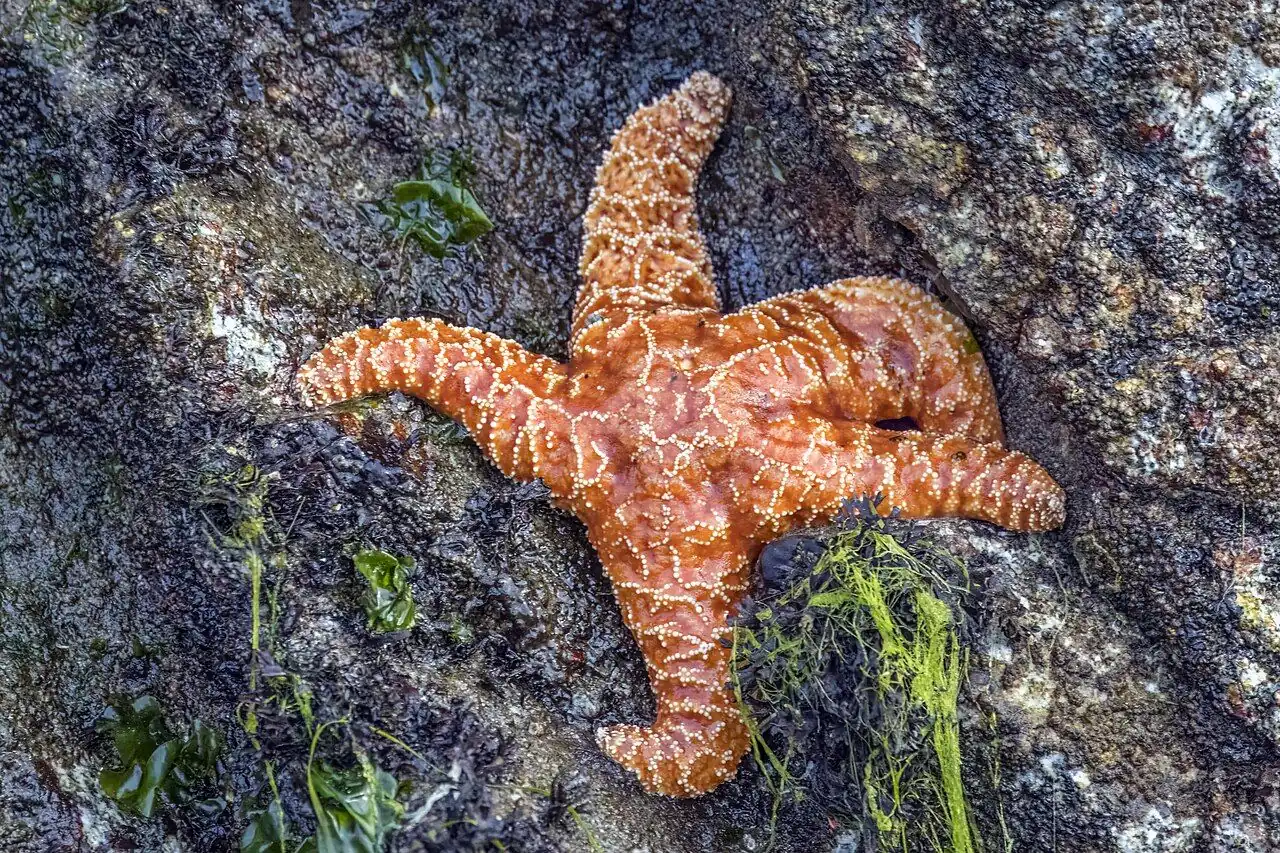
Ochre Sea Star
Pisaster ochraceus
A purple or orange tide-pool sea star of the Pacific coast, and the animal behind the original idea of a keystone species.
Photo: Charles J. Sharp / CC BY-SA 4.0
3 things to know
- It comes in purple and orange; about 1 in 5 on exposed outer coasts is orange.
- Robert Paine's experiments removing it from Washington shores led him to coin the term keystone species in 1969.
- Sea star wasting disease cut its numbers by 59 to 84% at Oregon sites in 2014.
- Scientific name
- Pisaster ochraceus
- Depth
- 0 m – 90 m
0 – 295 ft - Size
- Arms typically about 9 cm (3.5 in) from the center in California and Oregon; can reach about three times that
- Weight
- Unknown
- Lifespan
- Thought to be up to 20 years
- Diet
- Mainly mussels; also barnacles, snails, limpets and chitons
- Where
- Pacific coast of North America, from Prince William Sound, Alaska, to Baja California, Mexico
- IUCN status
- Not Evaluated
- Depth zones
- Sunlight
At low tide on the rocky Pacific coast, clusters of five-armed sea stars cling to the rocks, some purple, some orange. Pisaster ochraceus can also be yellow, reddish or brown, and its upper surface carries small white spines arranged in a net-like or star-shaped pattern. Long-term monitoring by the MARINe network has found about 20% of the stars on exposed outer coasts are orange, across a wide stretch of coast. Why the colors differ is not fully understood, though diet may play a part.
It ranges from Prince William Sound in Alaska to Baja California, Mexico, mostly in the middle and low intertidal zone of wave-swept rocky shores, though it also lives below the tides to 90 meters (295 feet). On the open coast its main prey is mussels. A star wraps its arms around a mussel, pulls the shells apart with its tube feet and slips its stomach inside. It also eats barnacles, snails, limpets and chitons. Ochre stars are thought to live up to 20 years.
In 1963, Robert Paine of the University of Washington began prying ochre stars off a stretch of shore at Mukkaw Bay, Washington, sometimes with a crowbar, and throwing them into deeper water. Without them, barnacles spread and were then replaced by mussels, which crowded out algae and limpets. Within a year the number of species on the cleared shore had halved. Paine published the work in 1966, and in 1969 he called Pisaster a keystone species, a term later applied to sea otters, wolves and more. Later work by Bruce Menge of Oregon State University found the star's grip is weaker on sheltered shores than on the exposed coast Paine studied.
In 2013 and 2014, sea star wasting disease killed sea stars along the whole west coast. In Oregon, Menge's team found the disease arrived in April 2014, and by September ochre star densities at their sites had fallen by 59 to 84%. By spring 2015 a surge of young sea stars had settled at every site, about 7 to 300 times more than in 2014. The bacterium Vibrio pectenicida was shown in 2025 to cause the disease in sunflower sea stars, but it is not yet known whether it does the same in ochre stars. Populations have been trending toward recovery in the Pacific Northwest and northern California, less so farther south, though MARINe reported new flare-ups in late 2026.
Sources
- marine.ucsc.edu/target/target-species-pisaster.html
- sealifebase.se/summary/Pisaster-ochraceus.html
- Study: doi:10.1086/282400
- Study: doi:10.1086/282586
- scientificamerican.com/article/the-man-whose-dynasty-changed-ecology
- hakaimagazine.com/news/shrinking-keystone
- Study: doi:10.1371/journal.pone.0153994
- pugetsound.edu/ochre-sea-star
- api.gbif.org/v1/species/2273754/iucnRedListCategory



