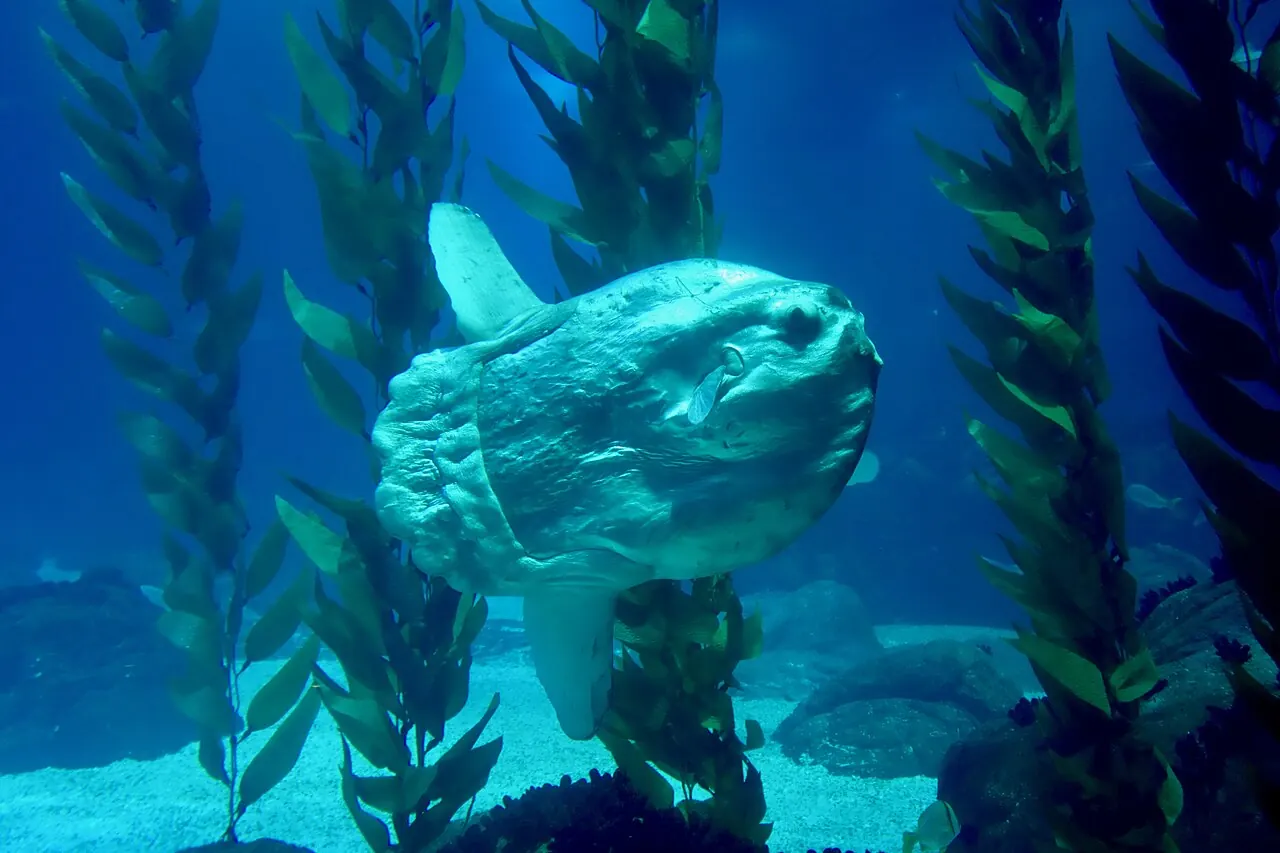
Ocean Sunfish
Mola mola
The common ocean sunfish, a tail-less disk of a fish that eats jellies, dives past 500 meters and is often caught by accident in swordfish nets.
Photo: Sonse / CC BY 2.0
3 things to know
- Instead of a tail fin, the ocean sunfish has a stiff, rudder-like flap called a clavus.
- A sunfish at the Monterey Bay Aquarium gained about 364 kilograms (800 pounds) in 14 months.
- In California's swordfish drift gillnet fishery, ocean sunfish have made up 14 to 61 percent of the total catch.
- Scientific name
- Mola mola
- Depth
- 0 m – 500 m
0 – 1,640 ft - Size
- Adults average about 1.8 m (6 ft) long and 2.4 m (8 ft) from fin tip to fin tip
- Weight
- Adults average up to about 1 metric ton (2,200 lb); FishBase gives a maximum published weight of 1.3 metric tons (about 2,900 lb)
- Lifespan
- Unknown in the wild; one lived more than 10 years at Kamogawa Sea World in Japan
- Diet
- Mainly jellies, siphonophores and other gelatinous animals; also small fish, mollusks, crustaceans and brittle stars
- Where
- Tropical and temperate oceans worldwide
- IUCN status
- Vulnerable
- Depth zones
- Sunlight · Twilight
Where most fish have a tail, the ocean sunfish has a stiff, rudder-like flap called a clavus. The rest of it is a tall, flattened disk wrapped in thick, elastic skin with no scales. It swims by flapping its high dorsal and anal fins from side to side together, which FishBase says can move it at a surprisingly good speed. Its small mouth holds teeth fused into a parrot-like beak, adults have no swim bladder, and much of the skeleton is cartilage.
This is the common ocean sunfish, Mola mola. It has two close relatives that look so similar they can be hard to tell apart without a DNA test. One of them, the bump-head sunfish (Mola alexandrini), often develops bumps on its head and chin as it grows, and it holds the record for the heaviest bony fish ever weighed. A Mola mola adult averages about 1.8 meters (6 feet) long and 2.4 meters (8 feet) from fin tip to fin tip, and weighs up to about 1 metric ton (2,200 pounds), according to oceansunfish.org.
They can put on weight fast. According to the same site, one sunfish at the Monterey Bay Aquarium gained 364 kilograms (800 pounds) in 14 months on squid, fish and prawns, and had to be flown out by helicopter and released into the bay. How long they live in the wild is unknown, but one was kept for more than 10 years at Kamogawa Sea World in Japan.
Sunfish live in tropical and temperate seas worldwide. Large ones feed mostly on jellies and other gelatinous animals. Camera tags have shown them catching mostly siphonophores, long, stringy relatives of jellyfish, and feeding mainly 100 to 200 meters (330 to 660 feet) down by day. Off Southern California, tagged fish spent their nights mostly in the top 50 meters and their days deeper, and four dived past 500 meters (1,640 feet). Adults also visit slopes near deep water to seek out cleaner fish.
Sunfish are often caught by accident. Tierney Thys and colleagues noted in 2015 that sunfish had made up 70 to 95 percent of the catch in Mediterranean swordfish drift gillnets, and 14 to 61 percent in California's own swordfish drift gillnet fishery, where observers reported that more than 95 percent were released alive. Nobody knows how many of those survive. The IUCN lists the species as Vulnerable.
Sources
- fishbase.se/summary/Mola-mola.html
- oceansunfish.org/diet-size-and-growth
- Study: doi:10.1016/j.jembe.2015.05.005
- swfsc-publications.fisheries.noaa.gov/publications/CR/2015/2015Thys.pdf
- scientificamerican.com/article/heaviest-bony-fish-ever-measured-is-a-wheel-shaped-behemoth
- Study: doi:10.1111/1365-2656.12346
- Study: doi:10.2305/IUCN.UK.2015-4.RLTS.T190422A1951231.en
- iucnredlist.org/species/190422/97667070
- api.gbif.org/v1/species/5213725/iucnRedListCategory



