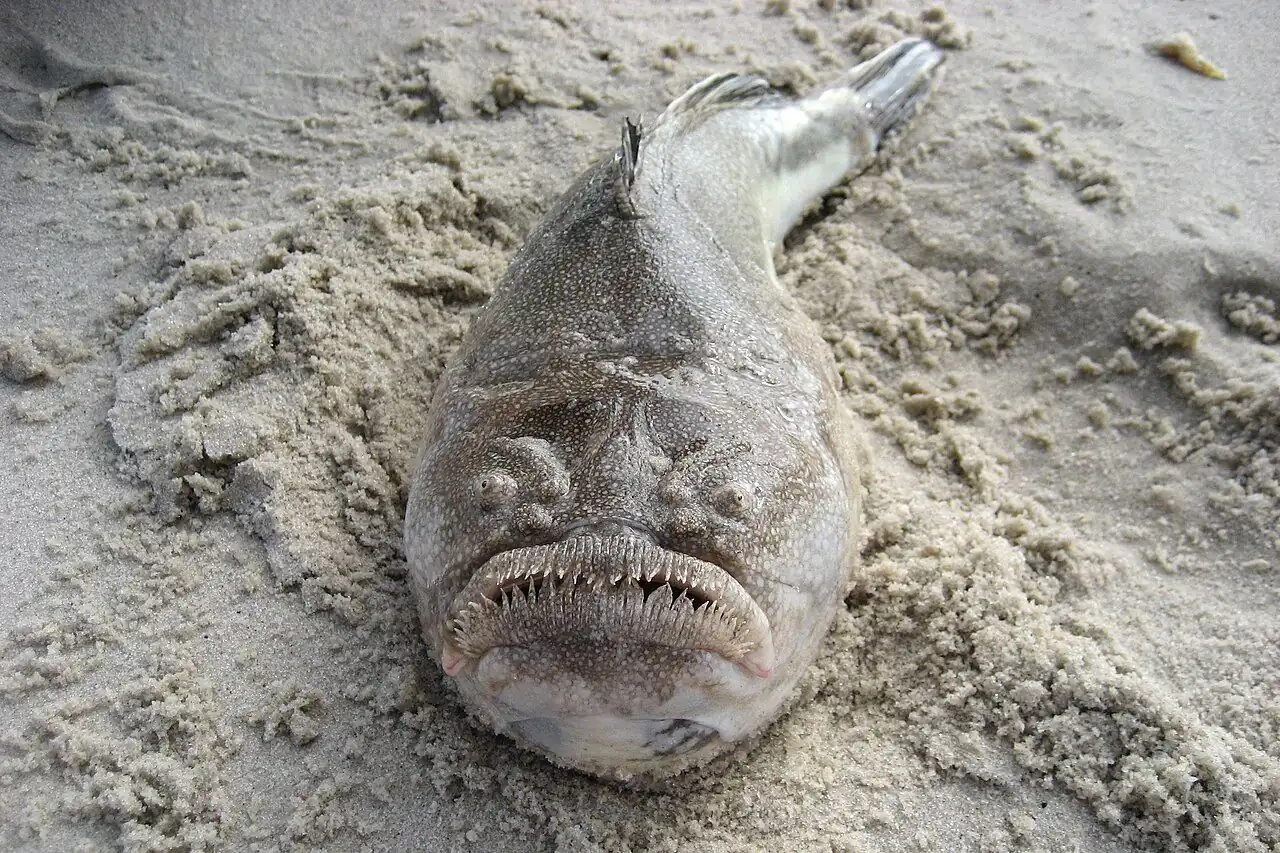
Northern Stargazer
Astroscopus guttatus
A sand-burying fish of the US East Coast with its eyes on top of its head and electric organs that grew out of eye muscles.
Photo: Canvasman21 at English Wikipedia / CC BY-SA 3.0
3 things to know
- Its electric organs sit just behind the eyes and are modified eye muscles.
- It breathes in through its nostrils, which are fringed to keep out sand.
- It can bury itself in a matter of seconds, using its pectoral fins as shovels.
- Scientific name
- Astroscopus guttatus
- Depth
- 0 m – 36 m
0 – 118 ft - Size
- Up to about 56 cm (22 in); usually 20 to 46 cm (8 to 18 in)
- Weight
- Up to about 9 kg (20 lb)
- Lifespan
- Unknown
- Diet
- Small fish, crabs and other crustaceans
- Where
- US Atlantic coast, from New York to North Carolina, including the lower Chesapeake Bay
- IUCN status
- Least Concern
- Depth zones
- Sunlight
Almost everything on a northern stargazer's head faces up. Its eyes, nostrils, gill slits and most of its mouth sit on top of a big, flattened head, because the fish spends most of its life buried in sand, with its eyes and nostrils still clear of it. Its pectoral fins work as shovels, and according to the Florida Museum of Natural History it can bury itself in seconds. Comb-like fringes guard the nostrils and mouth against sand, and instead of taking water in through its mouth like most fish, it breathes through its nostrils. The body is blackish brown with white spots that grow larger toward the tail, and three dark stripes run along the tail fin.
It lives only off the US East Coast, from New York to North Carolina, on sandy bottoms inshore to about 36 meters (120 feet), and in Chesapeake Bay it is found mostly in the lower bay. Adults can reach 56 centimeters (22 inches) but are usually 20 to 46 centimeters (8 to 18 inches) long. A stargazer waits under the sand until a small fish swims close, then rises from the sand and swallows it whole.
Behind each eye sits an electric organ. In a 1983 study in the Journal of Neuroscience, M. V. Bennett and G. D. Pappas described the electric organs of Astroscopus stargazers as modified eye muscles, wired to enlarged versions of the brain nuclei that normally move the eyes. Sources differ on what the shock is for. The Florida Museum says it is defensive and not used to catch prey, while the Chesapeake Bay Program says it also stuns prey. Either way, the museum advises handling live stargazers with care, and FishBase lists a venom gland on a spine behind the gill cover as well.
Stargazers spawn on the bottom in late spring and early summer. The eggs float up and hatch into drifting larvae, which grow fast and eat other larvae, including some of their own kind. The electric organs begin to form when the larvae are 12 to 15 millimeters (about half an inch) long, the size at which they settle to the bottom, and their eyes then move from the sides of the head to the top. The IUCN lists the species as Least Concern.



