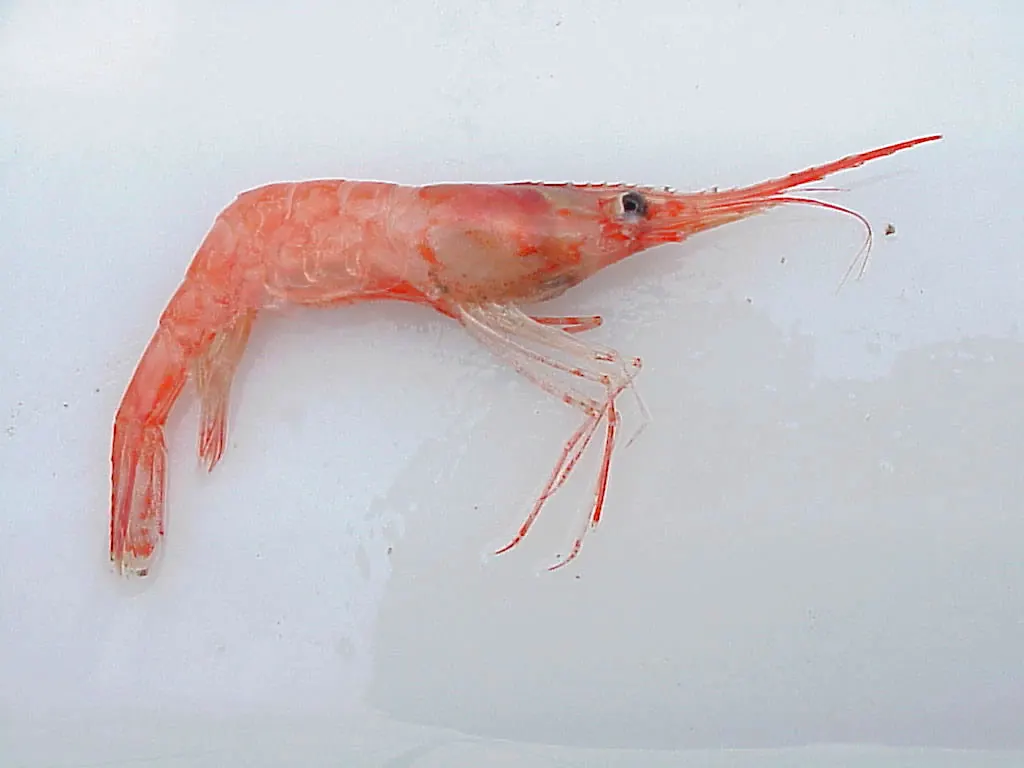
Northern Shrimp
Pandalus borealis
A cold-water shrimp that starts life male and becomes female, once a Gulf of Maine fishery and closed since 2014 as the water warms.
Photo: Alaska Fisheries Science Center, NOAA / Public domain
3 things to know
- Every northern shrimp begins life as a male and later changes into a female.
- New England's catch peaked at 28.3 million pounds in 1969.
- In a six-week sampling program in 2025, nine Gulf of Maine boats caught 70 shrimp in total.
- Scientific name
- Pandalus borealis
- Depth
- 50 m – 500 m
164 – 1,640 ft - Size
- Males up to 12 cm (4.7 in), females up to 16.5 cm (6.5 in); Gulf of Maine shrimp average 5 to 10 cm (2 to 4 in)
- Weight
- Unknown
- Lifespan
- Most do not live past 5 years in the Gulf of Maine
- Diet
- Plankton and bottom-dwelling invertebrates; also scavenges
- Where
- Cold waters of the North Atlantic and Arctic, south to the Gulf of Maine
- IUCN status
- Not Evaluated
- Depth zones
- Sunlight · Twilight
Alive, a northern shrimp is more red than pink, with a translucent shell; it turns pink when cooked. It is a slender shrimp of cold water and soft mud bottoms, usually 50 to 500 meters (165 to 1,640 feet) down, across the North Atlantic and the Arctic. On the US East Coast it lives mainly off Maine, New Hampshire and Massachusetts, the southern edge of its range. A nearly identical shrimp in the North Pacific is accepted by the World Register of Marine Species as a separate species, Pandalus eous, though some researchers still treat it as part of this one.
Every northern shrimp starts life as a male. In the Gulf of Maine, NOAA Fisheries says, they mature as males at about two and a half years, change into females at about three and a half, and mostly die by age 5. They spawn offshore from late July, mainly in deep mud basins in the southwestern gulf. The females carry their eggs on their abdomens and move inshore in late fall and winter, and the eggs hatch from February to April. Young shrimp stay near the coast for up to 20 months. The shrimp eat plankton and bottom-dwelling invertebrates and are eaten by cod, redfish and hake.
New England's fishery began in the late 1950s, and landings peaked at 28.3 million pounds in 1969. The stock collapsed and the fishery closed in 1978, reopened the next year and collapsed again in 2013. A moratorium has kept it shut since 2014, and in December 2025 the Atlantic States Marine Fisheries Commission extended it through 2028. Its 2024 assessment put the spawning stock in 2023 at 279 metric tons, against a long-term median of 4,732. During a six-week pilot sampling program in early 2025, five trawlers and four trappers caught 70 shrimp between them.
Ending the fishing has not brought the shrimp back. Strong year classes need a large spawning stock and cold water, and the commission says the western Gulf of Maine's shrimp habitat has warmed to unprecedented highs over the past decade. NOAA also points to more predators, such as spiny dogfish, redfish and silver hake. Northern shrimp are still harvested off Canada, Greenland, Iceland and Norway. The species has not been evaluated for the IUCN Red List.



