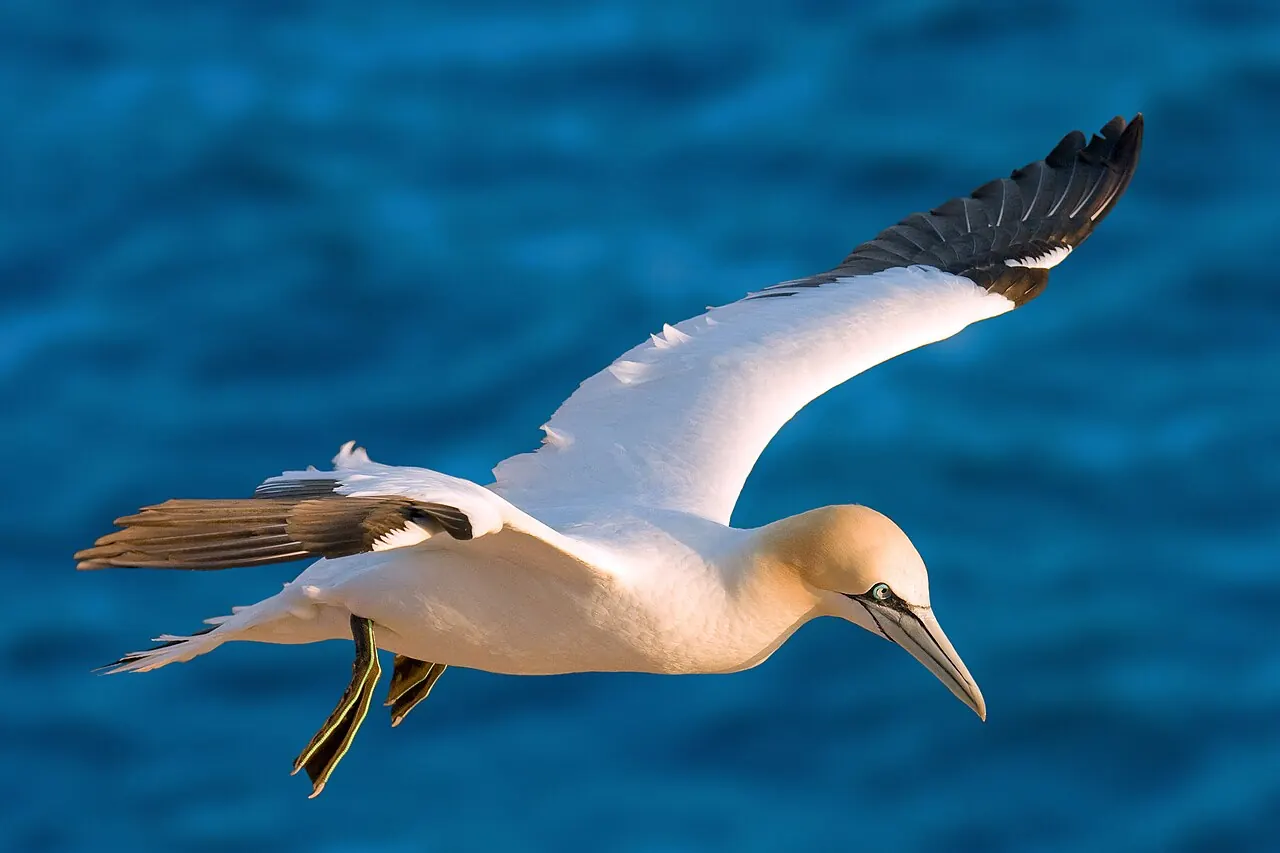
Northern Gannet
Morus bassanus
One of the North Atlantic's largest seabirds, a high-diving fish hunter whose colonies were hit hard by bird flu in 2022.
Photo: Andreas Trepte / CC BY-SA 2.5
3 things to know
- It hits the water at about 85 km/h (53 mph).
- Bass Rock, in Scotland's Firth of Forth, is the largest gannet colony in the world.
- Most gannets found to have survived bird flu in 2022 had black eyes instead of pale ones.
- Scientific name
- Morus bassanus
- Depth
- 0 m – 22 m
0 – 72 ft - Size
- 84–94 cm (33–37 in) long, with a wingspan of 1.7–2 m (5.6–6.6 ft)
- Weight
- 2.6–3.6 kg (5.75–8 lb)
- Lifespan
- Typically about 17 years once adult; the British ringing record is 37 years 4 months
- Diet
- Shoaling fish such as mackerel and herring, plus some squid
- Where
- North Atlantic; breeds in eastern Canada and northwest Europe and winters as far south as the US Atlantic and Gulf coasts
- IUCN status
- Least Concern
- Depth zones
- Sunlight
A northern gannet is white with black wing tips, a spear-like bill and a pointed tail. At 84 to 94 centimeters (33 to 37 inches) long, with wings spanning up to 2 meters (6.6 feet), it is one of the largest seabirds of the North Atlantic. Young birds start out gray-brown with white speckles and take three or four years to reach adult plumage.
Gannets breed in crowded colonies on sea cliffs and islands on both sides of the ocean. Bass Rock, in Scotland's Firth of Forth, is the largest; in North America the colony on Bonaventure Island, Quebec, draws crowds of visitors. A pair raises one egg a year, incubated by both parents for 42 to 46 days, and birds usually start breeding at five or six. In winter many fly south along the Atlantic coast, some rounding Florida into the Gulf of Mexico as far as Texas. Adults typically live about 17 years; the British ringing record is 37 years and 4 months.
Gannets hunt by plunging headfirst, sometimes from more than 30 meters (100 feet) up, and hit the water at about 85 kilometers per hour (53 mph). Momentum alone carries them to about 11 meters (36 feet); to go deeper they swim with their wings. Loggers on gannets at Funk Island, Newfoundland, recorded dives as deep as 22 meters (72 feet), though the median dive was under 5 meters (16 feet).
Egg collecting and the killing of adults cut their numbers sharply in the 19th century, and protection brought them back in the 20th. The IUCN lists the species as Least Concern, in an assessment from 2018. Then, in 2022, a highly pathogenic H5N1 bird flu swept through the colonies. Jude Lane and colleagues traced unusual numbers of dead gannets from Iceland in April to Scottish colonies in May, then to Canada, Germany and Norway, and recorded unusually high mortality at 40 colonies, about three-quarters of all known. At Bass Rock, occupied nest sites fell by at least 71 percent. Blood tests found antibodies in apparently healthy birds, so some gannets recover from the virus, and most of those survivors had black irises instead of the usual pale ones.
Bass Rock has started to recover: in Amy Tyndall's drone study, manual counts of the same area found about 21,300 live gannets in 2022 and about 51,400 in 2023.
Sources
- audubon.org/field-guide/bird/northern-gannet
- bto.org/understanding-birds/birdfacts/gannet
- Study: doi:10.1098/rspb.2000.1200
- Study: doi:10.1016/j.seares.2013.07.020
- hakaimagazine.com/news/seabirds-death-defying-dives
- Study: doi:10.1111/ibi.13275
- Study: doi:10.3390/drones8020040
- Study: doi:10.2305/IUCN.UK.2018-2.RLTS.T22696657A132587285.en



